Last updated on July 13th, 2026
📌 TL;DR:
Search has evolved from blue links to AI-generated answers. Traditional SEO drives traffic to websites. AEO (Answer Engine Optimization) delivers direct answers in snippets and voice results. GEO (Generative Engine Optimization) ensures your content gets cited by AI platforms like ChatGPT, Perplexity, and Google AI Overviews.
To win in 2026, combine all three to win in GEO vs SEO vs AEO. Use clear, upfront answers, question-led headings, and trust-driven content.
Stop competing for clicks. Start competing for answers with quality content.
Search behavior has changed immensely. Ten blue links are no longer what people want. Instead, now they want one clear and informative answer.
AI-driven platforms such as Google AI Overviews, ChatGPT and Perplexity summarize information rather than simply presenting sources. Hence, your content needs to do more than just rank. So, it requires to be chosen, recognized and pointed out.
If you still have the same traditional SEO strategy, then you are incorrectly competing for clicks. Forward-looking marketers are competing for answers on AI tools like ChatGPT and Google AI Overviews.
This is exactly where AEO (Answer Engine Optimization) and GEO (Generative Engine Optimization) will come into play.
GEO vs SEO vs AEO – The shift from search engines to answer engines
In the past, search operated like a directory. Users submitted a query, browsed results and clicked links. But today, AI engines act like assistants. They understand intention, draw insights from different sources and provide one unified response.
All of this creates a new reality-
– Visibility no longer means being ranked #1.
– It is about being used as a source in AI answers.
– Even if you rank, traffic is no longer guaranteed thanks to zero click searches promoted by AI Mode.
So, this is precisely the reason businesses need to look beyond SEO.
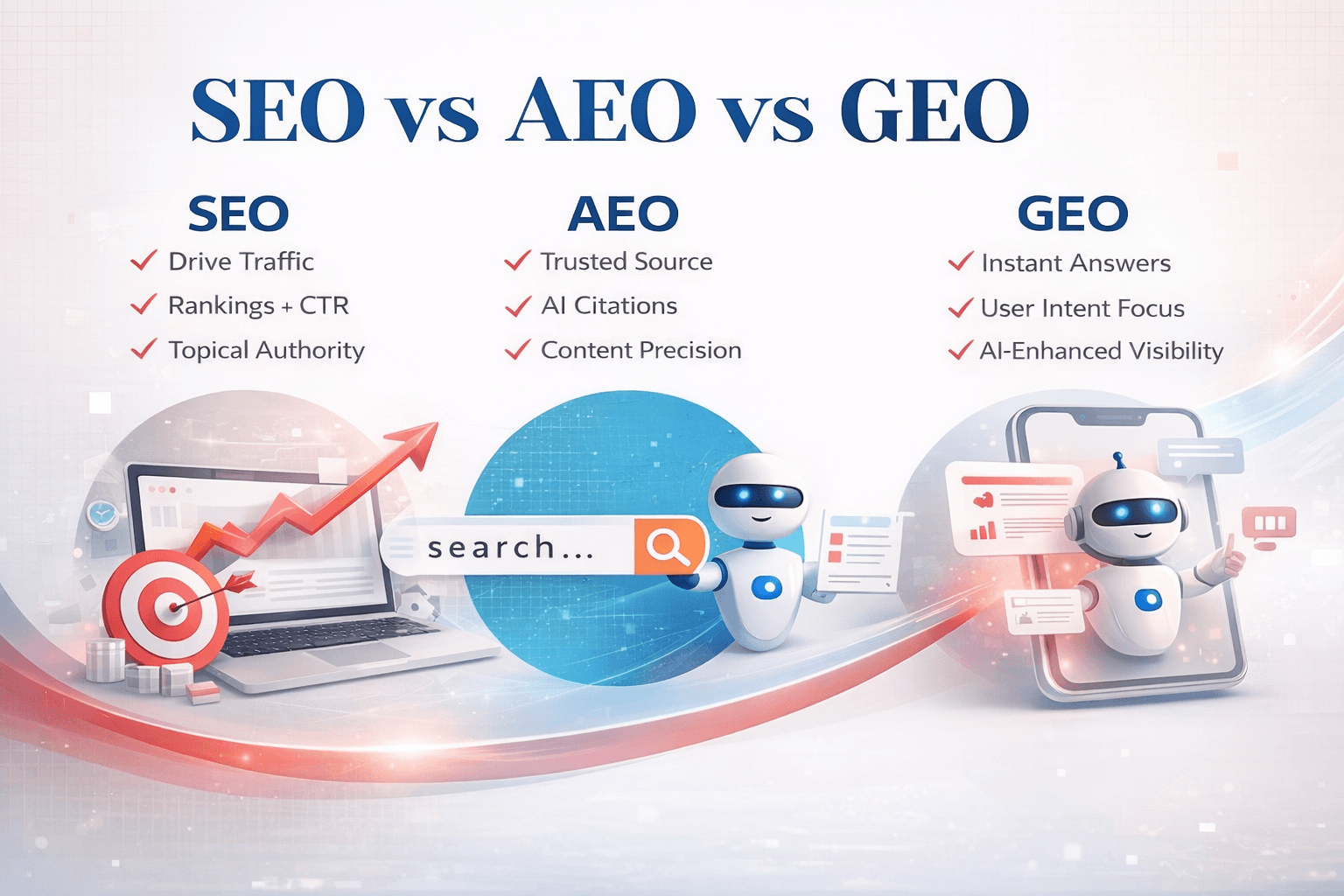
A good starting point would be to first know the difference between the three concepts – SEO, AEO, and GEO. Knowing this will help you create targeted content that will generate higher marketing ROI across traditional search as well as answer engines like Perplexity and ChatGPT.
Summary of Differences between SEO AEO and GEO
| Aspect | SEO (Search Engine Optimization) | AEO (Answer Engine Optimization) | GEO (Generative Engine Optimization) |
| Core Objective | Rank web pages on search engines | Deliver direct answers to user queries | Get included in AI-generated responses |
| Primary Platforms | Google, Bing, Yahoo | Google snippets, voice assistants (Alexa, Siri), AI Overviews | ChatGPT, Google Gemini, Perplexity |
| Content Goal | Drive traffic to your website | Provide instant, concise answers | Become a trusted source for AI synthesis |
| User Behaviour | Users click and explore multiple links | Users expect quick, single answers | Users rely on AI summaries without clicking |
| Content Style | Keyword-optimized, structured content | Question-led, concise, and direct | Context-rich, in-depth, and conversational |
| Visibility Format | Blue links on SERPs | Featured snippets, voice responses | AI-generated summaries and citations |
| Dependency on Clicks | High (traffic-driven model) | Medium (reduced clicks due to instant answers) | Low (answers delivered without clicks) |
| Success Metrics | Rankings, organic traffic, CTR | Snippet position, answer visibility | AI citations, brand presence in responses |
| Role of Structure | Helps with readability and indexing | Critical for answer extraction | Essential for AI understanding and synthesis |
| Trust Factors (E-E-A-T) | Important for rankings | Important for snippet selection | Critical for AI inclusion and credibility |
| Content Depth Requirement | Moderate to high | Moderate (focused answers) | High (topical authority and completeness) |
GEO vs SEO vs AEO- What is the difference?
The aim of SEO, AEO, and GEO is to increase visibility, but each works differently. Understanding how they work will give you insights into how you can create valuable content. Such quality content fits in well with today’s search habits and maximize visibility not only on traditional but AI-based platforms as well.
1. Primary Goal
SEO is meant for ranking web pages on search engines. On the other hand, AEO aims to give direct answers in snippets and voice results. GEO makes sure that your content gets used in any AI-generated response.
2. Search Output Format
SEO drives traffic using clickable links in SERP listings. AEO appears as featured snippets or voice search results. GEO forms part of AI-generated answers that do not require the user to visit your website.
3. Content Style and Structure
SEO relies on keywords targeting and content structure. On the other hand, AEO uses question-based format with brief answers. GEO needs detailed information with context that is easy for AI systems to understand. It is interesting to note that content is valuable for all systems – GEO vs SEO vs AEO.
4. User Interaction Journey
SEO depends on users clicking and exploring pages. AEO provides answers instantly and cuts down clicks. AI interfaces for GEO provide full responses, often eliminating the need to click on anything at all.
5. Success Measurement
Rankings and organic traffic are the two main metrics for measuring SEO success. The AEO algorithm specifically evolves around snippet visibility and answer placement. GEO assesses the frequency with which your answer is cited or reflected in AI outputs.
GEO vs SEO vs AEO- What is the similarity?
SEO, AEO, and GEO are not the same. However, there is something common between them. All these methods focus on making sure that the content is relevant, accessible as well as trustworthy. This is done so that search engines and AI systems can understand it clearly and deliver value to users.
1. User Intent Alignment
All three are focused on understanding what users are searching for. Hence content writers develop content that clearly answers their needs with helpful and relevant information.
2. Content Quality Matters
Content that is high-quality, informative, and unique will have a higher SEO ranking. As a result, this type of content will feature in snippet responses and even AI replies.
3. Structured Content is Essential
Experts in content writing services in India use clear headings, logical flow, and well-organized information. This will make things easier for both search engines and AI systems. They can interpret your content and retrieve it effectively.
4. Technical Optimization Plays a Role
Elements like schema markup, rapid loading speed, and clean website architecture facilitate visibility on traditional search and AI-driven platforms.
5. Trust and Authority Signals (E-E-A-T)
Companies that show expertise, credibility and reliability stand a good chance of being well ranked, featured, or cited by AI systems.
When you look closely, there is a common thread in all 3 search ecosystems- quality content.
Let us see a few reasons as to how content proves to be the backbone of AEO, SEO and GEO.
Why Content is Important in GEO vs SEO vs AEO
Whatever the future of search looks like, one thing never changes: visibility is content-driven. Regardless of ranking on Google, getting featured snippets, or being mentioned within AI systems, your marketing success is based on how well your content conveys value, clarity and trust.
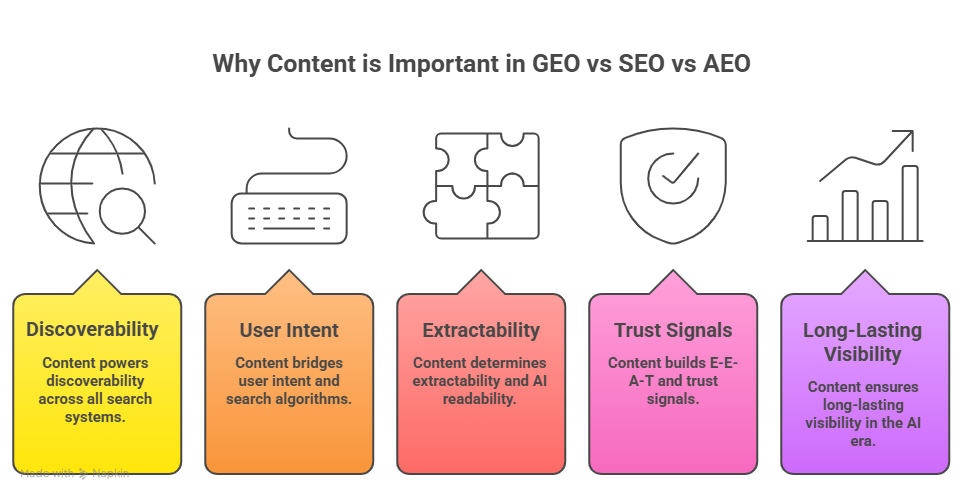
1. Discoverability is Powered by Content Across All Systems
Content is how search engines and AI platforms learn what your website is about. It helps SEO in page ranking, AEO in answer extraction, and GEO uses it for providing responses. In fact, without well-defined, relevant pieces of content, there is no way your brand could show up at all on any of those systems in a meaningful way.
2. Content Acts as the Bridge Between User Intent and Search Algorithms
A search typically starts with a question or need. Content is the bridge between that intent and the algorithm’s response. When your content resembles what real humans are searching for, it becomes easier for search engines and AI tools to match, retrieve and deliver it as a relevant answer.
3. Content Determines Extractability and AI Readability
It is not only about what you say but how you present it on GEO vs SEO vs AEO. Use clear headings, detailed answers, and a good structure so that it is easy to extract your content. Any informative content that is written poorly is more or less ignored, as it is harder for systems to interpret.
4. Content Helps to Build E-E-A-T and Trust Signals
Having good content establishes authority and trust over time. So, if your content always gives accurate, insightful and well-explained information, it signals that you can be trusted by search engines and AI systems. As a result, this will improve your chances of ranking higher, being featured and getting cited.
5. Content Is the Best Way to Ensure Long-Lasting Visibility
Visibility is not limited to website visits in the AI era. Your content can also influence answers, drive narratives and build brand recalls even when users do not click through. When you’re armed with strong content, you will be present on top no matter what search journey your leads choose – from discovery to decision-making.
How to Optimize Content to Win in AI Search?
Those who produce merely long or keyword-laden content will not find AI-powered search rewarding. It also focuses on clarity, usefulness and structure. To be consistently included in AI-generated responses, your content needs to match how these systems interpret, extract and compile information for humans.
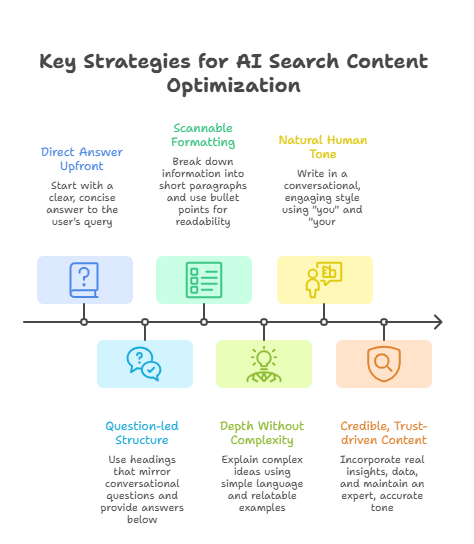
Direct, Clear Answers Upfront
The AI system prioritizes content that provides an immediate answer to the query. It is easier for the AI to extract and display if your page gives a clear, concise answer in the first few lines. Do not flood readers with a long-winding setup to get to the point. This is a crucial aspect when thinking about GEO vs SEO vs AEO. You need to explain the answer up front and then build with supporting insights.
For example-
Query: “What is AEO?”
Good response: “AEO (Answer Engine Optimization) helps your content appear as direct answers in search results like featured snippets and voice search.”
How to implement?
– Directly answer in the first 1–2 sentences of each section
– Do not tell a story before answering the query
– Use definition-style clarity where important
– Follow the answer with a deep explanation
2. Question-led Structure That Mirrors User Queries
Content written to match the way users naturally ask questions will do better in AI search. Headings in the form of questions better match conversational queries. This allows AI to link your content to the intent of the user accurately.
Example-
Instead of: “Voice Search Optimization Techniques”
You can use: “How Does Voice Search Optimization Work?
How to implement?
– Make use of tools like “people also ask” for inspiration
– Change H2 and H3 headings into real user questions
– Focus on finding conversational sentence structures, instead of keyword stuffing
– Make sure that there is one clear answer just below each question
3. Depth Without Unnecessary Complexity
AI likes when content talks about subjects in depth but does not become too complicated for the reader to comprehend. You must prove that you know everything there is to know about the subject. However, do not make it sound too technical for your audience.
Example-
Instead of: “Semantic indexing improves contextual retrieval efficiency.”
Use this: “Semantic search allows AI to make sense of queries beyond just keywords.”
How to implement?
– Simplify complex ideas without losing meaning
– Explain abstract ideas through examples
– Avoid excessive jargon unless necessary
– Give explanations in bite-sized chunks
4. Scannable and Well-Organized Formatting
Structured content is easy to read and get extracted and hence is valuable for GEO vs SEO vs AEO. AI systems favor content that is scannable and organized logically. Clear formatting helps identify key points easily. This increases the chances of your content being reused in AI-generated responses.
Example-
Instead of a long paragraph you can explain the steps via:
– Identify keywords
– Structure content
– Add schema markup
How to implement?
– Short paragraphs (2–3 lines max)
– Use bullet points or numbers where appropriate
– Keep a clear H2 → H3 hierarchy
– Only one idea per section
5. Writing in a Natural, Human Tone and Not Like Robots
AI systems prefer content that sounds natural and conversational. A content writing company in India like Textuar excels in this aspect as their content closely resembles how users interact with search tools. Robotic writing doesn’t have engagement or clarity. This reduces the chances of it being selected.
Example-
Robotic : “This article will deliver extensive insights on SEO processes.”
Human: “Let’s break down how SEO actually works and why it’s important.”
How to implement?
– Write in natural language
– Use you and your to build connection
– Use sentences of varying length for natural flow
– Avoid templated phrasing
6. Credible, Trust-Driven Information (E-E-A-T)
The element of trust has a major bearing on AI content selection. Content that exhibits authority, accurate information and consistency gets selected by AI. The AI algorithms favor trustworthy sources of information.
Example-
Weak: “SEO improves rankings significantly.”
Strong: “According to industry data, structured SEO strategies improve organic visibility over time. Especially when combined with technical optimization.”
How to implement?
– Add real insights or references where you can
– Maintain a consistent expert tone
– Don’t use exaggerated/promotional claims
– Use well-articulated points to demonstrate depth of knowledge
To conclude
Search has evolved from rankings. Now, it’s about how well your content gets discovered/understood and delivered across platforms. You need to optimize your content across all three layers of modern search like GEO vs SEO vs AEO. This helps to stay visible.
You should start with SEO to ensure your content is indexed/technically sound and aligned with relevant keywords. Next, you can build on that with AEO. You should begin by structuring your content to answer specific questions clearly. Make use of clear headings, concise response and FAQ sections. Then we move to GEO by creating context-rich content that has depth, which AI systems trust and include in generated responses.
Combining these three approaches means your content will do more than just rank well. It gets selected, summarized and recommended across search engines/voice assistants and AI platforms.
This is what true visibility looks like in 2026.
With content writing services in Bangalore, you can mix all three together, so that you can go from chasing traffic to owning visibility across the search ecosystems. Our content team at Textuar has evolved substantially to provide massive traction across a range of search platforms. The result- you can roll out content that speaks to your audience irrespective of whether they use Google search or ChatGPT to discover information.
Frequently Asked Questions
1. What is the main difference between GEO vs SEO vs AEO?
SEO concentrates on ranking web pages, while AEO is all about providing direct answers. GEO ensures your content will be used in AI-generated responses. Together, they make up a complete visibility strategy across conventional and AI-driven search environments.
2. Why is traditional SEO not enough anymore?
AI search tools are now providing answers directly without requiring clicks. So, even if you rank highly for something, people will not land on your page unless your content is chosen/displayed within AI-generated responses or snippets.
3. How can I optimize content for AI search engines?
It begins by directly answering questions and organizing the content via appropriate headings. Also, try to use natural amnd conversational language. It is crucial to include FAQ’s, enhance readability and include technical details such as schema markup. All this helps AI to understand your content clearly.
4. Does GEO replace SEO completely?
No. GEO builds on SEO. You need SEO to get indexed and be discovered. GEO makes sure that, once discovered, your content is used and cited by AI systems in their generated answers.
5. What type of keywords are best for AEO/GEO?
Long tail keywords and question-based keywords usually yield better results. This is because they are closer to how users use AI tools. They provide a conversational style which helps AI in determining the best answer.
6. Does content structure really matter from an AI visibility perspective?
Structure is critical. AI systems love it when content is well formatted, scannable and easy to extract. You maximize your chances of making the cut by using clear subheadings, short paragraphs and clear answers.
7. What is the single most common mistake that businesses are making in AI search optimization?
The worst mistake would be to focus only on rankings. Businesses tend not to consider how AI reads and processes information. Due to the absence of definitive answers, solid structure, and authority signals, even high-quality content is disregarded.