Last updated on September 28th, 2026
📌 TL;DR:
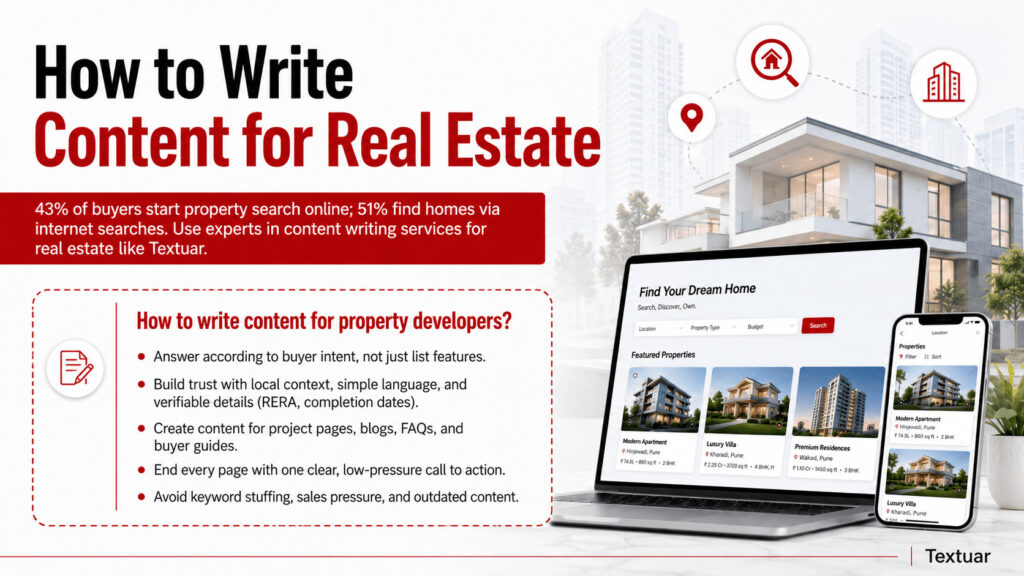
43% of buyers start property search online; 51% find homes via internet searches. Use experts in content writing services for real estate like Textuar. They take care that-
– Content answers buyer intent, not just list features.
– Builds trust with local context, simple language, and verifiable details (RERA, completion dates).
– Builds content project pages, blogs, FAQs, and buyer guides.
– Ends every page with one clear, low-pressure call to action.
The writer also avoids keyword stuffing, sales pressure, and outdated content.
We also take a look winning content types and common mistakes to avoid.
Property buyers do not wait for a sales office to open before they start researching. In real estate, attention starts online. In 2024, 43% of buyers said their first step was searching for properties on the internet, and 51% said they found their home through online searches.
These two stats tell a clear story. Developers need useful, fast, and trustworthy online content that answers questions before a prospect ever fills out a form. This is where content writing services make a real difference.
For property developers, online lead generation is not only about visibility. It is about building confidence at every stage of the buyer journey. A strong article, project page, neighborhood guide, or FAQ can move a visitor from curiosity to inquiry. The content has to do the work of an informed, patient sales associate. It should explain location value, investment potential, amenities, timing, and next steps without sounding forced.
How to do Content Writing for Real Estate Lead Generation
Real estate buyers ask practical questions. They want to know where the project sits, what surrounds it, who it suits, and why it matters now. Quality real estate content writing answers those questions in a way that search engines can understand and people can trust.
Here is how to create real estate content that matters.
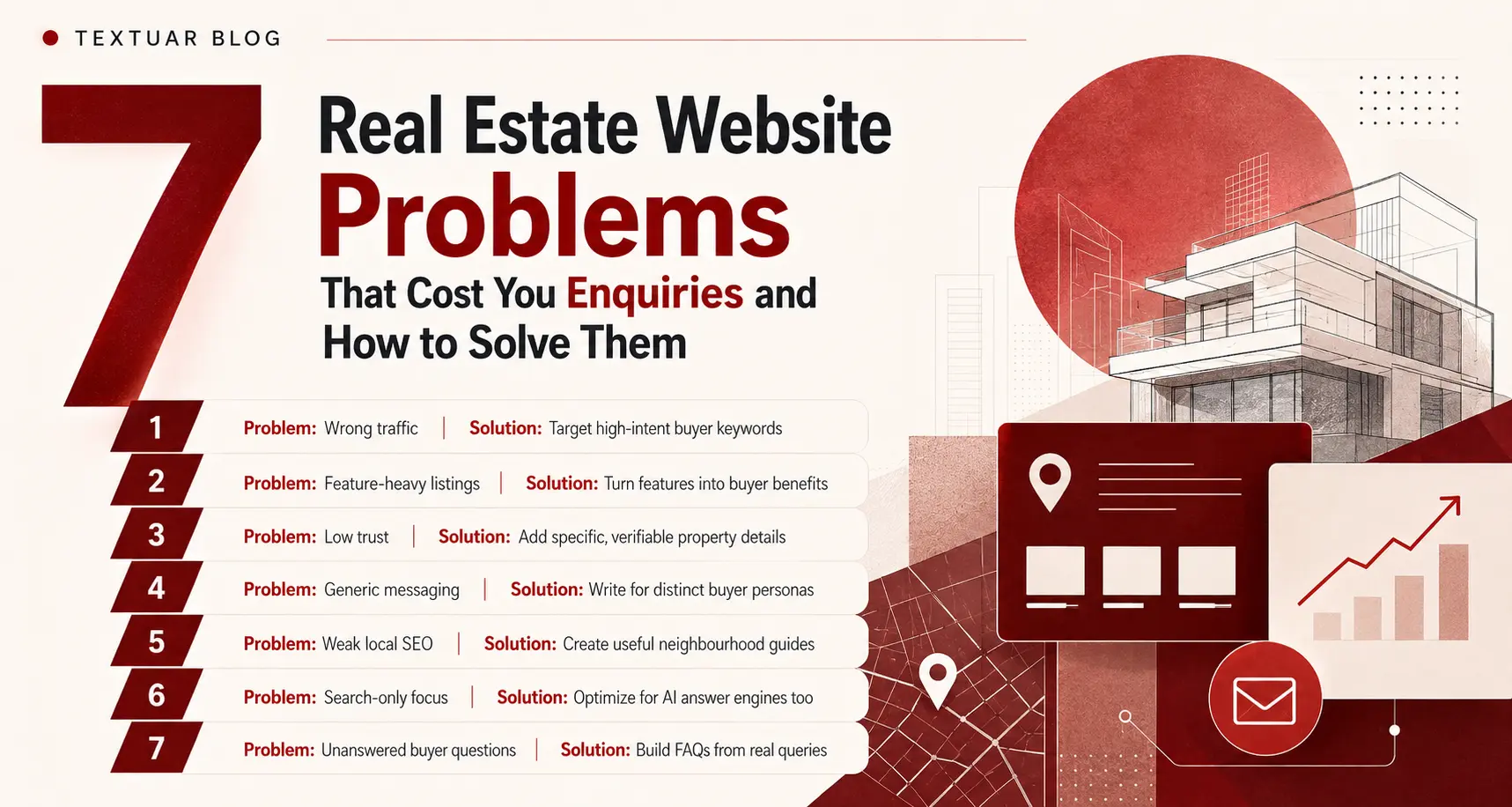
1. Start with buyer intent
Every piece of content should match a real search intent. A first-time buyer wants different information than an investor. A family looking for a 1 BHK apartment needs a different message than a buyer comparing bungalows. Content that follows intent feels relevant because it answers the exact question behind the search.
Focus on the decision, not just the property
In my experience, a strong page does more than list features. It explains why those features matter. A rooftop deck matters because it creates shared space. A nearby transit line matters because it shortens the commute. As a result, this simple shift helps readers connect the property to their daily life.
What is an example of buyer intent in real estate content writing
Wrong (ignores intent):
“SVAAR Tower homes come with luxury 2 BHK designs and excellent finishes.” (Too generic)
Right (consistent with the intent of a first-time working couple):
“Under ₹1.8 Cr? For the people who need to work from home, SVAAR Tower’s 2 BHK in Andheri West is offering them a separate work from home nook -Your Zoom calls shouldn’t compete with traffic noise.”
Why it works:
Delivers a genuine need – budget + WFH – not features.
2. Build content around local context
Location often drives the buying decision. Hence, property developers can use neighborhood pages, area guides, and local market explainers to show value without overpromising. These pages work well because they help readers understand the setting around a property, not just the property itself.
Content writing services for real estate can turn raw project information into content that feels clear, local, and search-friendly. This includes school access, commute patterns, nearby retail, parks, and future growth plans. It also includes plain language. Readers should understand the area at a single glance.
What is an example of contextual content in real estate content writing
Weak:
“Close to transport and shops.”
Strong:
“Walk to Versova Metro (4 mins) | 7 mins to Infinity Mall | 2 CBSE schools within 800m. Get upcoming coastal road access.”
Why it works:
Names real landmarks, compares sub-localities and builds trust through hyperlocal knowledge.
3. Use trust-building details early
Property buyers notice details that prove the project is real and well planned. Completion timelines, construction status, unit mix, financing basics, and amenities all matter. When these details appear early in the content, readers spend less time guessing and more time engaging.
What trust-building content should include
A useful page should answer, at minimum, who the development serves, where it sits, what stage it is in, and how a buyer can act. This structure reduces friction. It also helps sales teams receive better-qualified inquiries.
What is an example of adding trust building details early real estate content writing
Weak:
“Coming soon – A premium tower”
Strong: (establishes credibility upfront):
Completion: Dec 2026 | RERA Registered | 70% Sold | Carpet area: 580-720 sq. ft. | 3 elevator per 42 units | Expected occupancy certificate in Q1 2027
Why it works:
When it comes to numbers, there is no guessing around with concrete numbers. A serious purchaser instantly recognizes that the project is real and is on track.
4. Keep the language simple and specific
Real estate content should sound informed, not inflated. Readers do not need dramatic language. They need clarity. Use specific words that describe size, location, access, and timing. Avoid vague lines that could fit any project.
This is where professional content writing services help most. A skilled writer can turn technical project notes into readable content without diluting the message. This matters because a strong page can educate a cautious buyer and support the sales team at the same time.
What is an example of simple language in content writing for property developers
Overdone (inflated):
“Enjoy a symphony of urban luxury like no other”.
Simple & specific:
36th-floor rooftop pool | 5 min walk to D.N. Nagar Metro | 1 dedicated EV charging slot per flat | No stamp duty for women co-owners.
Why it works:
All phrases are verifiable. So, there is no fluff. As a result, a reader can fact check it and this helps build strong confidence.
5. Guide the reader to one next step
Every content asset should end with a clear action. The action may be to schedule a tour, request a brochure, download a floor plan, or sign up for updates. The point is to make the next step easy.
A weak call to action creates hesitation. In contrast, a clear one creates momentum. So, property content writers should keep it direct and low pressure. The content should invite action, not demand it.
What is an example of guiding reader to next step with content?
Weak CTA:
For more information, “Contact us.”
Clear, low-pressure CTA:
See the actual 2 BHK floor plan with sizes → Download 1 page PDF without signing up.
Better yet for capturing leads:
“Still want live RERA quarterly progress pictures? Input WhatsApp number – 1 update will be sent each Friday, until you tell us to stop.
Why it works:
One simple step, no big deal. A “book a visit” pressure to begin – no it’s a helpful next step.
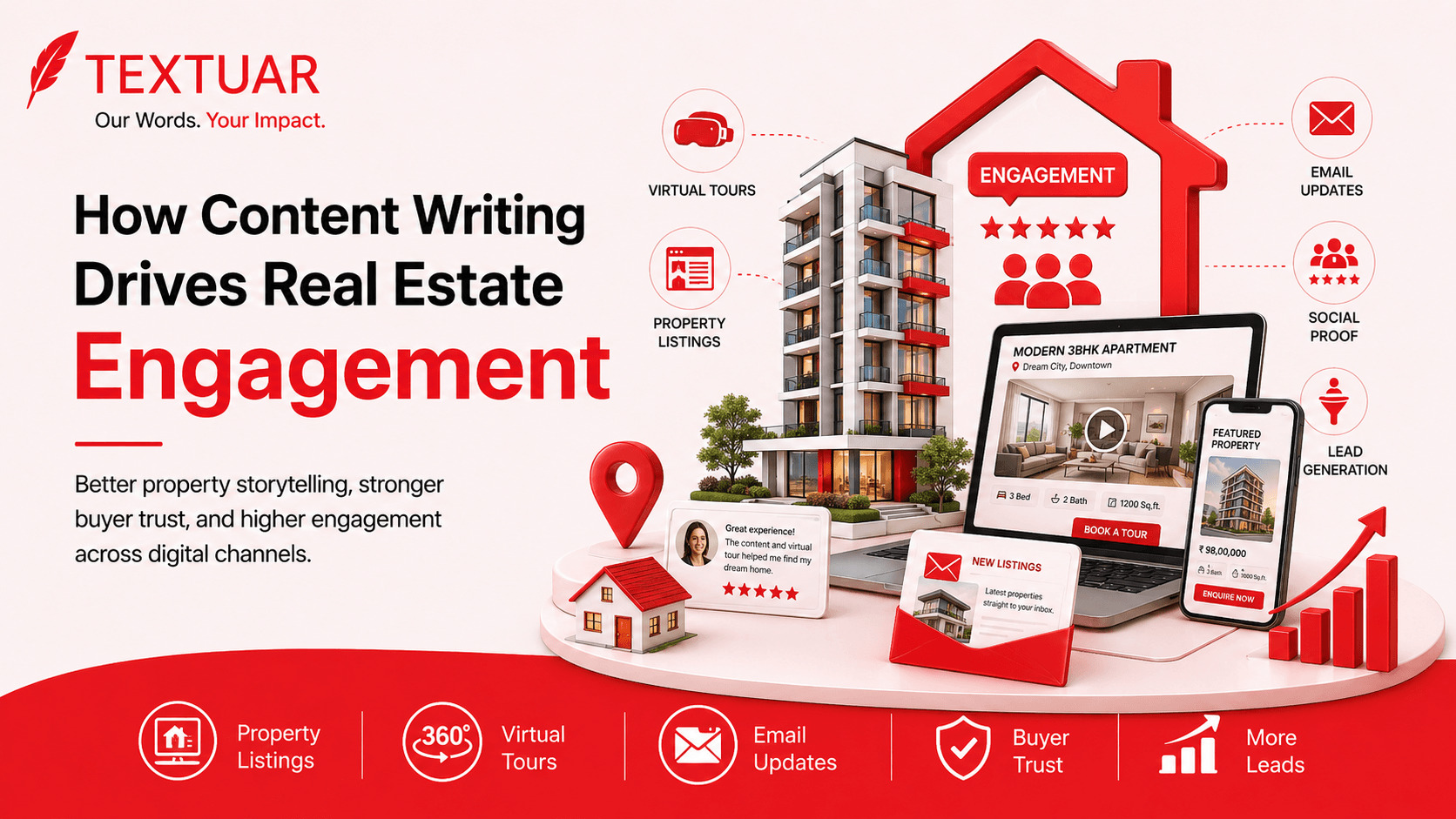
Content Types That Generate Better Leads
Different formats play different roles in the funnel. Some attract traffic, while others may capture contact details. Some help sales teams follow up better. A balanced content plan uses all of them.
1. Project landing pages
Project landing pages should act like the main hub for each development. So, they need a strong headline, a short overview, location highlights, key features, and a simple inquiry form. They also need updated information, as outdated pages weaken trust fast.
2. Blog articles
Blog articles support discovery. They work best when they answer questions buyers already ask online, such as how to compare neighborhoods, what to look for in a new build, or how to evaluate a development site. Content writing services for real estate can help teams publish these articles consistently without repeating the same angle.
3. Buyer guides
Buyer guides offer depth and explain the purchase process, financing basics, closing timelines, or how to compare floor plans. Hence, these guides work well as downloadable assets because they attract serious prospects and support email capture.
4. FAQs and resource pages
FAQs reduce hesitation. Also, they help prospects move past common objections. These include parking, deposits, ownership terms or move-in timelines. Resource pages also support search visibility because they match exact questions people type into search engines.
5. Email follow-up content
Lead generation does not end when someone submits a form. Follow-up emails should answer the next likely question and keep the conversation useful. They ought to feel personal and timely, not generic.
Content Writing Services for Real Estate – Common Mistakes to Avoid
Here are some mistakes you might want to keep an eye on when using content writing services for real estate.
1. Writing only for search engines
Search visibility matters, but content writing services for real estate still need to help people with valuable information. Pages that read like keyword lists may rank poorly over time because they fail to hold attention.
2. Overloading pages with sales language
People online are really good at picking up on pressure. So, it’s wise to focus on delivering straightforward details and tangible benefits. Strong content earns interest by being useful first.
3. Ignoring content updates
Real estate projects change. Timelines shift, amenities evolve, and market conditions move. hence, old content can create confusion. Regular updates keep the site accurate and credible. This is where content writing services for real estate comes in handy.
4. Publishing without a content system
Random posts rarely produce steady leads. A simple content system, with defined topics, ownership and review cycles helps you maintain a focused output. Many developers use content writing services for this reason. They want consistency, not just volume.
5. Ignoring answer engines
Content writing services need to adapt to let the site be cited on answer engines like ChatGPT, Claude and Perplexity. With structured data, multi modal information, FAQs and tables, there is a better chance of your website being picked up by these AI answer tools.
Content Writing Services for Real Estate- How to Measure Results
Lead generation content should be tracked like any other business asset. Watch traffic, time on page, form submissions, brochure downloads, and inquiry quality. A page that gets fewer visits but stronger leads may be more valuable than a high-traffic page that never converts.
Also compare content types. A neighborhood guide may bring early interest, whereas a project page may convert better. This insight helps developers refine the mix over time.
Conclusion
Real estate lead generation works best when content answers real buyer questions and moves people toward a clear next step. Developers that invest in useful pages, strong local information, and consistent messaging create more trust and more inquiries. The right strategy and real estate content writing services from Textuar helps.
With our expertise, your property website becomes a steady lead source instead of a digital brochure.
FAQ
1. What kind of content brings the best real estate leads?
Content that answers buyer intent brings the best leads. So, focus on producing location guides, project details, FAQs and comparison pages. Such types of content help people decide faster.
2. How often should property developers publish content?
An expert in content writing services for real estate know that we need to publish consistently, not randomly. Hence, you should follow a routine of sharing one or two insightful pieces every week. This also helps keep your website active and gives search engines something new to index.
3. Do project pages need SEO?
Yes. SEO helps buyers find the project page when they search by location, property type, amenities, or price band. Hence. clear titles, links, and useful copy from content writing services for real estate matter a lot.
4. Should every page include a call to action?
Yes. Every page should guide the reader to one next step, such as booking a visit, downloading a brochure, or requesting pricing details. As a result, this improves the impact of real estate content writing
5. When should a developer use content writing services for real estate?
Use content writing services for real estate when the team needs clearer messaging or stronger search visibility. It also helps when the property developer needs faster content production without sacrificing quality, accuracy or buyer trust.