Last updated on August 28th, 2026
📌 TL;DR:
The blog looks at Instagram’s new wordmark and the debate around distinctiveness, then connects that idea with the need for humanizing AI content to avoid templatized content. It explores why human input matters and how brands can move beyond convenient AI drafts to create content with stronger identity and reader value.
* See how the distinctive wordmark redesign connects with the need for distinct AI content.
* Understand why convenient AI drafts can become generic and forgettable.
* Learn how human expertise adds perspective, personality, and reader value.
Instagram just changed something that hadn’t changed in a decade.
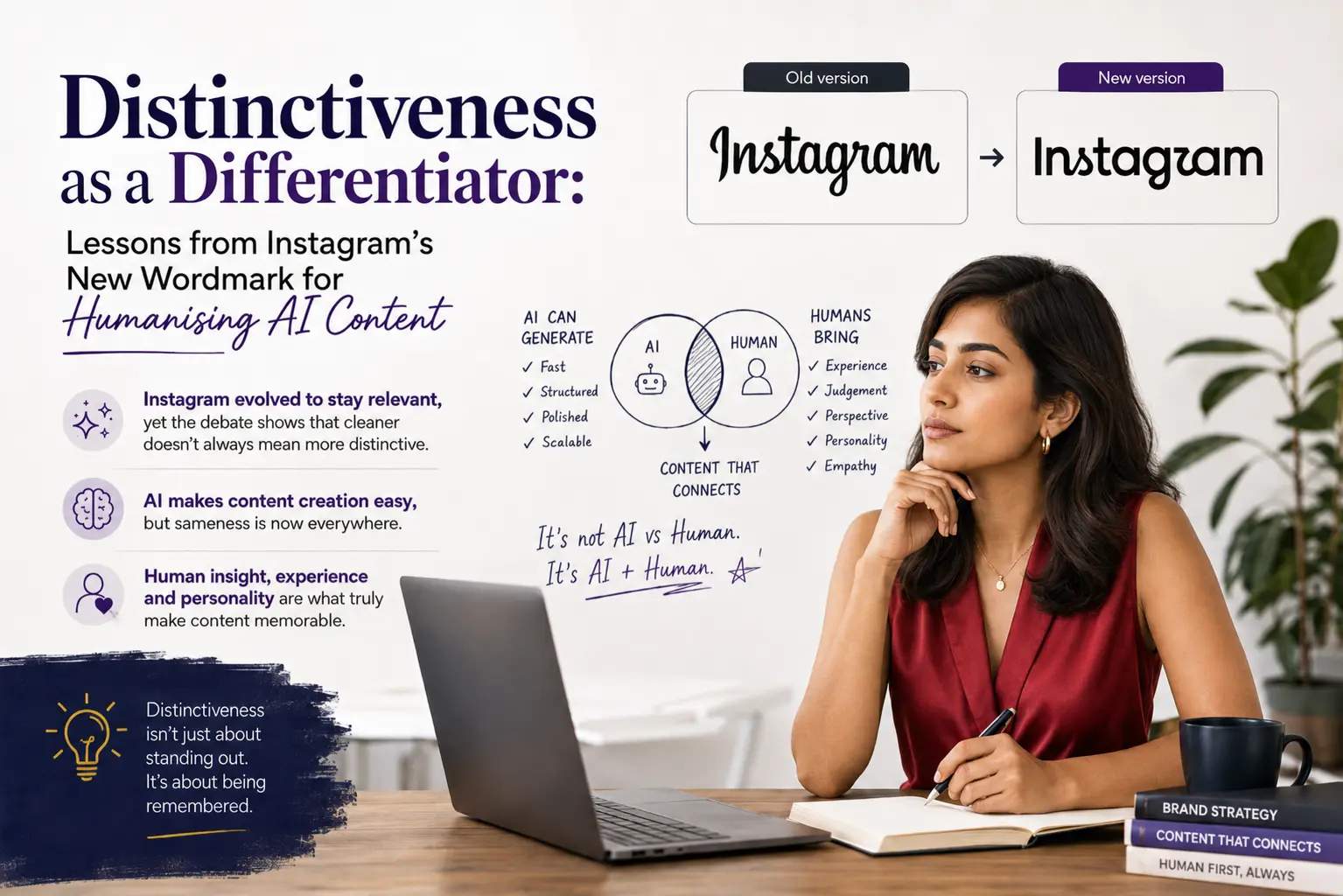
The signature cursive font has been substituted for a cleaner, modern look. Instagram head Adam Mosseri said that the whole point was to design something “cleaner and more modern” while retaining references to the original identity. But the redesign has now sparked controversy over whether the app’s cleaner look might make Instagram seem somewhat little less distinctive.
You might wonder what this news has got to do with the world of SEO content.
In my experiences, the debate quite interestingly echoes the ongoing discussion about AI-generated content.
Generative AI has made it remarkably easy to create polished, structured, grammatical and professional content almost effortlessly. However, now, there is a new challenge as more companies use similar AI tools.
“Polish alone stops being a differentiator when virtually anyone can produce polished content.”
Hanif Hasan
Co-founder, Textuar
The next frontier of competitive advantage will come from something distinctly human – experience, exercise of judgement, personality, perspective, and genuine value for the reader.
The Instagram Wordmark Controversy: What It Tells Us about Branding Today
Altering an existing brand identity is seldom a trivial task. By August 2026, Instagram had replaced its cursive wordmark—a design the company had used for about ten years. The new typeface incorporates both cursive and print elements as part of an effort to refresh Instagram’s visual identity.
This reaction reveals a significant brand lesson.
1. Cleaner Won’t Always Be More Distinctive
The Verge raised the question why making brands “cleaner and more modern” can lead to businesses looking even more like pretty much everyone else. It also reported that others believed the original wordmark had greater personality.
Of course, this is a subjective matter. The ‘polish versus personality’ tension is evident here, though. Such updates tend to remove some of the aspects that previously made it instantly recognizable.
2. Effective Brand Marketing Requires More Than a Professional Polish
Unique brands often have traits that are memorable.
It may be a visual identity, tone of voice, opinion, story, phrase, experience or perspective.
Content works the same way.
An AI content piece can be written flawlessly, and yet you will not remember it. It can be used and reused again and again without anything remotely distinctive that tends to stick in the minds of the readers.
This lack of distinction is a ticking time bomb waiting to erode brand equity.
AI Is Creating a Similar Sameness Problem in Content
AI has eliminated a number of barriers to creating content at scale. You enter a prompt in an AI tool with a topic and some instructions; it can generate rough content drafts within seconds.
That capability is incredibly useful.
The issue is compounded when the AI draft becomes the final product instead of a base to work from.
Across industries, AI-assisted written content will start feeling more and more identical quickly. Here are some ways AI content feels bland and robotic.
1. Predictable Introductions
Many blogs begin by providing an overview of a changing world or increasing competition. Yes, we are talking about those ‘in today’s times…’ type introductions on articles that flood the Internet.
There may not be anything technically wrong with these introductions. But they simply don’t give anything new and intriguing for readers to spend more time on.
2. Familiar Content Structures
AI tends to organize information logically. This is very handy, but this often means that you end up with article after article following the same template:
Introduction-> Benefits-> Challenges-> Best Practices-> Conclusion
By this point, readers start to recognize the pattern.
3. Recycled Vocabulary
Some phrases can also repeat through AI, especially in its writing. Words like “leverage,” “seamless,” “robust,” “unlock,” and “transformative” may sound professional in isolation.
However, use them everywhere, and you begin to lose personality in the writing.
4. Little Evidence of Lived Experience
AI can synthesize information. It will not be able to provide the conversation you had with an frustrated customer last Tuesday, where your team went wrong executing a project or what you learned after experimenting three different times.
These details tend to transform generic information into quality content.
Humanizing AI Content Means Stepping Out of the Comfort Zone
There’s another lesson in Instagram’s decision to rework the wordmark.
The company could have stayed comfortable with a wordmark, which has been in existence for 10 years. People recognized it. It worked. Changing a very familiar element is bound to earn criticism.
Instagram, however, felt it was time to reconsider it.
Content teams also have their comfort zone dilemma.
AI is comfortable.
It is fast. The cost is less than launching all the pieces from scratch. It can arrange information, develop ideas, and create a blank screen into several hundred words in a matter of minutes.
Once this initial draft starts to be a reasonable ballpark estimate, it suddenly becomes tempting to publish with minimal editing.
Comfort Zone Can Lead to Content Complacency!
The threat of AI lies not in the creation of bad content. It can output content that is good enough most of the time.
But “Good enough” is potentially hazardous because it removes the incentive to think harder.
- Does the reader really ‘learn’ anything?
- Is there some nugget of insight not found on the 20 other competing websites?
- Does it answer the reader’s real question or pain point?
These questions require more work than generating another draft.
Humanization is not Cosmetic Editing but Applying Thinking
Many people confuse humanizing AI content with altering a select few words to make the copy more human-like. But this is not the essence of content humanization.
It should be based on the questions:
- What does our reader genuinely need to know?
- What can our organization contribute from its own experience?
- Does the content portray us as experts about addressing this issue?
- Do you think we could do it better?
- What useful piece of information would an industry be kept in this field find of value?
- What should the reader do after reading this article?
In this case, writers and editors must move beyond the comfort of an AI-generated draft.
Content creation is made easy with AI. Humanizing it involves keeping that comfort aside so that the content asset is truly beneficial.
The Risk of AI Content is Erosion of Trust
Many marketers tend to focus on the wrong question, “Can anyone tell that this is AI written?”
In my experience, a more pertinent question for marketers would be:
“Will anyone remember who published it?”
Imagine five rival companies writing articles on the same subject.
All five of the articles are correct. They use appropriate headings. All of the recommendations are similar. They possess good grammar. All basically end with the same advice.
Which company does the reader remember?
Possibly none.
This is where the concept of AI sameness turns into a brand issue.
Your content not only fights for rankings or AI citations. It also competes for attention, trust, and recall. When there aren’t any original or first-hand examples, unique opinions, or recognizable voice, the brand behind the content can disappear. This is why the goal should be to enable people to go beyond making AI content look human.
The goal should be to make it distinctly yours.
What is Humanizing AI Content?
Humanization is not deliberately setting out to make grammatical errors or to make professional writing too informal.
It involves the addition of the characteristics that can only be added by humans to AI.
1. Add First-Hand Experience
Include details from customer meetings, projects, experiments, processes, failures and actual business experiences in the article.
Instead of writing:
“The businesses need to keep in touch with the consumers at regular intervals.”
Describe what your company found out when communication broke down or what occurred after bettering this process.
Specific experience counts more heavily than general or “how to” information.
2. Clear Point of View in Humanizing AI Content
Not all articles are necessarily controversial. Ideally, valuable content will convey the author’s expertise and authority to the reader. They will provide clarity on:
- What is your suggestion on how to do this?
- Some points prevalent in the industry that you don’t agree with
- What do you see that businesses often do wrong?
A viewpoint provides the reader with something to react to and to remember.
3. Substitute Generic Examples with Real Ones
AI tools like ChatGPT can confidently make mistakes and provide non-existent examples.
Human editors can ensure that this doesn’t happen.
They strengthen the content with numbers, scenarios, client questions, mistakes, before/after comparisons, and observations.
4. Preserve the Brand Voice
A cybersecurity firm should NOT be like a fashion retailer. A dentist shouldn’t sound like a SaaS start up.
Human editors know how the organization communicates, the words customers use, what words sound natural, and what don’t.
That brand voice and choice of words help make content instantly recognizable.
Why the Human-AI hybrid Approach Works Better?
There is no need to forgo AI totally as this step would be sacrificing many efficiency measures that give a differentiating advantage to competitors. Rather, companies must be more specific on the value of AI and when human input is required.
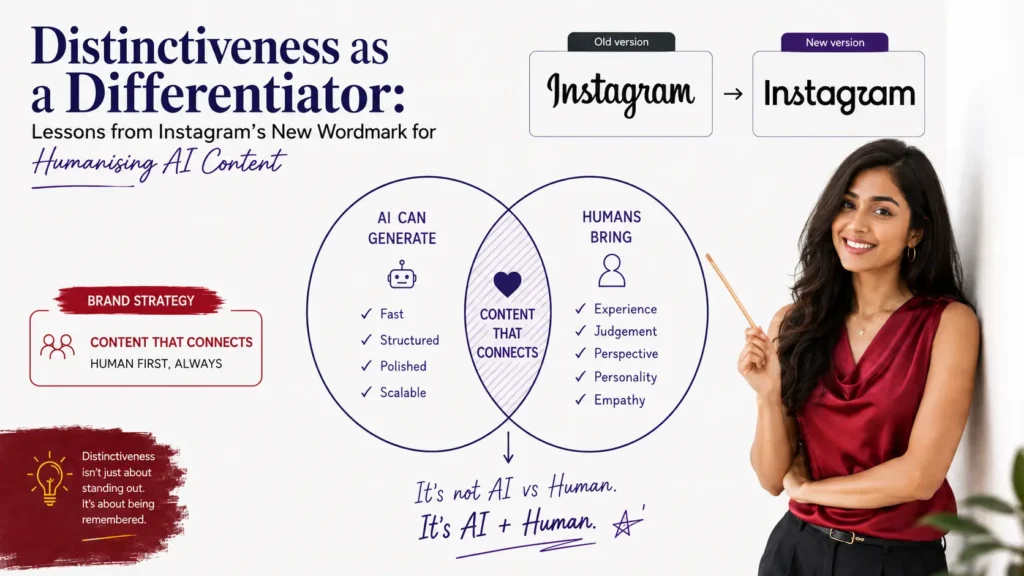
Use artificial intelligence to manage the foundation work.
AI can assist with:
- organizing research
- brainstorming angles
- building initial outlines
- summarizing information
- creating first drafts
- generating content variations
- regeneration of information on various channels
These applications save a lot of time. Let humans handle meaning.
Human editors can add immense value through:
- factual verification
- context
- interpretation
- first-hand experience
- examples
- brand voice
- opinions
- emotional nuance
- editorial judgement
- final reader value
AI can aid in compiling the content. There must be a human who must make the decision of what deserves to be said.
5 Questions to Ask Before Publishing AI Content
Before an article is published with AI assistance, an editorial team can perform five easy checks.
1. Could One of Our Competitors Publish This Exact Same Content Under Their Name?
Strike out your company name.
If they can use the content to explain a concept that could just as easily be done on just about any other competing site, it likely requires more brand-specific details and insights.
2. Have We Added Lived Experience in Real Life?
Be on the lookout for examples, observations, customer conversations, proprietary processes, results or lessons learned.
A single insightful and personally experienced remark can make a huge difference to generic messages.
For example, the process of QC for AI content for Textuar may be different for other similar competitors. Readers get genuine value with our original insights.
3. Does the Article Have a Point of View?
Information explains.
Expertise interprets.
Be sure to communicate the meaning of the article and a clear conclusion regarding how the reader should use it.
4. Does It Truly Sound Like Our Brand?
The vocabulary, sentence rhythm, examples, tone and opinions should be aligned with the organization publishing the information.
Brand voice is meant to live beyond the AI process.
5. Will the Reader Receive Something Other Than a Generic AI Answer?
This could be the most critical test.
Now, readers can get access to the AI tools. No one wants to read something just to get what they already can find with a simple prompt, so why expend time on reading your article?
Provide them with knowledge and skills they wouldn’t have been able to access from the prompt.
What the New Instagram Wordmark Change Teaches Content Marketers Ultimately?
Instagram’s redesign just poses the interesting question:
What happens when the features that make something unique are taken away by modernization?
The same should be considered for content marketing.
Creating professional content with generative AI is now simpler. It democratizes correct grammar, coherent structure and thorough coverage.
📌 At Textuar, we believe that the differentiators move elsewhere.
- Experience matters.
- Perspective is critical.
- Voice matters.
- Original thinking will add value.
- Most of all, genuine help to the reader is important.
A wordmark should be sufficiently distinctive to be recognizable.
So does your content.
The Summary: Being Human is a Branding Advantage
AI is continually evolving, and it’s an essential tool to enhance efficiency and speed in content creation for companies.
Efficiency, however, should not be the ultimate goal.
With this greater access to polished content through AI, businesses will need to work harder to provide the attributes that AI can’t replicate – judgement, experience, context, empathy, opinion and original insight.
Content does not have to be an AI vs. human competition.
Rather it should be AI and human synergy.
The more powerful one is efficiency based on clearly human thought that is driven by AI.
That could mean saying goodbye to the comfort of AI generated first draft.
But that’s where really useful content starts, typically.
FAQs
What does humanizing AI-generated content mean?
To humanize AI-generated content, you should incorporate human expertise, experience, examples, opinions, brand voice, and context. This helps the content to be of greater value than a generic, AI-generated response.
Why does AI-generated content sound alike?
AI can generate structures, wordings, examples and explanations, though not necessarily neutrally. If these patterns are not well edited by humans, then the same content can be easily interchanged across businesses without any soul or genuine insight as a differentiator.
Do businesses need to stop using AI completely to create content?
No. AI can enhance research, ideation, initial drafting and boosting content creation productivity. The best solution is to include both AI efficiency and editorial judgement, human expertise and brand perspective.