Last updated on September 28th, 2026
📌 TL;DR: Summary
Patients now ask AI about symptoms, specialists, tests, costs, and urgency before booking. Healthcare content must answer these questions early to build trust and visibility. A skilled healthcare content writer creates question-led, accurate content that guides patients from research to appointment without replacing clinical judgment.
I have noticed a recent trend where patients are no longer arriving at a healthcare website with a blank slate. Many have already asked AI what their symptoms could mean, whether they need a doctor, which specialist to see, what a test may involve, and how urgent the issue might be.
Recent 2026 research from Gallup and KFF shows that people use AI for symptom research, test explanations, treatment comparisons, and decisions about seeking care.
That changes the job of healthcare content. Hospitals, clinics, and practitioners now need pages that answer questions before a patient clicks “Book Appointment.” This is where effective healthcare content writing services can support visibility, trust, and a smoother path from research to consultation.
Why Are Patients Turning to AI Before Booking?
Patients use AI because it gives fast, conversational answers. They can describe a concern in everyday language, ask follow-up questions, compare options, and narrow down what they may need next.
AI is not simply replacing doctors. It is becoming part of the research stage around a healthcare visit. Gallup reported in April 2026 that 59% of AI health-information users researched before doctor visits. KFF also found common uses such as symptom research, test explanations, treatment comparisons, and decisions about seeking care.
This matters because the traditional patient journey is changing.
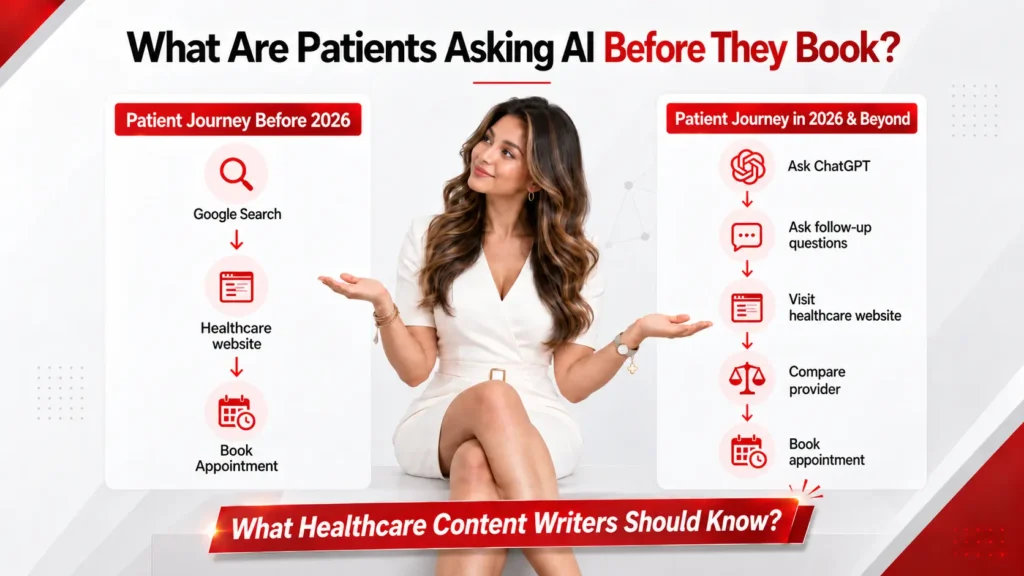
Previously, it might have looked like:
Search → Healthcare website → Appointment
Now, it may look more like:
Ask AI → Ask follow-up questions → Visit healthcare website → Compare provider → Book appointment
Healthcare content therefore needs to serve patients much earlier in that journey.
What Are Patients Asking AI Before They Book an Appointment?
Most pre-appointment questions fall into several predictable categories.
1. “What Could These Symptoms Mean?”
This is often the starting point.
A patient may ask, “Why do I feel dizzy after eating?” or “What can cause persistent shoulder pain?” Usually, they are trying to understand possibilities and decide what to do next.
Healthcare pages should explain common causes, warning signs, when medical evaluation may be appropriate, and which type of clinician may help.
A skilled healthcare content writer must find the right balance. The content needs to be useful without sounding diagnostic, alarming, or dismissive.
2. “Do I Actually Need to See a Doctor?”
This question sits very close to the appointment decision.
Patients may ask whether they can manage a problem at home, how long they should wait, whether the situation is urgent, or whether they need a GP, specialist, urgent care center, or emergency department.
In fact, KFF found that 16% of adults surveyed said they had used AI in the previous year to help decide whether to see a doctor or seek medical care.
Useful content can reduce that uncertainty. It should help patients understand the appropriate next step rather than push every reader toward an appointment.
Good healthcare content supports informed action, not appointment pressure.
3. “Which Specialist Should I See?”
Healthcare systems can be difficult to navigate.
Someone with jaw pain may not know whether to consult a dentist, ENT specialist, neurologist, or another provider. Similarly, a person with recurring digestive discomfort may not know whether the issue warrants seeing a gastroenterologist.
Hospitals and multi-specialty clinics can answer this need with:
- “Who should I see for…?” pages
- symptom-to-specialist guides
- condition-specific FAQs
- simple patient decision pathways
These formats can also be useful for AI search because they connect a specific question with a clear answer.
4. “What Will Happen During the Appointment?”
Uncertainty can create friction before booking.
Patients may want to know what the first consultation involves, whether tests may be discussed, what questions the doctor could ask, how they should prepare, and what medical records they need to bring.
A healthcare content expert can turn these seemingly basic operational details into valuable “what to expect” content.
Such pages can reduce uncertainty and help patients arrive better prepared. They also answer questions that conventional service pages frequently overlook.
5. “What Tests or Treatments Might Be Discussed?”
Patients increasingly ask AI about blood tests, imaging, screenings, procedures, medications, physical therapy, surgery, and other treatment options.
KFF reported that explaining tests, lab results or diagnoses and understanding or comparing treatments were among common AI uses for physical health questions in 2026.
Healthcare organizations should avoid predicting what an individual patient will need. Instead, content can explain:
- why a test may be ordered
- what the test usually involves
- how patients may need to prepare
- what a treatment is designed to do
- which factors may affect treatment suitability
That distinction matters.
Educational content provides context. It does not replace clinical judgment.
6. “How Much Will This Cost?”
Cost can influence whether a patient books.
Patients may ask AI about consultation fees, procedure costs, insurance coverage, or payment options.
If an exact fee cannot be published, the healthcare website can still explain what may affect the cost, whether insurance may apply, and where the patient can request an estimate.
Leaving patients with no information at all simply gives them another reason to continue their research elsewhere.
7. “Is This Doctor or Clinic Right for Me?”
Patients may also use AI to compare providers.
They may ask what qualifications matter, whether a doctor has relevant experience, or what to look for when choosing a specialist.
Provider bios should therefore go beyond degrees. Useful profiles can cover clinical interests, areas of experience, relevant credentials, languages spoken, and what patients can expect from a consultation.
This is another area where professional healthcare content writing services can help standardize information across multiple doctors, specialties, and locations.
What Does This Mean for Healthcare Content Strategy?
The shift toward AI-assisted research means healthcare content should increasingly be built around patient questions, not keywords alone.
A page titled “Cardiology Services” may still be necessary. But it should connect to questions such as:
- When should I see a cardiologist?
- What symptoms could require cardiology evaluation?
- What happens during the first appointment?
- What tests might a cardiologist recommend?
- How should I prepare for my consultation?
Clear headings, concise answers, FAQs, comparison tables, and internal links make information easier for readers and answer engines to interpret.
Google has also reported that users are asking longer and more complex questions as they interact with AI-enabled health search experiences.
The implication is important: healthcare organizations need to think beyond ranking for one keyword. They need to become a useful source for the conversation surrounding that keyword.
How Can Healthcare Content Writing Services Prepare a Website for AI Search?
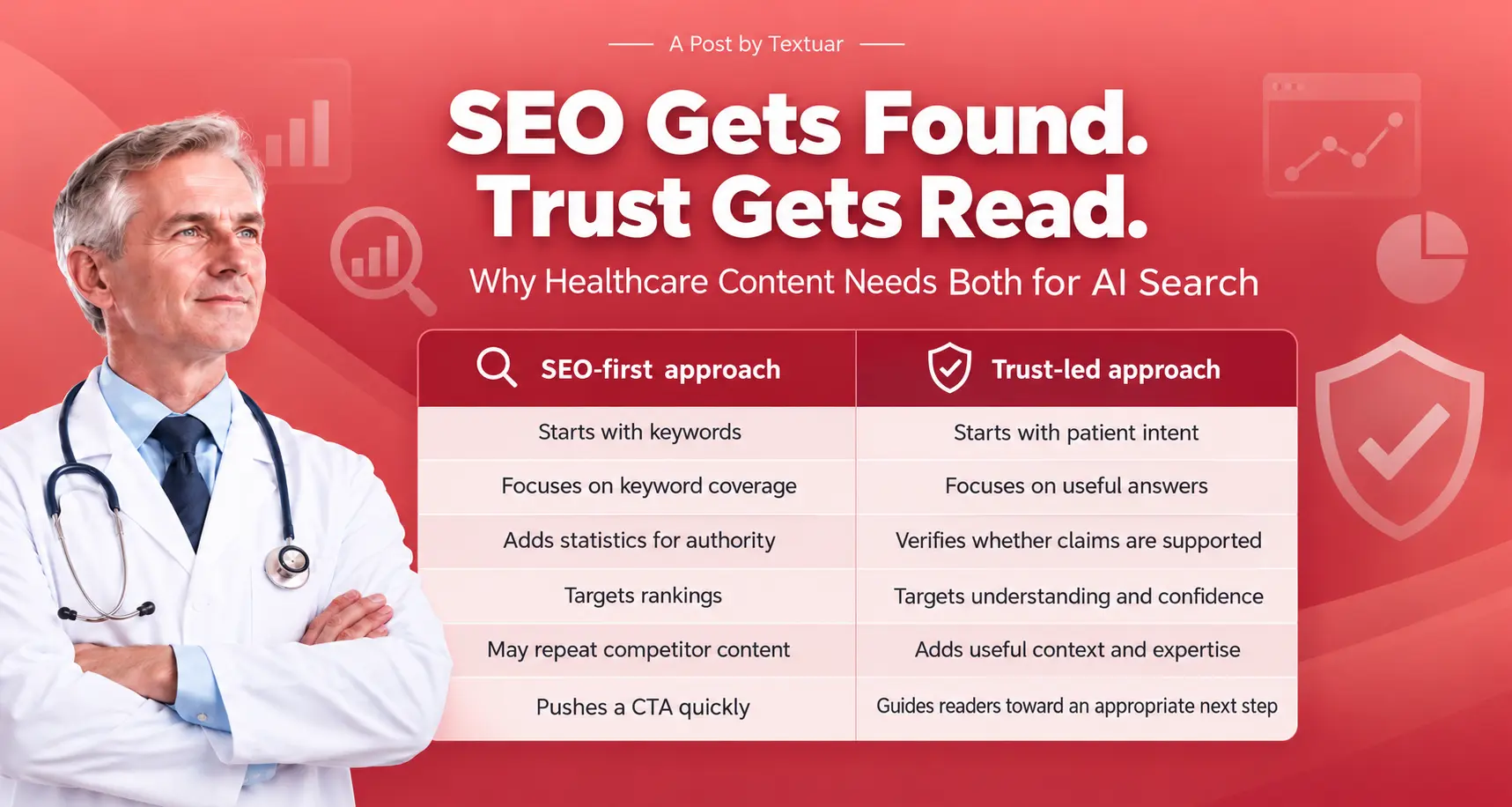
Professional healthcare content writing services now need to consider conventional SEO as well as answer-engine discovery.
1. Build Content Around Real Patient Questions
Start with search queries, appointment FAQs, physician input, call-center questions, and common concerns handled by front-desk teams. These sources often reveal content opportunities that keyword volume alone will not uncover.
For instance, “orthopedic specialist” may be the SEO keyword. But actual patients may be asking, “Should I see an orthopedic doctor for knee pain that only happens when climbing stairs?” That second question reveals intent.
2. Give the Answer Early
If a heading asks, “When should I see a dermatologist?”, answer the question immediately. Do not make the patient read several paragraphs before reaching the point.
This answer-first format improves usability. It also gives AI systems a clearer passage to interpret when generating responses.
3. Give Coverage to the Surrounding Decision
A healthcare content writing company should not stop after placing the primary keyword naturally into a service page.
Depending on the topic, patients may also need information on symptoms, evaluation, treatment pathways, preparation, alternatives, recovery, and next steps.
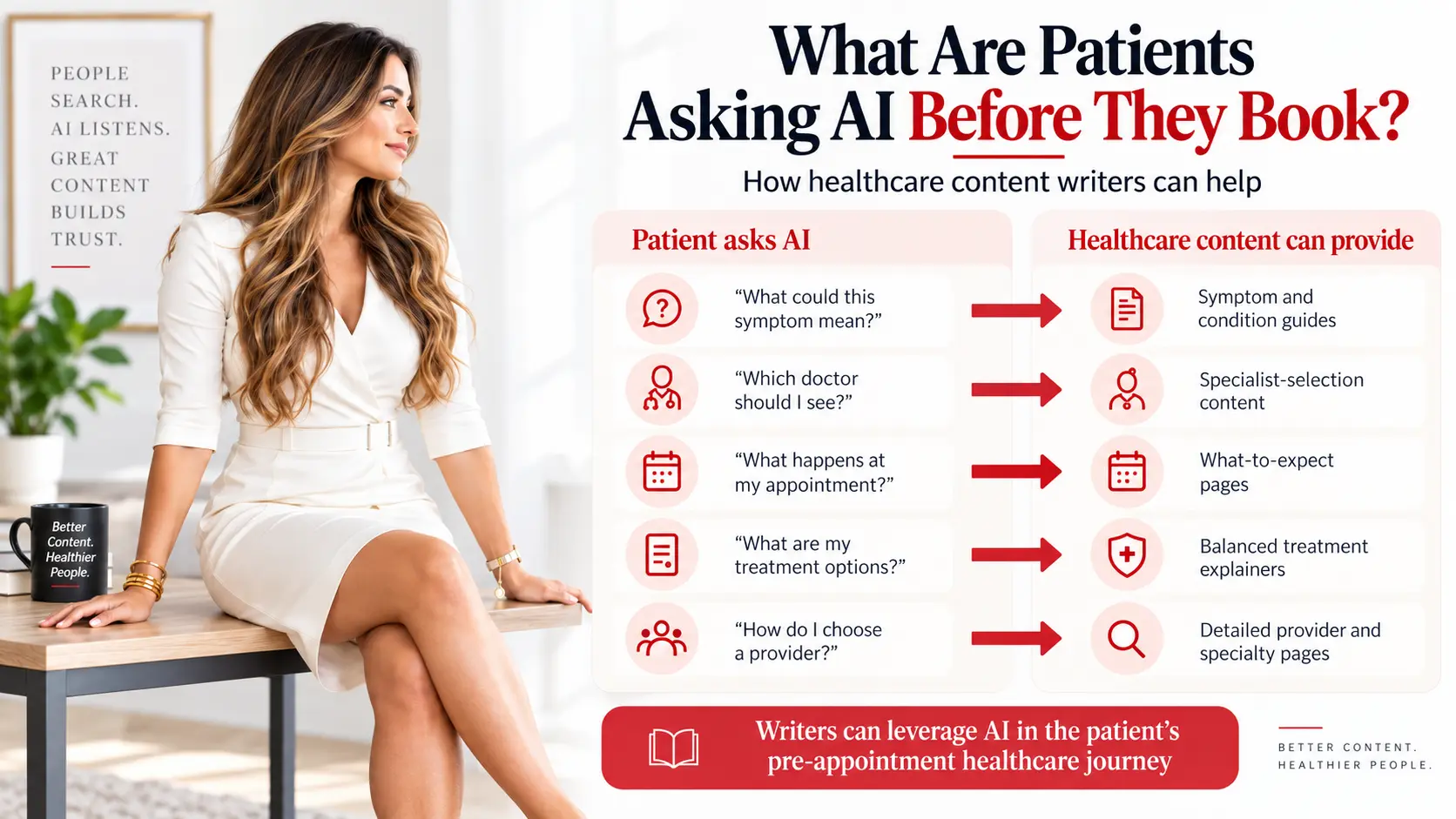
| Patient asks AI | Healthcare content can provide |
| What could this symptom mean? | Symptom and condition guides |
| Which doctor should I see? | Specialist-selection content |
| What happens at my appointment? | What-to-expect pages |
| What are my treatment options? | Balanced treatment explainers |
| How do I choose a provider? | Detailed provider and specialty pages |
The goal is not to add more keywords. It is to answer more of the patient’s connected questions.
4. Separate Education From Diagnosis
Healthcare content can explain possibilities and typical care pathways. It should not tell an individual reader that they definitely have a medical condition or that a specific treatment is right for them. For high-risk or technical topics, authoritative sourcing and suitable clinical review remain essential.
5. Keep Healthcare Information Current
AI visibility has little value if physician profiles, services, clinic locations, preparation instructions, or treatment information are outdated. A healthcare content expert should therefore view accuracy as an ongoing editorial responsibility rather than a one-time content task.
Common Mistake: Writing Only for the Booking Stage
Many healthcare websites move directly from:
“Here is our service” → “Book an appointment.”
That misses everything happening between those two points.
A patient may need several answers before feeling ready to contact a provider. If the healthcare website does not supply them, an AI response, online forum, or competing healthcare site may fill the information gap.
A stronger healthcare content journey looks like this:
Symptom question → Condition education → Specialist guidance → What to expect → Treatment information → Appointment
Internal linking should connect these stages so that patients can continue researching without leaving the website.
Key Takeaway for Healthcare Organizations
Patients are not only searching for doctors. They are searching for enough understanding to decide whether, where, and when to book. Healthcare organizations that answer those questions clearly can become useful much earlier in the patient journey.
The strongest healthcare content does not attempt to replace the clinician. It prepares the patient for the point at which clinical expertise becomes necessary.
Conclusion
AI is becoming part of the pre-appointment healthcare journey. Patients use it to explore symptoms, urgency, specialists, tests, treatments, costs, and appointment expectations.
Strong healthcare content writing services can help healthcare organizations answer these questions accurately while maintaining appropriate clinical boundaries. Your next content plan should therefore start with one practical question: What does the patient need to understand before feeling ready to book?
FAQs
What type of healthcare content is suitable for AI search?
Question-led content can effectively address user intent. Symptom guides, treatment explainers and “what to expect” pages, by healthcare content writers can also help. Even specialist-selection content, FAQs and comparison pages provide structured information that patients and AI systems can understand more easily.
Can AI-generated healthcare content be published without medical review?
High-stakes healthcare content should not rely on unchecked AI output. Healthcare content writers need to carefully check medical claims, treatment information, risks, diagnostic guidance and other clinical statements. These should be verified against authoritative sources and reviewed by an appropriately qualified expert where necessary.
Why hire a healthcare content writing company instead of a general writer?
A healthcare content writing company combines SEO, patient-friendly communication, research, and careful handling of medical claims. An experienced healthcare content writer understands that useful content should educate readers without overpromising, diagnosing individual patients, or creating unnecessary fear.