Last updated on April 6th, 2026
📌 TL;DR Summary- What is Covered?
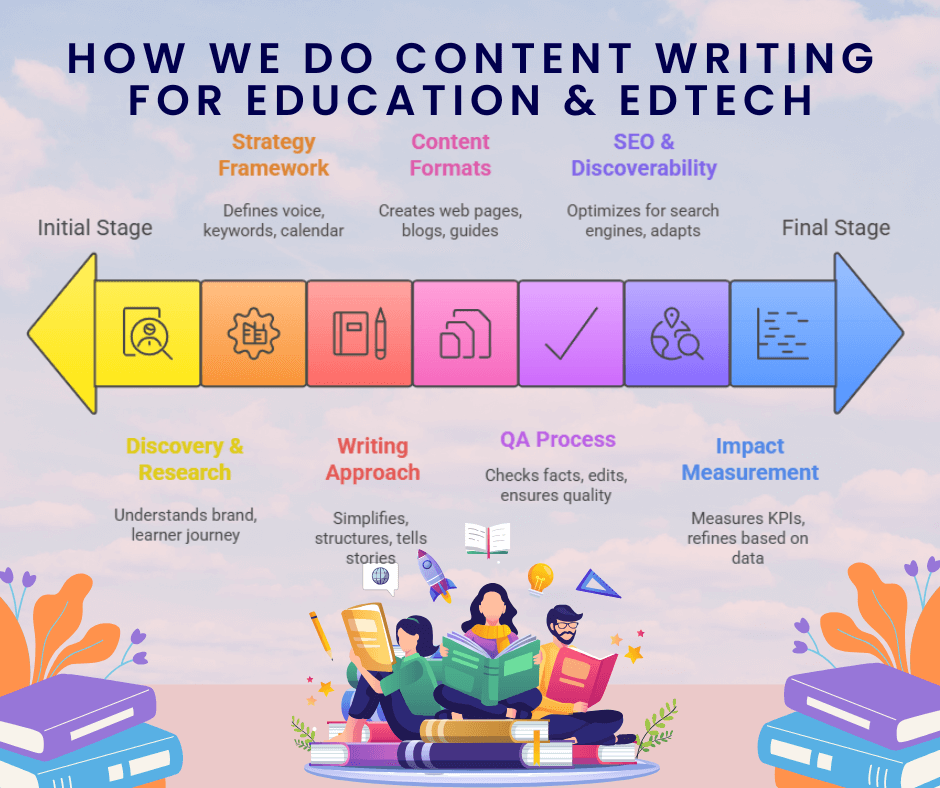
This blog shows precisely why high-quality content writing for education helps institutions and EdTech brands to attract, educate and convert learners. You will see the exact step-by-step process that Textuar uses to write academic and marketing content for educational institutions like schools, colleges, universities, and edTech-
–discovery and tone creation
–strategy framework
–writing approach
–content formats
–quality assurance
–optimizing for AEO / SEO
–measuring impact
So, if you need clearer communication and higher organic ranking visibility then this guide will show how professional education writing creates measurable results.
The education space has evolved significantly over the past decade. Students, parents, workers and lifelong learners now prefer tech platforms to:
-assess institutions
-select the right program
-consume learning materials.
In this scenario, education institutions and edTechs cannot rely on generic content. They need clear, credible and student-centered communication that builds trust and articulate specific value.
At Textuar, we consider education content writing services as both a storytelling and learning exercise.
Our education content writing balances academic precision with accessible language, so that your communication is appealing to a broad audience.
Such expertise is of immense value to a long standing academy as well as a booming EdTech platform. It appeals to the right learners and increases engagement.
Read how we make content writing for education a successful endeavor.
What is Education Content Writing?
Learners today, compare institutes on various parameters such as course structure, faculty expertises, fee structures, placement and delivery formats before enrolling/getting associated with one. As such, education brands and online learning platforms need to communicate with clarity and credibility at every stage of the student journey.
A content writer for education sector works toward multiple goals-
-help you establish trust
-educate prospects and
-help differentiate your institution or EdTech product in the marketplace.
Who Benefits from Education Content Writing Services?
When you hire education content writers, they craft informative and quality, student-centered content. It enables schools, colleges, universities and EdTech companies to easily communicate complex information to students and parents.
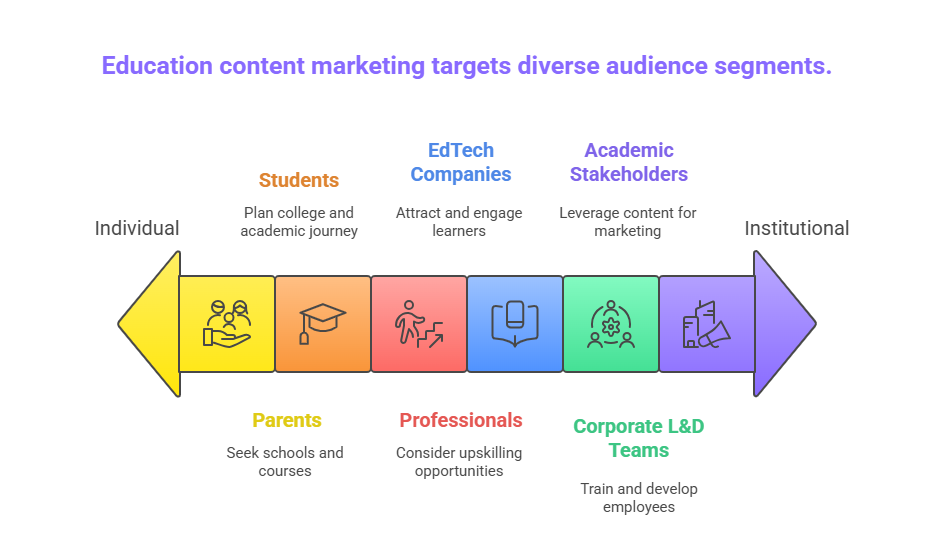
We create content for different types of audience-
-Parents looking at schools and courses,
-Students searching colleges and planning academic journey,
-Working professionals considering upskilling needs,
-EdTech companies who need to attract learners,
-Corporate L&D teams,
-Academic stakeholders looking to leverage content marketing for education industry success online.
We adapt the tone, depth and complexity based on your target audience. This way, your writing remains relevant, accurate and compelling for each of your readers.
Now let us see the various steps we take to ensure that we create high-value content for the relevant target audience.
Step 1- How to Begin the Process for Education Content Writing?
1. Initial Discovery Call
Before we pen a single word, we start by getting to know what sets your educational brand apart from the competition. Each school and each EdTech product has its philosophy, teaching style and outcomes.
Through our discovery process, we are able to extract the essence of these factors.
This way, we get good guidance on how to write course content for online learning. The content asset will reflect your voice exactly the way you want it.
2. Get Details of Your Courses, Results & Brand Story
We start by structured briefing calls or workshops to understand your:
-academic programs,
-curriculum architecture,
-learning approach,
-certifications and achievements, and
-program strengths.
This makes it easier for us to know what your USP is (faculty quality, placement assistance, teaching style, tech innovation or industry focus).
Along the way, we also decode your brand personality (aspirational, premium, approachable, career-focused or innovation-led).
3. Mapping Content to Learner Journey
There is a lot of emotion and research in education decisions, so we align content with each stage of the learner journey.
-Awareness stage
On the awareness stage, students and parents discover you by reading blogs, explainers and social content.
-Evolution stage
When they evaluate, they compare programmes, search for career benefits and read FAQs or guide-type pages.
-Decision stage
Here, content helps convince them to enroll or book a demo. For this, we use program pages, case studies, testimonials, email sequences and course previews.
Such type of structuring enables us to secure higher engagement and better conversions.
Step 2- What is Our Education Content Strategy Framework?
At Textuar, our education content writing agency follows a strategy first approach. It combines technical accuracy with SEO as well student-friendly communication. This way, each piece of content helps your admissions, engagement or learning objectives.
Here is a peek at the framework that guides us on how to create content for educational institutions.
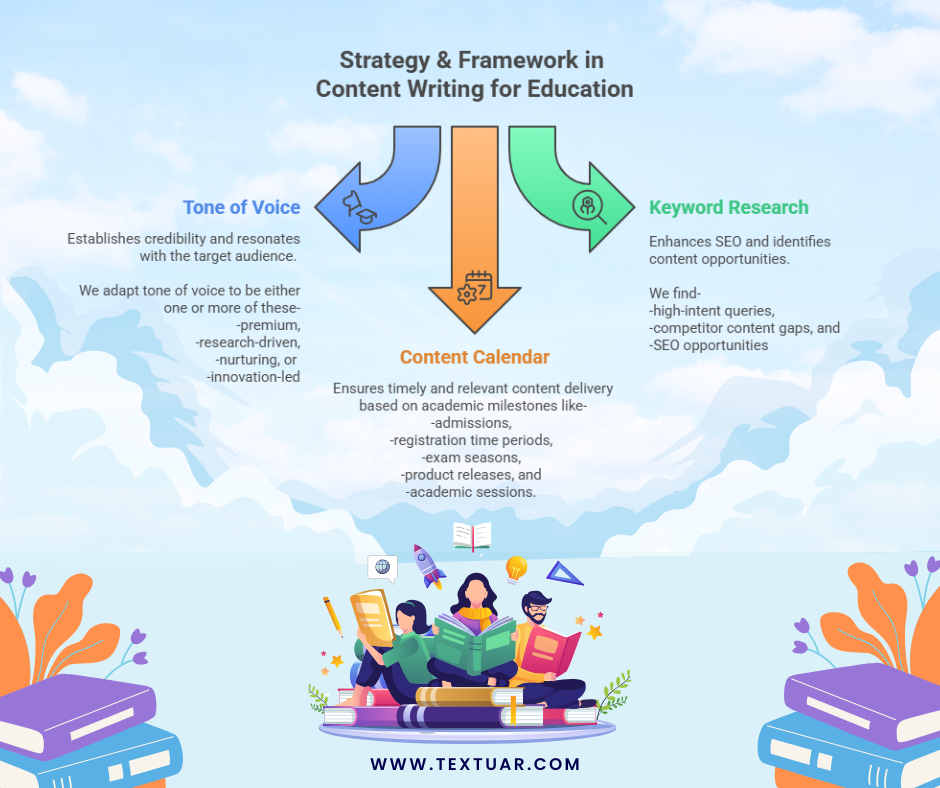
1. Establishing an Academic Tone of Voice
Tone is critical in education. Our education content writing agency develops a unique voice that combines authority with accessibility to engage both learners and decision makers in your content. We understand that this becomes one of the crucial best practices for education content writing.
We adapt tone of voice to be either one or more of these-
-premium,
-research-driven,
-nurturing, or
-innovation-led
We use the right language, structure and depth to suit the appropriate tone of voice.
Such consistency helps you build trust through the entire website, blogs, course pages, brochures & learning material.
2. Keyword & Topic Research for the Education Space
Students and parents are searching with intent. Some examples may include “best online certification in AI” or “top CBSE schools near me.”
We spend time doing keyword research to find high-intent queries, competitor content gaps, and SEO opportunities. They will help immensely in website content writing for educational institutions and fit well with the courses or EdTech product.
With this information in mind, we shortlist topics that will help garner discovery, build topical authority and answer the actual questions your target audience is asking.
3. Content Calendars Aligned to Academic & Admission Cycles
Timing is of massive importance when presenting relevant content to the target audience. Timing varies a lot for various aspects like:
-admissions,
-registration time periods,
-exam seasons,
-product releases, and
-academic sessions.
They generally come with predictable schedules. We map our content calendars to these cycles, so that your communication remains timely and consistent.
This will ensure all of your blogs, landing pages, social posts and email sequences are there supporting your brand during those crucial points when people are ready to take action
The result? More exposure/traffic and higher conversions.
Step 3 – How to Write Content for Education and EdTech?
When you hire an education content writing agency like Textuar, you would create educational content that informs first and persuades second.
We excel at building content that simplifies concepts without losing academic depth.
Here are some examples of content writing for education sector.
1. Simplifying complex topics
Academic themes and subjects are rich in the amount of jargon, theories and processes which can confuse the readers. Our education content writers dissect the ideas into digestible learning targets, subtopics, and modular explanations that can be easily digested by our learners.
And with real-world examples, analogies and scenarios students find it easier to consume content on advanced concepts with ease. This helps with complex topics like AI, finance or quantum physics.
2. Structuring for Learning & Engagement
The structure of learning impacts understanding. We apply tested learning design principles model such as-
-micro-chunking,
-step-by-step progression,
-key takeaways, and
-recap sections.
This is to make sure that long articles, course modules, guides and lesson content remain easy to read.
We also incorporate subheadings, bullet points, callout boxes and simple formatting to facilitate retention and efficient scanning.
3. Through Stories, Caselets and Visual Cues
Learners tend to connect deeply with stories. An example of content writing for education is visible through laws of physics explained in real-life scenarios like speed, momentum, or velocity.
We’ll weave in caselets, career pathways, student success stories or mini-scenarios. They work well to show how an idea works on the ground.
Also, as appropriate, we suggest visually appealing aids such as
-infographics,
-diagrams,
-flowchart and
-screenshots
These help to improve comprehension.
This human storytelling approach creates more engaging and memorable educational content.
Step 4- What Types of Content to Write for Education & EdTech?
School and education brands require multiple types of content to draw learners in, articulate value, aid learning support and solidify brand authority.
Enter Textuar – We cover both your marketing requirements as well as academic pursuits. Each format is designed to fit your brand voice and students’ journey. We help in consistent and successful delivery across channels.
Here are some formats of content we can help with.
| Content Format | What do they cover |
| Website & Landing Pages | Clear program pages, About sections, benefits, pedagogy, outcomes. |
| Blogs & Guides | Research-friendly content to boost traffic and explain concepts. |
| Course Material & eBooks | Lesson scripts, study guides, modules, workbooks, micro-learning. |
| Sales Funnel Content | Emails, onboarding, reminders, webinar scripts, app microcopy. |
1. Website Copy and Landing Page for Schools and EdTech Brands
Your website is often the first interaction students and parents have with your programs. We write clear and captivating program pages, department descriptions, “About” sections and landing pages. The content works to make your strengths memorable and establish trust.
These page descriptions cover a lot of topics that help readers make informed decisions-
-eligibility of course,
-length and duration,
-career outcomes,
-pedagogy,
-certification’s value in the real world, and
-unique benefits of the course
2. Blog, Guides & Thought Leadership Articles
Search-driven educational blog posts and in-depth guides assist audiences in-
-researching courses,
-understanding concepts, and
-comparing options among various courses and institutions.
We write quality educational articles that serve a range of purposes-
-to respond to student questions
-boost your organic traffic, and
-establish you as the expert in your space.
These stories help to guide top-of-funnel discovery and nurture aspirational learners with actionable insights.
3. Course Material, eBooks & Learning Support Content
Educational brands often require structured content that beyond marketing messages. We help by writing -lesson scripts,
-module intros,
-study guides,
-practice oriented content,
-eBooks,
-workbook copy, and
-micro-learning resources.
This means your learners receive a coherent, well-organised level of support. As a result, they get to learn concepts more effectively throughout your curriculum.
4. Performance & Sales Funnel Content
In education and edtech, nurturing doesn’t end on a first touch point. We understand this and create various formats like-
-email journeys,
-onboarding content,
-application instructions,
-reminder messages,
-webinar scripts, and
-app-based microcopy
They help the users through every milestone of their journey. This content drives conversions and increases retention. It boosts learner confidence at each step, from discovery to registration through to ongoing engagement.
Step 5 – What is the QA Process for Education Content Writing?
Educational content requires the highest standards of accuracy and responsibility. At Textuar, we have a strict quality control policy. With us, every content asset is factually correct and academically compliant.
Our review process below is the gold standard in education content writing.
1. Fact-Checking & Curriculum Alignment
Accuracy is a non-negotiable in education content writing. We check every claim, statistic, learning objective and technical concept. We refer only reputable academic sources, institutional documents or your own faculty contributions.
For schools and colleges, we check to make sure the content is board or university compliant. For EdTech platforms, we validate to the course structure, assessment ways and learning paths.
2. Partner with faculty and subject matter experts
We work with professors, teachers, trainers, scholars or product teams inside to ensure content is accurate and in-depth.
They enable us to
-vet the terminology,
-simplify complex concepts, and
-strike the right balance in difficulty level.
This collaboration-based workstyle keeps the final content true to both pedagogical clarity and subject matter expertise.
3. Language, AI & Plagiarism Checks
Every content is edited on multiple layers for-
-typos, grammar, tone, structure and comprehension
-AI detection using premium tools, and
-plagiarism detection with premium tools.
At Textuar, we steer clear of academic ghostwriting. So, we don’t write papers, theses or submissions written meant to replace a learner’s evaluation
We try to help learners, not hurt their learning potential.
| QA Process | What we do |
| Accuracy & Alignment | Fact-checking, curriculum mapping, validation with faculty. |
| SME Collaboration | Work with teachers, trainers, professors for depth and correctness. |
| Language, AI & Plagiarism Checks | Multi-layer editing, AI usage checks, plagiarism review. |
Step 6- How to do SEO for Education Content Writing
In the field of education, students and parents rely on search engines and answer engines like ChatGPT or AI Overviews. These channels help provide concrete information before they decide upon either an educational institute or an EdTech platform.
This makes SEO content a vital element of your visibility strategy. We, at Textuar, craft content to address high-intent queries, enhance organic visibility and establish your brand as a credible academic expert.
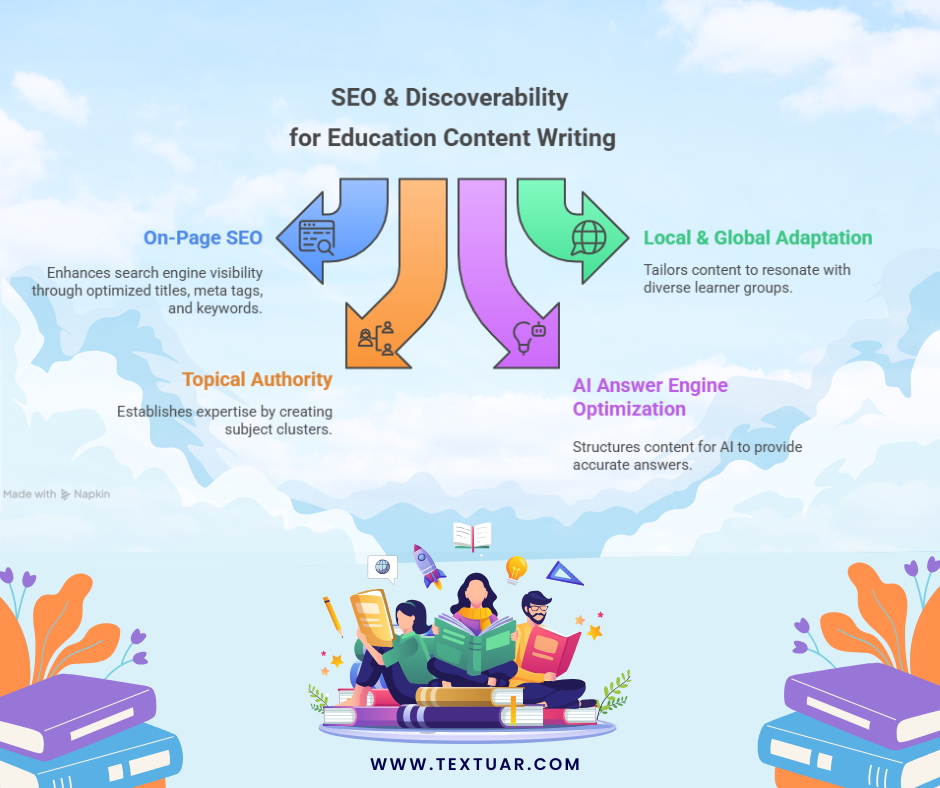
1. On-Page SEO for How Learners Really Search
We build SEO-optimized on-page elements like-
-titles,
-meta descriptions,
-headers,
-keyword-infused quality content,
-internal links, and
-page structures
These elements are made according to actual search behaviour and SEO algorithms.
Parents search information on fees, safety, results and brand credibility. Our SEO strategy fuses these requirements into actionable and keyword-focused content that ranks and engages.
2. Local & Global Reach
The institutional messages Indian student needs are different from those that international learners engage in. We tailor your content with localized examples, currencies, qualifications and culture.
For EdTech brands serving audiences on a global scale, we adjust for terminology, content depth and tone level across dozens of markets with varying learner needs.
3. Building Topical Authority Over Time
A long-haul visibility goal needs more than a one-off content asset. We develop connected blog clusters about subjects on broad topics like
-student life,
-exam prep and tips,
-technology,
-wellbeing aspects of studying, and
-career guidance and counseling.
This builds your domain authority and helps would-be learners discover your business at all stages of their research.
Over time, this authority translates to more organic traffic, better quality leads and increased brand trust.
4. Optimizing for AI Overviews and ChatGPT Answer Engines
Many of today’s learners discover information on AI-powered answer engines, not search engines. At Textuar we make learning content to be concise, true and context-rich. This way, it can be easily cited within the AI Overviews, Claude & ChatGPT.
We write with
-concise headers,
-definition-first language,
-use of multi-modal data like tables, images and infographics,
-natural language questions and explanations, and
-detailed responses.
This gives greater appearance likelihood in Zero-Click searches enhancing your visibility. At the same time, students get accurate educationally aligned information directly from AI platforms.
Step 7 – How to Measure Impact with Education Content Writing
Education brands succeed when their content changes and grows in line with the changes in learner behavior, curriculum updates, and platform updates.
Our education content writing services experts help monitor what works and refine it for continued performance.
This allows your comms to stay fresh, relevant and in line with your institutional or EdTech objectives.
1. Track relevant KPIs
We track KPIs such as
-organic traffic,
-session duration,
-lead quality,
-demo registration or application’ starts,
-click-through rates, and
-engagement with course content.
This intelligence can help us learn more about what kind of content is pulling interest. We also come to know which pages are promoting admissions, and what learning resources lead to a greater understanding.
2. Refining content with data & feedback
Using analytical knowledge, we’ll refresh a listicle topic of a blog post, refine the landing pages in question and enhanced CTAs, and overall expanded content for new academic or industry trends.
We also consider feedback from institutions or product teams and use it to improve terminology, lesson clarity and the learner experience. Such well-thought iteration will help your brand remain responsive and focused on the learner.
Why Education Clients Love Textuar for Content Marketing
Universities and EdTech brands need to hire education content writing companies like Textuar to amplify brand messaging and refine course content. Our education content writers have a potent mix of subject understanding, organized articulating processes and storytelling flair that appeals to education audiences.
Here are some reasons why we are the ideal choice of content experts for your academic and EdTech needs.
1. Institution & EdTech Product Domain Experience
We have partnered with various institutions like-
-schools, colleges and universities,
-coaching institutes,
-digital learning platforms,
-test-prep companies, and
-B2B EdTech providers.
This understanding exposes us to academic depth, program structure, accreditation nuances, student drivers and ‘user’ journey.
As a result, you get content that is both accurate in and learner-friendly.
2. We are a Success Partner and not a Vendor
We partner with your academic, product, admissions or marketing teams to develop content that reflects your brand.
From learning about your teaching philosophy to aligning with your enrollment seasons, we become a part of your ecosystem. This collaboration keeps the communication in your voice and centers around your strategic priorities.
3. Consistent Quality at Scale
Marketing for education brands calls for a consistent and high volume content across program pages, blogs and learn modules to. Textuar’s education content writers will work with structured writing and multi-layer editing process.
Doing so ensures consistency in tone, quality, and accuracy over large volumes. Whether it is 10 pages or 100, you get polished, academic content that aligns with your academic goals.
To Conclude
Education is one of the rare sectors where content informs as well as shapes future of young minds. Such content can influence students selecting a school, parents selecting a university, or professionals pursuing a credential or degree. They all need clear and credible information in an easily understandable format.
It is here that you need the proficient experience of Textuar’s education content writers. With us, your institution or EdTech platform will shine with a voice of authority and credible content.
From discovery and enrolment through into ongoing engagement, our content enables your brand to teach better, communicate better, convert better. So, go ahead and connect with us today for engaging content that serves your business needs.
FAQs – Education Content Writing
Which education brands Textuar has worked with?
Our clients include schools, colleges, universities. We have prestigious names like Vedantu, UpGrad and Akash who use our content for marketing and academic content. We have deep experience with EdTech startups, e-learning businesses and corporate trainers as well.
What is the difference between education content writing and general content writing?
Educational content requires clarity, accuracy, organization and pedagogical value. Unlike general blogs, it has to simplify complicated topics, deliver learning objectives and assist students and parents in making educated decisions.
Can you align the content with our curriculum/academic guidelines?
Yes. We collaborate with your faculty or product teams. This helps us to harmonize content with course structures, syllabus requirements, accreditation mandates and institutional protocols.
How do you measure the ROI for content writing for education?
We measure organic visibility and demo bookings. Others might also look at number of enquiries and traffic quality. Some engagement KPI’s including average time on page and engagement with learning content. These KPIs inform and refine the content strategy for better outcomes.