📌 TL;DR: How We Deliver Success with SaaS SEO CTR Optimization
This case study explains how SaaS SEO CTR optimization helped a mid-stage productivity software company convert visibility into real trial signups. The client was generating impressions on Google but wasn’t receiving clicks or conversions. Textuar reworked titles, metadata, content depth, structured data, technical performance, and intent alignment to match how SaaS buyers compare and evaluate tools.
In 90 days, the company achieved a 200% CTR uplift, jumped 18 SERP positions, captured rich-results, and improved demo and free trial signups. The study highlights why impressions alone don’t matter in SaaS; CTR, buyer intent, and demand framing determine actual conversions.
Visibility is not sufficient in the competitive SaaS market. You can have your pages displayed to thousands of users by search engines but unless they click, assess or convert, your business won’t see any benefit.
This is the point where the optimization of the click through rate (CTR) ensures relevance.
This case study discusses the way Textuar assisted a mid stage productivity SaaS company in Bangalore in improving CTR, boosting search positions, and finally getting more signups for trials. We managed to do this without extensive ad spend or intensive backlinking efforts.
Instead, the returns were based on structured optimization, narrative alignment, and improving technical factors and SERP.
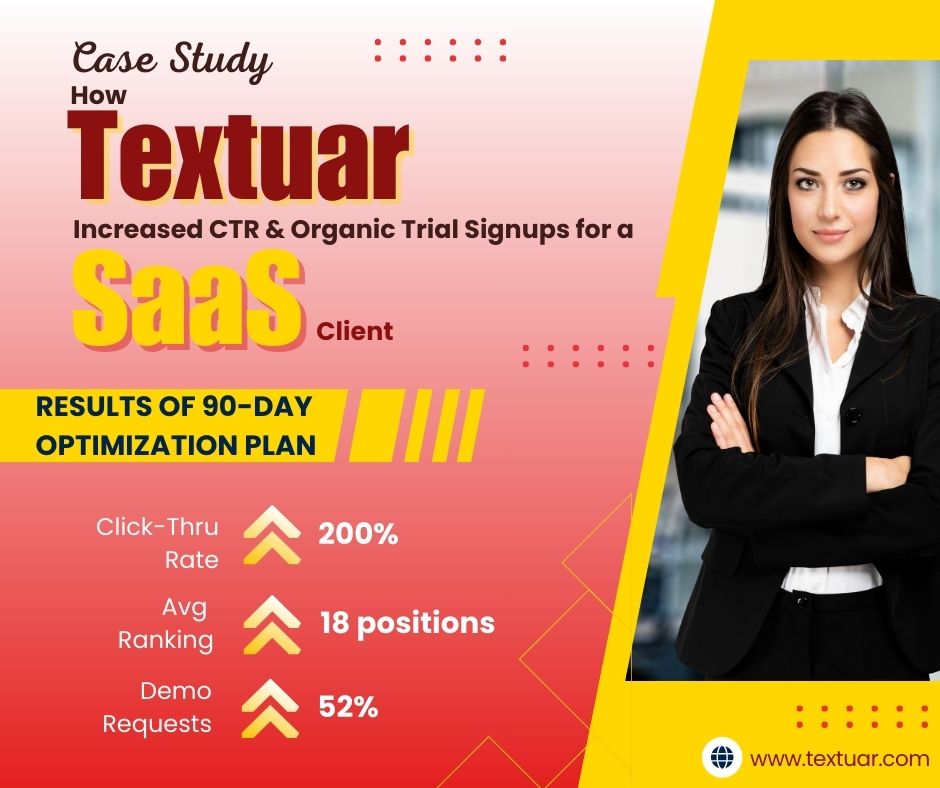
In 90 days, Textuar managed to:
-increase the CTR of the client by 200%,
-enhance average ranking positions by over 18 positions,
-enable rich-result status, and
-enhance the quality of the organic traffic that accessed trial and demo pages.
Let us now see how these results were obtained.
| Metric / KPI | Before Textuar Optimization | After 90 Days with Textuar | Improvement |
| Organic CTR | 0.40% | 1.20% | +200% increase |
| Avg SERP Position (Target Keywords) | ~29–30 | ~11 | +18 positions uplift |
| Top 10 Keyword Share | ~3% | ~47% | +44% points jump |
| Featured Snippets / Rich Results | 0 keywords | 12 keywords in snippets + FAQ/How-to rich results | Enabled rich SERP footprint |
| Organic Clicks | Low (despite impressions) | +2× growth (even with lower impressions) | Improved traffic quality |
| Demo Requests (Organic) | Baseline not converting consistently | +52% increase | Higher SaaS evaluation interest |
| Free Trial Signups (Organic) | Low volume & low intent | +41% increase | Improved bottom-funnel conversions |
Background: The Client and the Starting Point
The client offers a SaaS based workflow productivity subscription model which is aimed at distributed teams. Organic performance was worse than that of the rivals, despite having a great product.
The client has been generating the appropriate impressions through search, yet the traffic growth was not in the same proportion as the impressions.
Baseline: First Metrics Snapshot
Prior to optimization, the measures resembled the following:
- CTR hovered around 0.4%
- Average SERP position of strategic informational keywords was at 29 – 30.
- There were less than 3% of keywords that ranked in the top 10.
- Most pages had short-form blogs (~700 words)
- Thin product pages did not have trial-oriented storytelling.
- Speed of loading on mobile influenced user interaction.
- Rich result eligibility was almost zero.
- Extremely few internal linking pathways.
- Title tags were not persuasive, but description oriented.
The question of the client was as follows:
Why are we not getting the clicks when users are viewing us on Google?
The solution needed more in-depth diagnosis.
Diagnostic Phase: Knowing the CTR Bottleneck
Textuar started with a hybrid SEO/UX/Intent Alignment audit. We checked impression analysis, cluster of keywords, SERP features and funnel behavior.
Three key insights emerged
Insight 1: Intent Was Misfit
The content of the blogs was authored to provide answers to the questions, but the buyer journey in SaaS must involve:
- Evaluation framing
- Comparison thinking
- Outcome messaging
- Business validation
- Product interfaces
- Pricing justification
- Switching arguments
The current content structure garnered impressions on problem keywords, but failed to make a solution-based keywords a necessity in terms of clicks.
Insight 2: Titles Lacked SERP Competitiveness
The SERP pages for SaaS searches typically include:
- Lists
- Comparisons
- Templates
- Checklists
- Market reports
- Pricing guides
- How-to frameworks
Frameworks employed by competitors were:
[X] 2026 Tools (Free and Paid) [Audience].
The client used models like:
Enhance Work efficiency with our Software
The difference was evident – one promised a solution, and the other advertised a product.
Insight 3: Content Depth Limited Perceived Value
Pages that had less than 1,000 words struggled to compete for SaaS-decision keywords. Our checks showed that:
-High-intent SaaS informational keywords often rank in the top-3 ranking pages. They are 1800-2500 words and include business context.
-This was not about the length of words per se, but the cognitive indication about better information present in long form content.
These insights gave the direction for Textuar’s action.
Strategy & Implementation
Textuar created a CTR Optimization Program structured in 6 layers:
- Search Intent Re-Mapping Keyword Re-Mapping
- Meta Description and Title Tag Rewrites
- Deep Content Enhancement
- Inter-relationship Architecture
- Mobile Optimization, Technical Optimization
- Structured Data Markup (Schema)
This strategy did not focus on back links or paid traffic but it saw CTR as a behavioral and perception issue.
| Optimization Tactic | Before Textuar Optimization | After 90 Days with Textuar | Improvement |
| Content Depth | Short blogs (~700 words) | Long-form SaaS content (~2400+ words) | +Business context + Comparisons |
| Meta Titles & Descriptions | Informational & dull (product-advertising style) | Persuasive & outcome-oriented (Comparison + Use Case) | Higher SERP competitiveness |
| Technical Performance (Mobile TTI) | ~3.8 seconds | ~1.4 seconds | Faster UX & lower bounce |
| Internal Linking Paths | Minimal | Structured linking architectures | Improved authority & navigation |
| Rich Results Eligibility | ~0% | Enabled (FAQ + Article + How-to + Breadcrumb) | Higher SERP density & click triggers |
| Commercial Funnel Alignment | Not aligned to SaaS buyer journey | Full-funnel roadmap (Awareness → Trial) | Improved behavioral alignment |
| Search Intent Mapping | Mismatch (problem keywords only) | Multi-bucket mapping (Informational + Comparison + Commercial) | Higher click intent relevance |
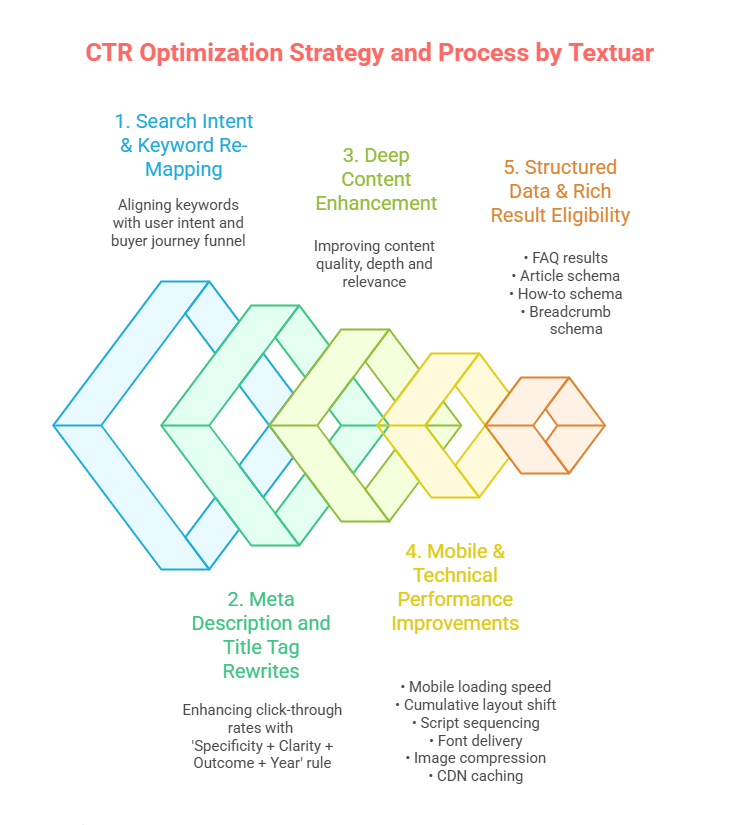
Below is the breakdown.
1. Search Intent and Keyword Re-Mapping
The SaaS company was selling productivity workflow software, though search users were searching:
- Alternatives to popular tools
- Project management templates
- Productivity frameworks
- Comparison reports
- Tutorials
- Buying guides
Textuar developed three keyword buckets:
a) Informational (Top-funnel)
e.g., how to increase the productivity of a team when working remotely.
b) Comparison (Mid-funnel)
e.g., productivity tools comparison 2026.
c) Commercial (Bottom-funnel)
for e.g. productivity SaaS free trial.
The outcome was the creation of a content roadmap that was in line with current SaaS buying stages.
2. Metadata Rewrites: Descriptions and Titles.
Textuar has reformulated over 180 titles and meta descriptions with persuasive CTR models.
The rule used was:
Specificity + Clarity + Outcome + Year
Examples of improved formats:
- 10 Productivity Tools for remote teams (2026 Comparison).
- How SaaS Teams Enhance Workflow Efficiency: Strategies + Templates.
- Productivity Software for Distributed Teams: Free Demo.
The following formats achieved 2 results simultaneously:
✔ Claimed SERP intent positioning.
✔ Stimulated increased desire to click.
The action showed early improvements even before ranking shifts.
3. Deep Content Enhancement and Narrative Upgrades
CTR depends on SERP promise, however, conversions rely on delivery within the page.
Textuar converted thin content into more valuable content assets:
- Blog articles were improved from 700 words to approximately 2400+ words.
- Comparison frameworks introduced.
- Integrated data points and use cases.
- Incorporation of product screenshots.
- Reasons of switching stated.
- Rebates reframed for SaaS evaluation.
This transformed the narrative of the buyer as:
“This is what productivity entails.”
to
“Here is why productivity tools are important, their comparison, and why ours fits in your workflow.”
This repositioning directly boosted demo interest.
4. Mobile & Technical Performance Improvements
The buyers of SaaS often conduct research on tools at fragmented moments of work – in mobile mode, in the process of commute, between meetings.
Textuar optimized:
- Mobile loading speed
- Cumulative layout shift
- Script sequencing
- Font delivery
- Image compression
- CDN caching
Mobile time-to-interactive went down to 1.4s compared to 3.8s. Response time was shortened, and the bounce rates decreased.
5. Structured Data & Rich Result Eligibility
Schema assisted the client in qualifying in:
- FAQ results
- Article schema
- How-to schema
- Breadcrumb schema
This did two things:
- Increased SERP footprint
- More emotional trust by SERP previews.
CTR gains improved with the rolling out of rich results.
Results After 3 Months
These were quantitative and qualitative results.
Quantitative Results
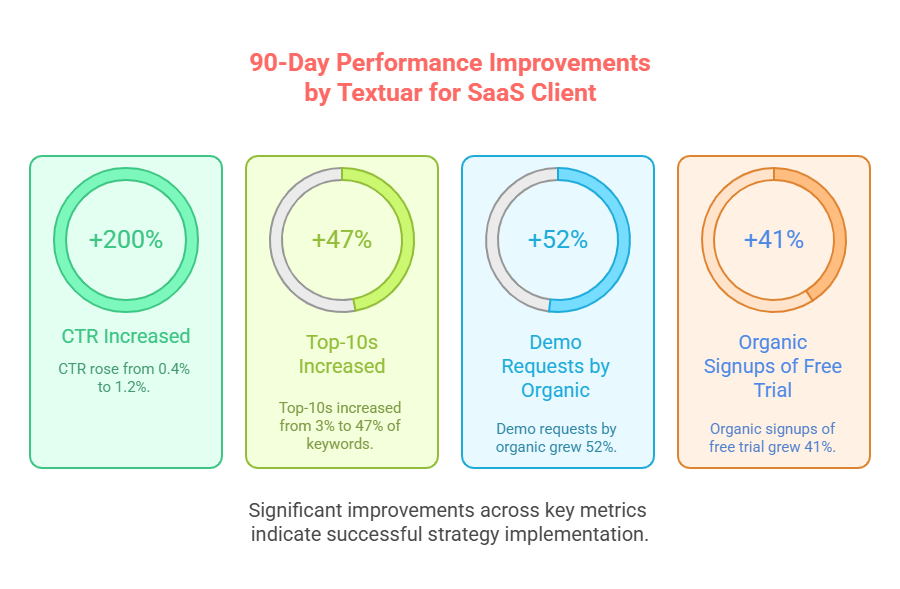
After 90 days:
- CTR increased from 0.4% → 1.2% (200% gain)
- Mean position changed to better levels of around 29.5 to around 11.
- Top-10s increased 3% to 47% of monitored keywords.
- 12 keywords typed in were in a featured snippet position.
- Organic clicks increased twice even with decreased impressions- an indication of quality increase.
- Demo requests by organic grew 52%.
- Organic signups of free trial grew by 41%.
CTR improvements came first. The next thing was ranking improvements. Last came improvement in conversion.
Why This Strategy was Successful with SaaS?
There were four factors which had a massive impact:
1. SaaS Buyers React to Comparative Thinking.
Users want:
- Benchmarks
- Proof
- Alternatives
- Pricing
- Outcomes
Content that answers these questions earns clicks.
2. Titles and Metadata have an impact on Perceived Utility
Where all the search results appear to be similar, the winning click goes to the one that appears:
- newer
- clearer
- more specific
3. Content Depth Signals Authority
In SaaS, it is important to radiate context instead of being verbose.
Context includes:
- use cases
- personas
- workflows
- decision factors
- ROI framing
Lessons for SaaS Companies
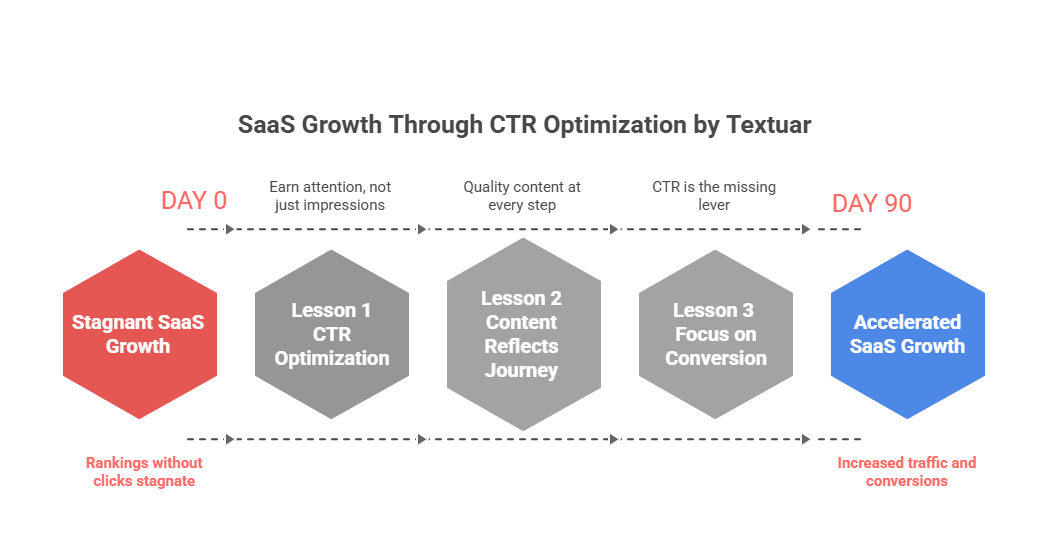
Textuar has distilled three lessons out of the engagement:
Lesson 1: CTR Optimization Goes Beyond SEO to Create Demand Framing.
-SEO gets impressions.
-The CTR optimization earns attention.
Lesson 2: Content should Reflect Buying Journey
SaaS buying involves:
Awarenessà Researchà ComparisonàValidationà Trialà Adoption.
There has to be quality content in every step.
Lesson 3: Rankings Without Clicks Stagnate Growth
There are a lot of SaaS companies that optimize for rankings. This is a big issue as traffic can be a vanity metric.
The missing conversion lever is CTR.
Conclusion
The SaaS client presented a client with a straight forward concern to Textuar:
We are appearing on Google, however, no one is clicking.
Textuar took a bit over 90 days to demonstrate that the combination of CTR optimization, intent-conscious SEO, and structured content optimization can achieve scalable organic results without costly advertising or backlinking.
Due to this, the outcome not only increased CTR, but also better rankings, increased engagement, and more valuable conversions through demos and trial signups.
Connect with Textuar to know how our SEO services can help augment your revenues with new client accounts.
FAQs (Frequently Asked Questions).
-
What is a good click-through rate in SaaS SEO organic search?
Position and industry CTR vary. Higher ranks and placements can have 20-30% CTR and the middle results can achieve 5-15%. SaaS and long sales cycles niches are expected to have low CTR because of consideration behavior, although >1% is quite high improvement from low baselines like 0.4%.
-
Can CTR improve without changes to ranking?
Yes. The use of better title tags, meta descriptions and rich snippet eligibility will increase CTR within the same rankings since these measures render your result more attractive to customers.
-
How long does SaaS SEO CTR optimization take to deliver results?
Within weeks of indexing, technical SEO fixes and a change of titles can provide improvements in CTR. The depth and ranking are gains that can need 3-6 months to show any measurable improvement.
-
Why does mobile performance impact CTR?
Quick-loading mobile pages decrease the bounce rates and enhance the user experience, which in turn increases user engagement and increases in rankings, which increases CTR.
-
Should SaaS businesses focus on title tags or content?
Ideally both. Title tags affect more instant CTR potential whereas deep intent-oriented content justifies improved rankings and a more sustainable increase in clicks.