
Last updated on September 28th, 2026
📌 TL;DR:
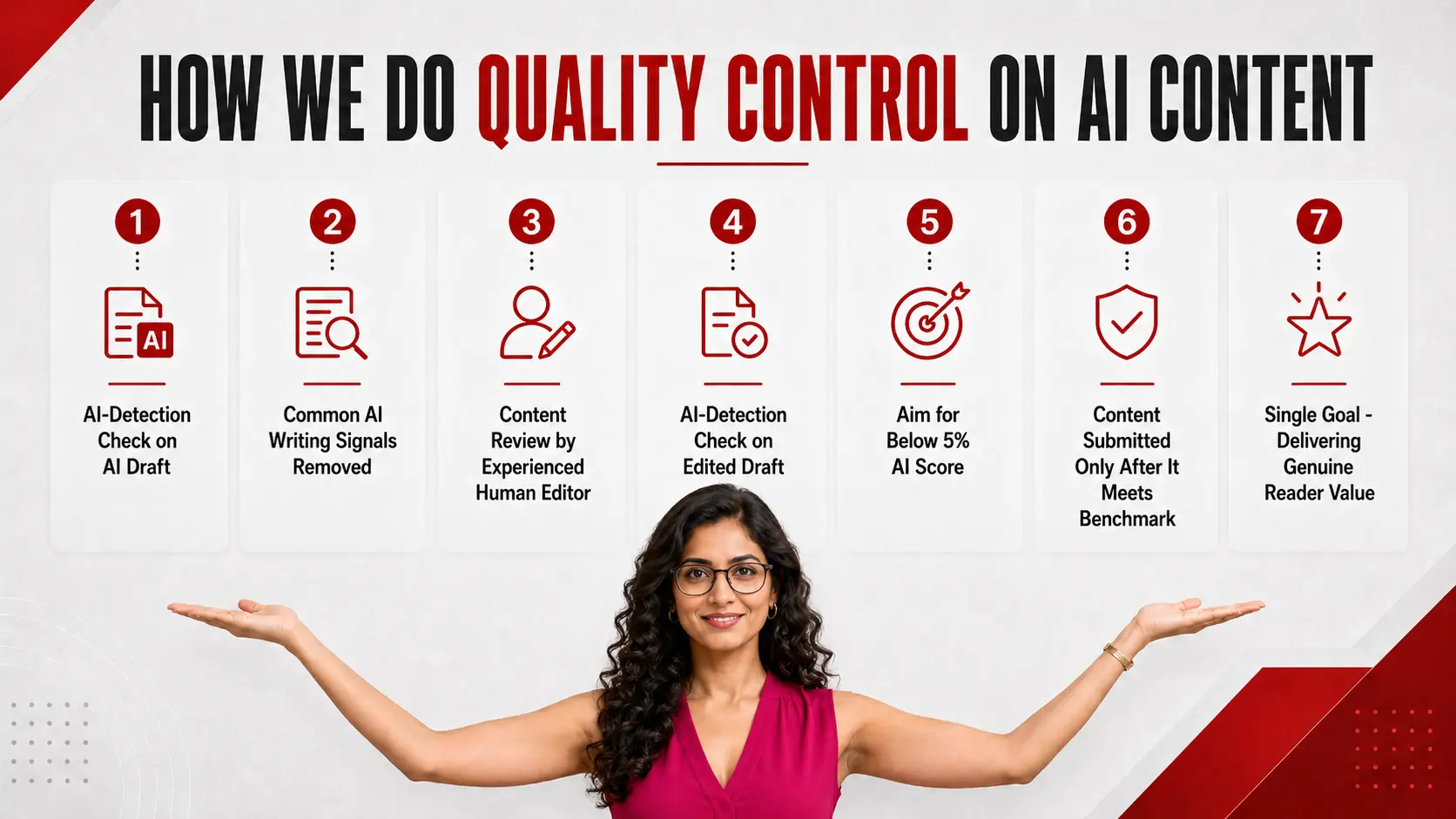
With strict quality control for AI content writing, we ensure polished and valuable content is published for readers. This is the 7-step process we follow.
1. AI-Detection Check on AI Draft
2. Common AI Writing Signals Removed
3. Content Review by Experienced Human Editor
4. AI-Detection Check on Edited Draft
5. Aim for Below 5% AI Score
6. Content Submitted Only After It Meets Benchmark
7. Single Goal – Delivering Genuine Reader Value.
At Textuar, every AI-assisted draft goes through these steps to meet our internal quality benchmarks. This helps preserve content quality, meaning, brand voice, accuracy, and most importantly, genuine reader value.
Human-Led Content Quality Matters More Than Ever
B2B readers do not visit your website to read predictable sentences assembled from information they can find anywhere. They want-
-credible insights,
-practical answers, and
-a clear understanding of how your business can help them.
Google does not automatically penalize content simply because AI was involved in creating it. Its guidance focuses on whether the final content is original, accurate, helpful, and written primarily for people rather than search engines. The same qualities can also make information easier for AI-powered search experiences to understand and potentially cite.
That is why Textuar does not treat an AI-generated draft as finished content. Every draft passes through a structured process of quality control for AI content. The QC process is designed to remove generic language, protect factual meaning, and add genuine value for the intended reader.
Why Is Quality Control Needed for AI Content?
Generative AI can accelerate research, ideation, and first-draft creation. However, publishing its raw output can weaken credibility, reduce differentiation, and introduce factual or contextual errors. Human-led quality control can turn an automated draft into useful branded content.
1. AI Content Can Sound Generic
AI tools often rely on familiar sentence structures, predictable introductions, and overused expressions. As a result, articles produced for different companies may sound almost identical, even when those companies have distinct expertise, audiences, and services.
2. AI Can Misread Facts and Context
A sentence can be grammatically right and still misrepresent the subject or context. AI may overlook the geographical differences, the industry-specific requirements, product limitations, or the commercial intent inside a topic, unless an editor carefully checks the context.
3. Unedited Content Can Hurt Brand Credibility
Experienced business owners and marketers usually spot thin explanations fast. If the content is repetitive, lacks examples or proof, and has no practical takeaways, a brand can start looking less informed. Readers often lose confidence in the services of such a brand.
Our Quality Control Process for AI Content Writing
Our quality control process blends technology with experienced human editing. AI-detection tools help us find patterns that need attention. But editorial judgement is the deciding factor for whether the text is correct, useful, easy to read, and truly consistent with the client’s brand.
1. We Check the Draft Using Two AI-Detection Tools
We start by running the content through two separate AI-detection tools: QuillBot and ZeroGPT. Using both gives us a wider signal about sections that might have machine-like writing patterns or passages that appear overly uniform.
An AI-detection score is never treated as final evidence of whether the content was generated by AI or written by a human. Detection tools can flag formal business writing, technical breakdowns, or repetitive sentence rhythms even when the content was created entirely by a human writer.
Hence, this is the just the preliminary step in quality control for AI content.
We treat the outputs like editorial signals. When a section earns a high score, our editors review it for predictable phrasing, excessive sameness, vague explanations, and other signs that it might sound automated in a subtle way.
2. We Remove Common AI Writing Signals
AI generated content often contains recognizable writing patterns. During editing, we identify the signals and revise them without shifting the core message. As a result, the writing still reads like a real person wrote it rather than appearing formulaic.
a. Predictable openings
Common AI signal:
“In today’s fast-paced digital landscape, businesses must stay ahead of the competition.”
This type of introduction can appear in just about any marketing piece. It sounds solid, but it doesn’t actually tell the reader anything concrete about what the article is going to cover.
Our correction:
We start from the reader’s real, day to day concern. It may be a relevant observation or a direct answer. For example: “Your website content may attract steady traffic but still fail to produce qualified B2B enquiries.”
b. The sentence rhythm gets repetitive
Common AI signal:
“Content improves visibility. Content builds trust. Content generates leads.”
These sentences are correct, technically. But the cadence feels too even, too rehearsed. And the ideas can end up underdeveloped, like they’re being merely listed instead of explained.
Our correction:
We mix up sentence length and connect related ideas like a normal conversation, as a part of our quality control for AI content. In the above case, the corrected text would be: “Strong content improves your visibility, but its value does not end there. It also helps prospects understand your expertise before they contact your sales team.”
c. Transitional words get overused
Common AI signal:
“Moreover,” “Furthermore,” “Additionally,” and “In conclusion” show up over and over again.
None of these words are wrong on their own. Still, repeated use makes the article feel like it’s checking boxes rather than flowing naturally, and paragraphs can feel a little disconnected.
Our correction:
We switch to transitions that match what’s actually happening in the text. Depending on the context, we might choose lines like “The challenge is,” “This matters because,” or “A better approach is.”
d. Vague Claims Without Support
Common AI signal:
“High quality content can significantly enhance business growth and improve customer engagement.”
The statement sounds positive, but it dIt feels good, but it kind of skips the part where you actually say how that content produces those results, or what the reader should do different after reading it.
Our correction:
We add some more details: “A well-structured service page answers buyers’ questions, tackles common objections, and nudges qualified prospects to book a consultation.”
e. Formulaic Conclusions
Common AI signal:
“By following these tips, businesses can unlock the power of content and achieve long-term success.”
That ending repeats a broad promise without giving the reader a clear next step or a useful takeaway. This common issue is handled in our process for quality control for AI content.
Our correction:
We summarise the practical choice the reader should make next: “Before publishing an AI-assisted article, check whether it contains original expertise, verified facts, and a clear reason for the reader to trust your company.”
3. An Experienced Human Editor Reviews the Content
AI detection is only a small piece of our process in quality control for AI content. The most important stage remains a rigorous editorial review done by a human content specialist.
Our editors look at whether the draft matches the search intent, and whether it really covers what the audience needs. A blog written for a procurement manager, for instance, should not sound like an easy introduction for a general consumer.
We also review:
- Factual accuracy and internal consistency
- Relevance to the assigned topic
- Brand voice and tone
- Sentence flow and readability
- Grammar, spelling, and punctuation
- Repetition and unnecessary filler
- Keyword placement
- Heading structure
- Calls to action
- Examples, evidence, and practical value
If superficial rephrasing of a single section does not resolve the AI problem, then the editor may rewrite the entire section. The goal is not simply to make the wording sound more human. Its purpose is to render the content clearer, more authoritative, and genuinely useful.
4. We Recheck the Edited Draft for AI
After human editing, the edited content is sent back to QuillBot and ZeroGPT for further review.
This second scan helps identify content text that may still contain repetitive or predictable patterns. If either tool highlights a passage, we go back to that portion to evaluate why it may have been flagged.
One approach to overcome AI detection may be to vary sentence structure. In other instances, the paragraph may need a stronger example or a more natural transition.
We review carefully instead of mechanically replacing words. Random synonym substitutions may lower the AI score, but make an otherwise clear sentence awkward or inaccurate. This is something the editors should avoid at any cost.
5. We Aim for AI Detection Score Below 5%
Or internal benchmark is to keep the AI detection scores below 5% where possible.
This threshold gives our editorial team a consistent internal benchmark across projects before they are submitted or published. The percentage, however, is not a stand-alone measure of content quality.
A low score does not necessarily indicate that an article is useful, accurate or persuasive. Likewise, a good technical paragraph can occasionally have a higher score due to the use of standard vocabulary or formal sentences.
The score is therefore used in conjunction with human evaluation for this reason. The content should satisfy both, the tool-based benchmark and our editorial quality standards.
6. Content Is Not Submitted Until It Meets Our Benchmark
Content is not sent to the client immediately after the first edit. If the draft doesn’t meet our agreed standard, it goes back to the editorial stage again.
The editor revises the highlighted text to Improve clarity and ensures it doesn’t include unnecessary repetition, general statements or artificial phrasing. The revised draft is re-evaluated.
This extra step will require more editorial effort, but will help prevent rushed content from reaching the client. We are not just looking for a certain wordcount here. Rather, the goal is publication-ready content.
7. Our Single Goal is to Deliver Genuine Reader Value
Every editorial decision eventually circles back to one question-
Will this information genuinely help the reader.
A business article should do more than satisfy an algorithm, or slot in a target keyword. It should answer a real question, simplify a complicated choice, or offer a useful insight the reader can actually apply.
Google also recommends creating helpful, reliable, people-first content, not material made mainly to influence rankings. And its guidance for generative AI features points website owners toward the same baseline SEO and content quality practices you’d use for regular search.
For AI visibility, the factors keep evolving, but some commonly established methods include:
-pages to be semantically aligned
-content is well arranged and packed with extractable definitions
-grounded facts, comparisons, and step-by-step procedures
-use of structured h1-H5 headings
-use of FAQs
-use of tables, images, diagrams, and charts
These factors can be more helpful for generative AI systems. Still, citation outcomes can vary a lot across platforms and search queries.
This is why we go with usefulness over shortcuts. When readers get a complete, accurate, and neatly organized answer, the same piece is often in a better place to show up across search and also in AI-driven discovery pathways.
Why Choose Textuar for Editorial Checks on AI Content?
Quality control for AI content requires more than proofreading. It needs content strategy, real subject understanding, and careful editorial judgement, not just polishing. Textuar blends these skills so your output can serve both human readers and digital discovery.
Here is why our team remains a preferred choice in quality control for AI content-
1. Human-Led Editorial Know-How
Every draft is handled by an experienced content professional. We assess intent, reasoning flow, accuracy, tone and usefulness instead of leaning only on automated scores or thin paraphrase tools.
2. A Staged, Multi-Pass Workflow
Our workflow covers dual-tool scanning, manual editing, contextual verification, and a final recheck. This structured QC process helps keep quality consistent across blog posts, service pages, and thought leadership.
3. Content Shaped to Match Your Brand
We fine-tune the draft around your audience, positioning, and preferred communication style. The finished writing feels connected to your company rather than a generic article that could belong to any business.
Conclusion
AI can help speed up content production. But quick output alone doesn’t create authority or attract qualified leads. Every AI-generated draft needs solid editorial review before it goes live.
At Textuar, we mix AI-detection tools with human expertise, contextual accuracy, and editing that stays focused on the reader. Our aim is not only to lower an AI score. It’s to produce content that feels credible, useful, and aligns with the brand. People will trust such content, Google can readily understand it, and AI-driven platforms can cite it.
FAQs
1. Does Google penalize all AI-generated content?
No. Google looks at quality and intent, rather than simply how the content was produced. Unhelpful, wrong, or mass produced content that’s built mainly to play with rankings may do more harm than good to site ranking and reputation.
2. Are AI-content detectors completely accurate?
These tools may sometimes flag false positives and return uneven scores. Textuar treats them as extra editorial signals, not as final proof that a specific content asset was written by AI.
3. Why does Textuar use two AI-detection tools in quality control for AI content?
Because different tools evaluate writing patterns differently. Running content through QuillBot and ZeroGPT gives our editors more signals to examine before the final, fully human review is done.
4. Can paraphrasing reduce the quality of AI content?
Yes. Mere mechanical paraphrasing can quietly shift facts, strip away key context, and lead to sentences that sound awkward. Human editors retain the original meaning, then improve clarity, flow, specificity, and how naturally it matches the brand voice.
5. What is Textuar’s main goal when editing AI content?
Our main goal is to give readers accurate, practical, genuinely useful information. Detection scores, target keywords, and formatting stay secondary. What matters more is clarity, credibility, and authentic value for the intended audience.