
Last updated on September 28th, 2026
📌 TL;DR Summary:
SaaS content can drive organic traffic but might fail to align with buyer intent or ICP needs with a strong SaaS content writer.
— Learn why a high traffic volume doesn’t always equate qualified demo requests.
— Recognize the most frequent SaaS content issues.
— Learn how to move content into your ICP and the intent of the buyer with 7 types of SaaS content.
When more organic traffic comes in, it’s good progress. You’re getting relevant keywords ranking on your SaaS website, your blog is getting more visits and your impressions show well in the search reports. However, the needle barely moves for the number of demo requests.
This is more prevalent than some SaaS marketers realize.
The issue is not necessarily traffic. It’s the content behind the traffic. It’s possible to have SaaS content that shows up highly in search results and yet not capture the attention of the target audience. If the writing generates widespread informational queries or offers general guidance, or if it doesn’t link up the user’s issues to your application, your users might walk away without taking any further action.
This means that SaaS content writing should do more than just win clicks. It should be able to make potential buyers understand their problem, evaluate potential solutions, see how your SaaS tech solution can meet their requirements and confidently move them closer to a demo.
Why is Traffic Not the Best Measure of SaaS Content Writing Success?
While organic traffic is a vital SaaS SEO metric, it doesn’t provide the whole picture.
An informational query may rank for one of the most general queries on a SaaS topic, drawing in 10,000 visitors per month. But not all of them may be your target customers. They may be students or research workers, freelancers or people looking for something else. They don’t necessarily want to buy software.
Meanwhile, if you have a very niche article getting 500 clicks, it could attract targeted operations managers who are actively comparing software platforms to eventually subscribe to.
The second article can be of much greater value to the sales pipeline.
That is why, SaaS marketers should look beyond pageviews. Qualified leads, product trials, demo requests, assisted conversions, and number of prospects who engage in content first before entering the sales journey are useful performance indicators.
Traffic tells you how many people found your content. Conversion-focused SaaS writing tells you whether the right people found value in it.
5 Common SaaS Content Writing Mistakes that Can Hinder Demo Conversions
Several writing problems can leave a space between organic visibility and business outcomes. They’re usually small pieces, but can add up to make otherwise successful content not convert.
1. Writing for Search Volume Instead of Buyer Intent
While high volume keywords might be appealing to consider for content planning, this doesn’t necessarily mean they’re commercially relevant.
For example, for a SaaS business, like a HR software provider, you may generate a lot of traffic for a very general topic like “what is employee engagement?” But, if someone is looking for “employee engagement software for distributed teams,” they would tend to be closer to assessing a solution.
A skilled SaaS content writer should get to know the keywords, as well as why people are searching that particular keyword.
2. Publishing Generic Educational Content
Some SaaS articles offer definitions and tips that may be found on any competitor’s website.
The reader is educated on the subject, but not much on your product, your method, or your skills. A SaaS content writer will help bring about these aspects of distinction in content.
Strong SaaS copy should educate without appearing like a sales pitch. At the same time, it should also relate to the challenges currently being discussed in a natural way, and indicate how the company’s platform can address these challenges.
3. Writing for Everyone Rather than Your ICP
Content often becomes too broad, because the company might want to target the biggest pool of audience.
However, SaaS applications typically serve specific users.
A SaaS content writer will use different nuances, voice, vocabulary, and tone for an enterprise cyber security platform and for a small business owner. It is important for writers to know these points before they before they develop a content asset.
-what is the reader’s role,
-what is the industry targeted,
-the size of a company,
-the problems they face,
-their technical knowledge and
-their buying influence
4. The Use of Generic SaaS Language
Terms like “seamless”, “powerful”, “innovative” and “all-in-one” appear across countless SaaS websites.
These words do not often tell you why to use one over another.
Specific language is better. Rather than use the buzzword “improves workflows”, a SaaS content writer may describe workflow changes, who they help, and how the software eliminates friction.
5. Ignoring Questions Your Sales Team Already Hears
Sales teams often hear objections and questions that the content teams could address.
Prospects may ask:
-what integrations are available,
-how easy or difficult it is to migrate,
-deployment timelines,
-how secure the solution is,
-how scalable it is, or
-what makes it better than the competitor’s product.
Providing prospective buyers with answers in the form of helpful content before they contact sales will enable them to have a more productive conversation when they do reach out.
What High Converting SaaS Content Writing Looks Like
High-converting content in SaaS does not push visitors to a demo. Rather, it brings about the development of a product conversation in a logical way.
For this, the SaaS content writer will have to strike a balance between visibility, genuine education, product relevance and buyer confidence. These tips will help.
1. Begin with the Reader’s Actual Business Problem
A strong article starts with the problem the prospect is trying to solve and not what the company is trying to sell.
Take the example of a SaaS platform providing automated invoice processing solution.
A weak introduction could start like:
“Invoice automation software can assist contemporary companies improve their effectiveness.”
While the statement is not wrong, it is generic.
Instead, a stronger option is:
“Frequent data inaccuracies, double entry and approval delays, can become a recurring nightmare in finance teams who process hundreds of invoices by hand.”
The second version addresses a recognizable operating issue. It builds a connection with the reader facing the same exact problem and give them a motive to keep reading.
2. Integrate Education With Product Relevance
Educational content should provide answers to the reader’s questions. A SaaS content writer needs to find moments where the product naturally fits into the conversation.
Take for example, a project management SaaS company writing about delayed client projects. A bad idea would be to suddenly insert sales language like:
“We are the market’s top project management platform.”
The article might give an explanation for:
“To reduce these delays, one option is to centralize responsibility for tasks, deadlines, approvals and client feedback in one robust project management platform. It consolidates these activities into a single workspace, eliminating the need to monitor changes via email and spreadsheets.”
Now the product category appears as a part of the solution and not an interruption.
3. Use Product-Led Examples
Examples clarify SaaS content. And a smart SaaS content writer would pepper the content full of viable examples that the target audience can relate with.
For example, let us consider you have a CRM solution that is explaining lead routing.
A generic description might say that automated routing helps to save time.
A better example would be demonstrating the workflow:
“If a B2B company receives 200 inbound leads per week, it might be possible to automatically route enterprise prospects to the senior account executives, and then to the SMB sales team. The sales manager doesn’t need to review and distribute all of the form submissions.”
The example will help the buyer see how the software will function in an actual business. Moreover, it showcases ‘lived experience’ as a part of Google’s EEAT protocols for SEO benefit.
4. Addressing Buyer Concerns Before Requesting a SaaS Demo
Potential SaaS solution buyers do not evaluate features alone. First and foremost, they assess if the solution is worth their pain point on hand. They may also worry about implementation, integrations, security, team adoption, switching costs, or scalability.
A good SaaS content writer will develop content to address these pain points.
For example, a post about how to transition from spreadsheets to inventory software might go over how companies should prepare data for the migration. Such hands-on advice shows authoritative knowledge and helps alleviate fears of new platform implementation.
5. Develop a Natural Next Step
Each article should answer this question – “What should the reader do next after reading the blog?”
The answer will vary.
– If someone is reading a beginner’s guide, a guide about a related use case might be helpful.
-A potential customer who is researching two options may be positioned for the product page.
-A potential buyer looking into vendors might be ready for a demo.
A conversion path works best when it follows intent rather than interrupting it.
Summary Table “How a SaaS content writer transforms a traffic-focused content into a conversion-focused content?”
| Weak Traffic-focused SaaS content approach | Stronger Conversion-focused content approach | Why it matters |
| Rising the search volume broadly | Targeting ICP relevant search intent | Increasing more commercially relevant traffic |
| Uses general terms instead of specific terms | Uses specific terms for business problems instead of general terms | Increases the value of the content to the buyer |
| Abrupt mention of product | Relevant mention of product, with contextual weaving inside content | Product doesn’t intrude on the article |
| Makes broad product claims | Provides concrete workflows and examples | Assists prospects in understanding the value for them |
| Avoids objections | Responds to questions about implementation | Establishes confidence prior to sales conversation |
| Applies the same demo CTA across all locations | Applies the right CTA for the reader’s intent | Makes for a more natural conversion path |
What Type of SaaS Content Can Improve Chances of Demo Requests?
Blogging for SaaS is helpful, but a SaaS content writer should know of other content assets that help move the needle in product demos. Buyers consume different content as they move from identifying a problem to evaluating vendors.
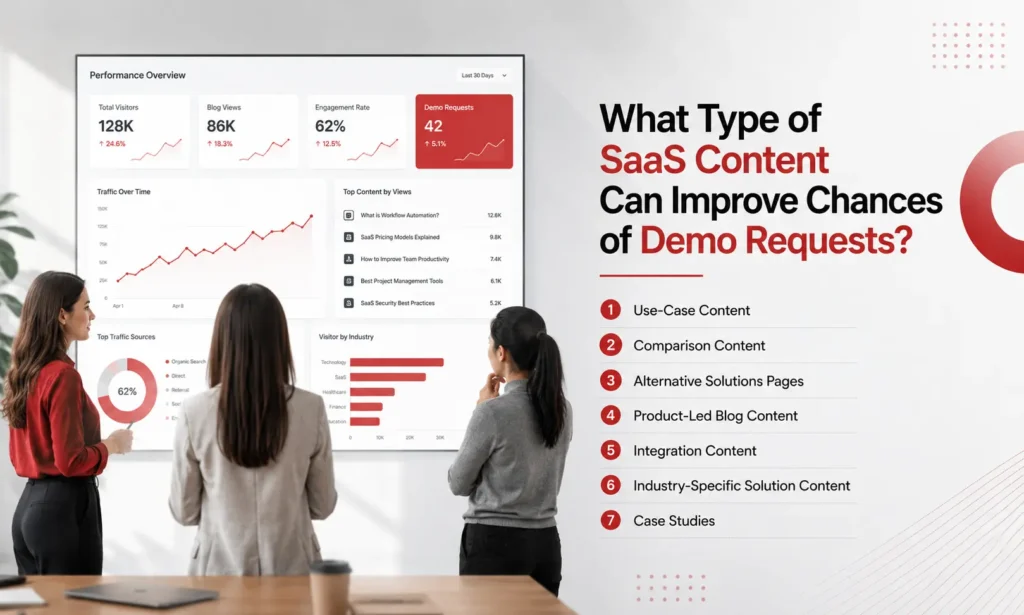
These content formats will provide a balanced content calendar for a SaaS client.
1. Use-Case Content
Use-case pages describe the problem that the product addresses for a given user, team or workflow.
It addresses the ‘How’ instead of ‘who’ or ‘what’.
So, instead of describing a feature like automated reporting, a use-case article could illustrate how a marketing agency can use automated reporting to consolidate campaign data across multiple client accounts.
Such content helps consumers to understand the product value.
2. Comparison Content
Before requesting a demo, prospects will do a comparison of products, approaches, or product type.
It may cover:
– SaaS platform options A vs. B
– Automated workflow software vs. manual processes.
– Cloud vs. On-Premise Software
The content in comparison should be factual and transparent. A company that recognizes the differences, but doesn’t claim to be the best in all categories will be more trusted by buyers.
3. Alternative Pages
Individuals looking for alternatives tend to have a strong business motivation.
An “[Competitor] alternatives” article should describe why companies might want to consider switching, features to weigh and compare, and the features that each platform provides.
These pages are better if they contain real advice about evaluation rather than if they become attacks on the competitor in an aggressive manner.
4. Product-Led Blog Content
A product-led blog optimized for SEO addresses a true information need but illustrates its ability to help with the solution.
In the case of a workforce management firm, a SaaS content writer may cover a topic like, “How to Reduce Scheduling Conflicts Across Multiple Locations.”
The article might contain implementation suggestions while naturally explaining where automation, centralized availability or shift notifications assist.
5. Integration Content
Integration pages are used to draw in traffic that is already on a tech platform and want to know how SaaS solutions can integrate with their existing tech stack.
For instance, a SaaS content writer may write on “How CRM and accounting software work together.” Here the SaaS content writing can address both search intent and an important buying consideration.
6. Industry-Specific Solution Content
A generic platform page can find it difficult to resonate with different industry audiences.
An industry-specific piece of content enables a SaaS business to talk about workflows, industry jargon, challenges, and priorities relevant to a specific industry, such as healthcare, manufacturing, professional services, retail, or any other niche.
The specificity can make the product easier to evaluate for the decision makers.
7. Case Studies
Case studies supply a substantial aspect that many SaaS articles cannot provide: evidence.
They can demonstrate to the customer the original challenge, the solution used, how the product was used, and the results.
Strong case studies do not need Exaggerated claims of success. Specific, believable information will have a greater impact than promotional language.
How a SaaS Content Writing Company Can Bridge the Traffic-to-Demo Gap
Many people assume that a SaaS content writing company will not begin with a monthly blog quota. The SaaS content writer first needs to understand the product, ICP, buyer journey, sales questions, search opportunities, and conversion goals.
The content team then can create topics based on the questions that a prospect asks at each stage in considering.
The SaaS content writer should combine research and use it in conjunction with product knowledge and customer knowledge. They also have to organize their content for traditional search and answer engine discovery by answering queries, while making it useful for human readers.
Most importantly, don’t evaluate performance based on traffic alone.
SaaS content writing should fulfill these pointers:
-attracting the right visitors,
-answering relevant questions,
-establishing product relevance, and
-moving visitors to the next step
Doing do, helps it turn search visibility into qualified SaaS opportunities.
Conclusion – Stop Treating Traffic as the Finish Line
Traffic is important, but it’s not the end-all-be-all of successful SaaS content.
Even if a page appears on the first page of search results, it can offer little value when it draws in the wrong traffic or fails to support the buying journey.
A SaaS content writer like Textuar will be able to connect visibility with intent. It answers the business problems at hand, is product specific, introduces the value of the product naturally, and gives confidence as prospects consider their options.
When these elements work together, they produce content that is defines the path from search to sales conversation.
FAQs
Why does SaaS content get traffic but not conversion?
SaaS content may attract visitors with low buying intent, contain general content, ignore product relevance, or not lead to a suitable next action. Addressing this problem will improve lead generation potential.
Which SaaS content is best for generating demo requests?
Use case pages, comparison content, alternate pages and product-led articles can help. Even case studies, integration content and industry-specific solution pages can help prospects who are evaluating software.
How can SaaS companies increase content conversion rate?
They can match topics with the buyer’s intent, write for their ICP, incorporate relevant product examples, answer buyer questions, enhance inbound flows, and track qualified leads in addition to traffic.