📌 TL;DR Summary
AI search reshapes the SaaS discovery experience, elevating content’s relevance for clear answers to buyer questions and enhanced AI visibility.
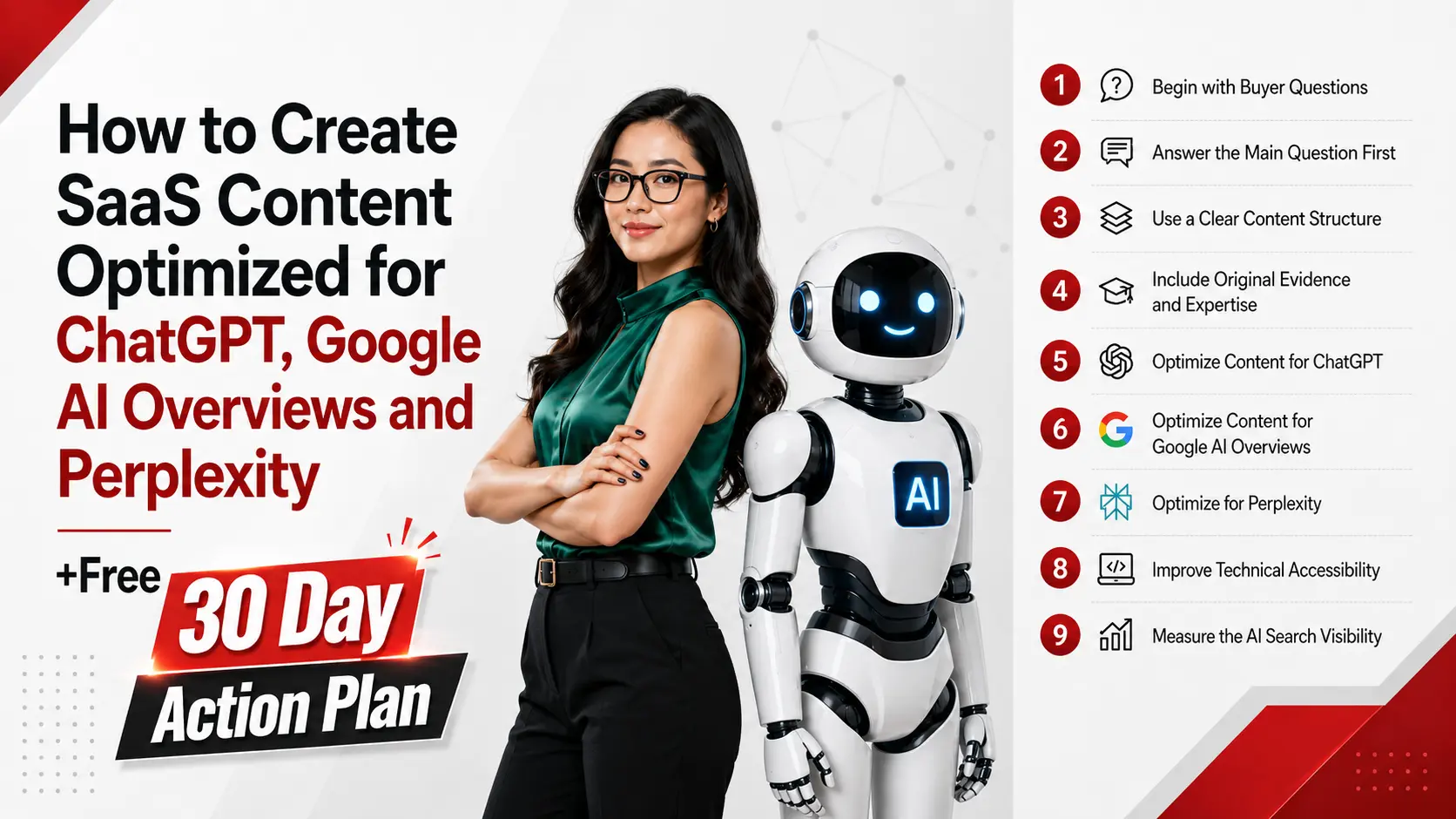
— Discover how to a SaaS content writer creates ChatGPT, Google AI Overviews, and Perplexity-optimized content.
— Learn how buyer inquiries, evidence, and answers enhance AI visibility.
— Adopt a realistic 30-day course of action to boost AI search visibility and conversions.
AI search is changing how people discover software. Instead of jumping through many websites, SaaS buyers can now ask AI tools like ChatGPT, Google AI Overviews or Perplexity. These tools explain a product category, compare tools, suggest a platform or sort out a business issue.
For SaaS companies, this opens up a real content opportunity. You need content that performs in classic search AND is also clear, structured and useful enough to be picked as a source in AI generated answers.
A strong SaaS content writer understands both sides of this process. The job is not to stuff an article with keywords, or to publish content only for machines. It’s to answer actual buyer questions, break down complicated topics into simpler pieces, back up statements with evidence, and make every page easy to scan and understand.
This guide walks you through how to create SaaS content optimized for ChatGPT, Google AI Overviews and Perplexity.
What Is AI Search Optimization?
AI search optimization is the work of creating content that can be found, understood and cited by generative search platforms.
You may also see terms like
- Answer engine optimization, or AEO.
- Generative engine optimization, or GEO.
- AI search optimization.
- SaaS content optimization.
The goal feels the same across each one: help your brand show up when potential customers ask AI tools questions that relate to your product, your niche or your industry.
For example, a traditional search query might be:
“Best project management software for remote teams”
An AI search prompt could be:
“Which project management software is best for a 50 person remote marketing team, and how do the leading tools compare on pricing, integrations and reporting?”
Do you see what is happening here from a SaaS content writer PoV?
They will now need to do more than target the keyword ‘project management software’. They now need to add helpful and well researched sections on features, pricing, use cases, limitations, and competitors.
In my experience, content optimized for AI visibility doesn’t replace SEO. Rather, it strengthens SEO and gets better cited by ChatGPT and Claude.
Here is how you can do it.
1. Begin with Buyer Questions
The first step in SaaS answer engine optimization is to know what customers ask. This helps the SaaS content writer create meaningful content to address and solve the questions.
Here the research needs to evolve as per the buyer journey.
| Awareness questions | Consideration questions | Decision questions | Implementation questions |
| These assist people to comprehend a trouble or category: | These assist customers in considering options: | These are closer to a purchase: | These assist customers to use or adopt a product: |
| · What is customer Success software? | · Which are the best CRM platforms for B2B SaaS businesses? | · Is [Product] is a worthwhile product? | · How to move data to a new CRM? |
| · What is SaaS Billing? | · What are some of the project management tools that can be used for remote teams? | · [Product A] vs [Product B]- which is better for startups? | · How do I enhance the adoption of software? |
| · What are the advantages of workflow automation? | · What are the features to look for in customer support software? | · What are the possible substitutes for [Competitor]? | · Duration to implement ERP software |
| · Why companies utilize the product analytics tools? | · Explain the differences between the top marketing automation software options | · Which platform offers the best Salesforce integration? | · How can an organization educate staff about the new SaaS platform? |
Make a prompt map for each significant question. Include the search intent, funnel stage, target page, product feature, supporting evidence and desired conversion action.
This will prevent your content strategy ending up as a series of standalone SaaS blog posts.
2. Answer the Main Question First
One of the most frequent errors by SaaS content writers is failing to get to the answer.
Many articles start off with an overarching description of the market shifts, business difficulties or the company’s mission. That information is helpful for later use, but readers typically want an answer immediately. They don’t want the answer buried in paragraph 6 of the content, by which time they will be frustrated.
A better structure is:
- Give a direct answer in the first paragraph.
- Define the topic
- Explain the main details
- Support with examples, evidence and limitations.
- Make a suggestion for what should happen next.
For example, you may have a topic to write about customer success software.
Weak introduction
In today’s business landscape, it’s a highly competitive world. Customers’ expectations are evolving and businesses must find more effective methods to establish enduring relationships.
Stronger introduction
Customer success software enables teams to track customer health, automate follow-ups and decrease churn. Most platforms feature a single workspace that integrates account data, product usage, health scores, playbooks and reporting.
The second version is more readable by humans, as well as easier for an AI system to read.
A SaaS content writer should make each section beneficial on its own. If an AI tool only takes one part, it should still be coherent if the reader doesn’t read the rest of the article.
3. Use a Clear Content Structure
Good formatting enhances readability and helps AI understand it better.
Use descriptive headings that represent genuine questions. For example:
- What is SaaS Customer Success Software?
- How does customer success software prevent customer churn?
- What features does a SaaS business need to take into account?
- What is the price of customer success software?
- What are the best alternatives?
Maintain short paragraphs with one idea per paragraph. When giving information about more than one feature, step or criterion, use lists. When readers must compare multiple products use comparison tables.
A good SaaS page should have:
A brief answer or definition.
- Key benefits.
- Main features.
- Use cases.
- Pricing information.
- Implementation requirements.
- Integrations.
- Limitations.
- Competitor comparisons.
- Frequently asked questions.
- An obvious next step.
Do not use images, accordions or interactive features for important information as search bots will not be able to crawl through them reliably. Key facts should be presented as easily accessible text, but can also be included in the explanation to be enhanced by the visuals.
Tables can be particularly useful for comparisons of software. Replace the word “powerful” or “easy to use” with a comparison of specific factors:
| Evaluation factor | Questions to answer |
| Pricing | Is pricing per user, usage-based or custom? |
| Integrations | Will it work with the tools that buyers are already using? |
| Setup time | How much time does it normally take to set up? |
| Reporting | What dashboards and reports are available? |
| Security | Are there any security controls and certifications provided? |
| Designed for customer | Startup, Mid-market or Enterprise? |
Specific information is better than a promotional language.
4. Include Original Evidence and Expertise
Content that is generic is very easy to create and very easy to ignore.
When you recycle the information that can be found on dozens of other sites, there’s not much that AI platforms have to choose from. Useful, specific, hard-to-copy information should be added to strong SaaS content.

Consider including:
- Original survey results
- Product usage data
- Customer success metrics
- Anonymized implementation findings
- Expert interviews
- Quotes from practitioners
- Calculation examples of real workflows
- Detailed case studies
- Product testing results
- Transparent research methodology
For instance, don’t just state:
Productivity can be increased by 40% with automation.
Describe the source of the figure:
- Who did you ask in the study?
- How many companies were there?
- What was the definition of productivity?
- What was the time period of the measurement?
- Was there anything that you found restricted?
Use first hand evidence for product level claims and independent sources of information for market level claims.
You can have a product page explaining what your software is all about. A research report can be used to describe the broader market. Case study can demonstrate the application of the product in real life situation. These assets, when combined, provide better entity coverage and set up topical authority.
Freshness also matters. Include publication dates and regularly review and remove information about outdated products.
5. Optimize Content for ChatGPT
It is common to use ChatGPT as a research assistant. Users use it to explain differences, make shortlists, summarize categories and recommend tools.
To have a greater chance of being included in ChatGPT Search Answers:
Make it as simple as possible to understand your brand.
Clearly explain:
- What your business engages in
- Which category it belongs to
- Who it serves
- The problem(s) it addresses
- How it is different from alternatives
- Integrations and use cases that it is compatible with
Consistently repeat the main description on your site, in your documentation, and on profiles and trusted third party pages. You’ll have more trouble getting your brand identified correctly with systems if you have inconsistent descriptions.
6. Optimize Content for Google AI Overviews
Google AI Overviews are integrated into Google Search, and they are closely linked with traditional organic visibility.
This still carries emphasis on the basics:
- Match the page to the intent of search
- Use a descriptive title
- Include an informative introduction
- Use logical headings to organize the page
- Improve internal linking
- Ensure that the website is mobile-friendly
- Improve page speed
- Use correct structured data, if applicable
- Demonstrate experience and expertise
- Keep information current
Google’s recent guidance focuses on the importance of providing valuable, unique and non-commodity content on generative AI features for developers.
Avoid developing a new copy of each page that includes unnatural phrases like “for AI search” or “optimized for Google AI. Please note that including a file in an AI-specific type does not imply that it is included automatically, as the file might not contain a schema.
Instead, enhance the page for humans first. Explain the topic clearly, respond to questions and back up key ideas with credible sources.
For SaaS businesses, A SaaS content writer can build these pages. They may help in getting better rankings in the AI-generated results, such as:
- “What is” guides
- Software category pages
- Feature explainers
- Pricing comparisons
- Industry use cases
- Product selection checklists
- Integration and migration guides
7. Optimize for Perplexity
Perplexity can be exceptionally helpful for research-related queries. The answers it usually returns contain links to supporting sources, so content needs to be easily verifiable.
The key points of a Perplexity-friendly page should be:
Provide a response to the central question quickly.
- Use precise dates and numbers
- Link to primary research
- Explain how data was collected
- Use expert commentary
- Provide original analysis
- Avoid unsupported superlatives
- Show an obvious update date
- Fix outdated claims as soon as possible.
For instance, if a SaaS company is releasing a report on customer retention, it might feature the customer retention data, sample size, the timeframe of the study, and the definitions used. This is better than some general blog article that states that “retention is important.”
According to the official documentation for Perplexity’s crawler, PerplexityBot is used to show and link websites in Perplexity search results. If it’s a priority for your business, check your robots.txt file to make sure you’re not inadvertently blocking the bot.
Along with technical strengths the SaaS content writer must use original information, credible sources and clear writing. This gives Perplexity enough reason to cite the page.
8. Improve Technical Accessibility
Even well-crafted content can remain invisible if the search systems can’t access it.
You can check the following technical information:
- Indexability should be encouraged for important pages
- Check robotstxt rules
- Review noindex directives
- Correctly use canonical tags
- Provide primary content in HTML
- Use semantic headings
- Improve mobile usability
- Use internal linking to link related pages
- Do not include important information in pictures
- Apply correct structured data
- Verify heavily JavaScript dependent pages
To ensure that your pages can be found in ChatGPT search results, verify if OAI-SearchBot can access your pages. This search crawler differs from other crawling controls, so take a look at your robots.txt policy based on your publishing and training requirements.
Also, monitor your Google Search Console and analytics platform for indexing and performance problems.
9. Measure the AI Search Visibility
Traditional rankings and organic traffic volume are not the only indicators.
A SaaS content writer will monitor these other indicators:
- Mention of brand
- Backlinks from another website that link to your site
- The URLs that are cited
- Position of the citation
- Accuracy of the brand description
- Sentiment towards the brand
- Competitor visibility
- AI referral traffic
- AI referrals for demo requests
- Trials or pipelines that have been impacted by AI discovery
ChatGPT, Google AI Overviews and Perplexity Optimization – 30 Day Action Plan for SaaS Content Writers
You can begin with a simple four week process.
| Week 1: Research | Week 2: Restructure | Week 3: Add authority | Week 4: Test |
| • Collect 20–30 buyer questions. | • Rewrite introductions in the form of direct answers. | • Include original data and expert information. | • Run your target prompts across each platform. |
| • Go and look at competitor pages and cited sources. | • Add question-based headings. | • Add customer examples. | • Record citations and quotations. |
| • Recognize out of date or missing information. | • Enhance tables, lists and FAQs. | • Refer to primary and secondary sources. | • Correct the incorrect or missing data. |
| • Organize topics by stages of the funnel. | • Strengthen internal links. | • Check author information and date. | • Compare AI visibility with leads and conversions. |
Conclusion
It’s not necessary to build a new content marketing system for ChatGPT, Google AI Overviews and Perplexity. It’s only a better version of a system that you should have anyway: clear audience research, helpful answers, solid evidence, good technical SEO and regular updates.
An effective SaaS content writer like Textuar fuses these together and creates content that enables buyers to decide. We help make your pages user-friendly by using simple language for complex ideas, answering queries directly and providing information that isn’t readily available on other platforms. Doing so makes the content more valuable to both humans, search engines and generative engines.