
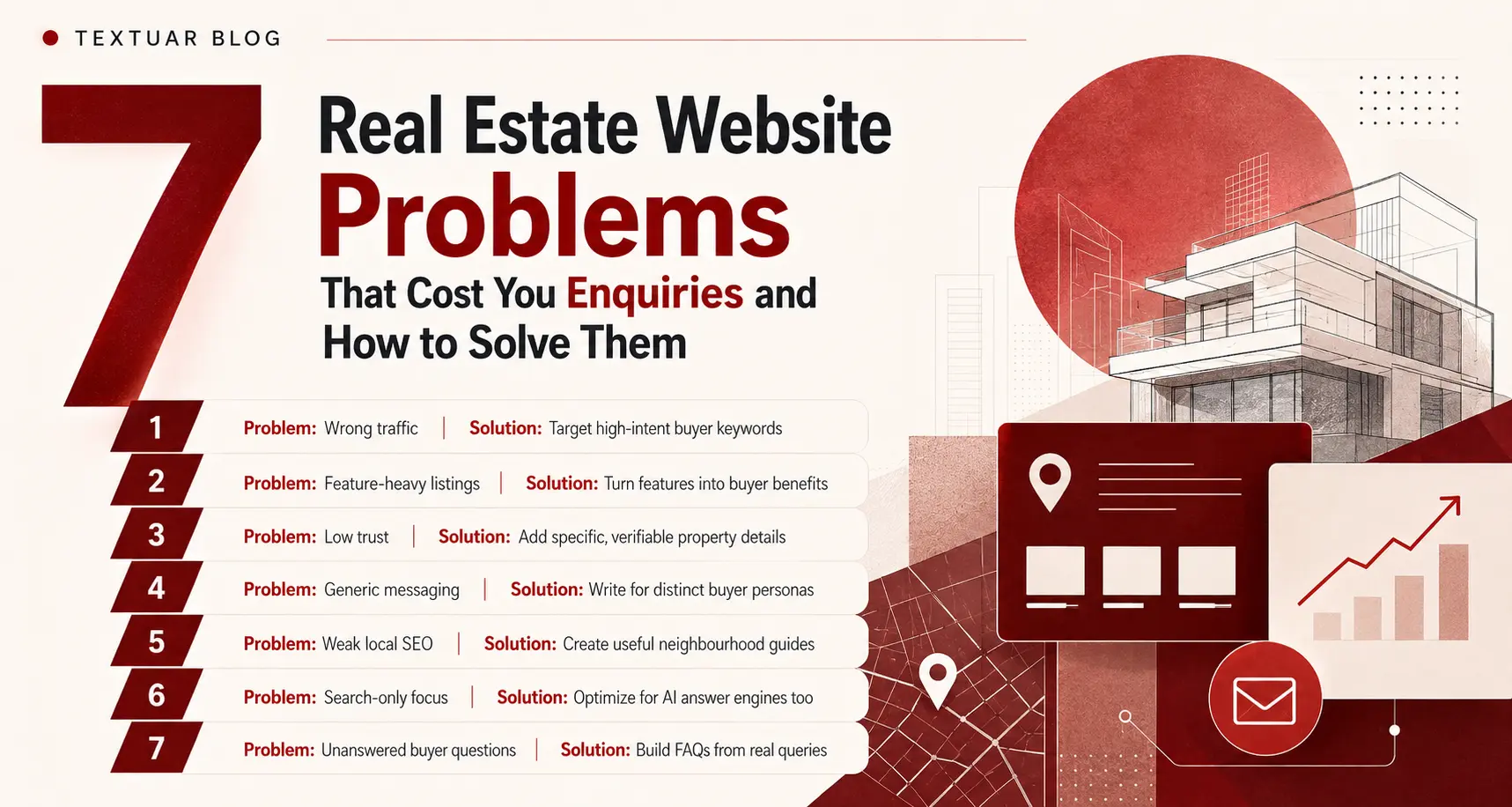
📌 TL;DR Summary:
– Traffic alone does not generate property enquiries if your website is not optimized by a real estate content writer.
– Focus on buyer-specific, benefit-driven, and locally relevant content to support decision journey.
– Strong real estate content should clearly show relevance, credibility, and the next action.
Having visitors to your real estate site is a step in the right direction. Your pages could be ranking for relevant keywords, show in local searches, and bring people interested in properties to your site. However, if those visitors don’t call or complete an enquiry form, then what is the point? If they don’t provide details of properties they are interested in or make an appointment to view a property, then traffic alone is not providing business value.
This is a bigger problem than what builders, real estate brokers or property developers think. A site may drive hundreds or thousands of potential visitors but may not give them a compelling reason to take the next step.
In my experience leading a real estate content writer agency, traffic is not the key metric to look at when analyzing site performance. It’s not necessarily about traffic generation. Often, the bigger opportunity is to make your existing traffic more relevant, useful, trusted and conversion-oriented. That’s where strategic real estate content writing can come in handy.
Let us explore more on this topic.
Why Real Estate Website Traffic Doesn’t Always Convert to Enquiries?
Not every visitor coming to a site via Google is ready to inquire about the property. Someone looking for the “best places to live in Mumbai” is looking for information on good neighborhoods. But anyone who is looking for “2 BHK flats for sale in DN Nagar, Andheri West” has already made a decision on where to buy and, hence, has a much more commercial interest.
But even high-intent visitors may leave your website if your website content does not answer their questions, communicate the value of your property, build trust or simplify the next step.
The good news is that these problems can often be resolved easily.
7 Dangerous Problems in Real Estate Website Content and How to Fix Them
1. You are Attracting Site Traffic Without Targeting the Right Buyer Intent
The problem
Your site may be ranking for keywords that have high search volume but fewer qualified leads. For instance, ‘home interior ideas’ can result in huge traffic but do not target actively potential home buyers.
The solution
Do not create content solely based on search volume. It is a better idea to focus on search intent.
Use keywords that show a need to know something related to a property, location, budget, configuration, and/or consideration. Develop content such as:
– 2 BHK flats for sale in [location]
– Living in luxury apartments in [location]
– New residential developments in the vicinity of [location]
– Flats near [landmark]
– Best areas to buy property in [city]
– Apartment for rent in Galena Park, Illinois.
You can still target more general informational content to draw in people at earlier stages of the research process. The idea is to link those articles to other more marketable pages.
For Example
If you’re a real estate company, do not just publish “Best Areas to Invest in Mumbai.” You can build a comprehensive guide comparing locations and organically link readers to your respective project or property pages.
This way, a prospect beginning his search now has a clear way for exploring available properties.
2. Your Real Estate Content Writer Shows Features Instead of Buyer Benefits
The problem
This is common with a lot of home search aggregator sites and property developer pages. A lot of property pages are specification pages. They talk about carpet area, balconies, parking, amenities, flooring, security and clubhouse facilities.
But they don’t tell you the reasons that they are important to a buyer.
The solution
Turn the positive aspects of your real estate into particular advantages for your customers with real estate content.
Instead of “The project has a state-of-the-art fitness center,” try writing “The on-site fitness center ensures convenient workouts without having to head off to a gym.”
The second version will make the reader think about the feature in its applications.
For Example
This method can be applied in a similar way during a property description:
– Feature: Large balcony
– Benefit: Provides extra outdoor area for families to have their morning coffee, plant their garden, or simply relax after the day’s work.
– Feature: Dedicated parking
– Benefit: Reduces the daily hassle of finding parking, particularly in busy neighborhoods.
The goal is not to exaggerate about the property. It is to explain its practical value to the home buyers.
3. Your Website Doesn’t Build Enough Trust
The problem
Purchasing property requires a substantial financial commitment. Visitors may hesitate when they see vague claims like premium lifestyle, world-class amenities, or best investment opportunity. These words should be backed by enough information that supports these claims.
The solution
Replace vague promotional wording with concrete, substantiated details.
Helpful relevant information may contain:
– Precise site and nearby landmarks
– Features and dimensions of property
– Available amenities
– Developer or agency Information
– Possession information
– Prices or price ranges, as applicable
– Connectivity and nearby infrastructure
– FAQs on most common customer inquiries
Additionally, develop supplementary content that conveys an understanding of the local market.
For Example
If the project is well connected, you should describe which significant roads, transportation, businesses, schools, hospitals or other pertinent destinations are within reach of the property.
Specificity provides readers with something to assess. This enhances the value and shows reliability as a website as opposed to being crammed with promotion.
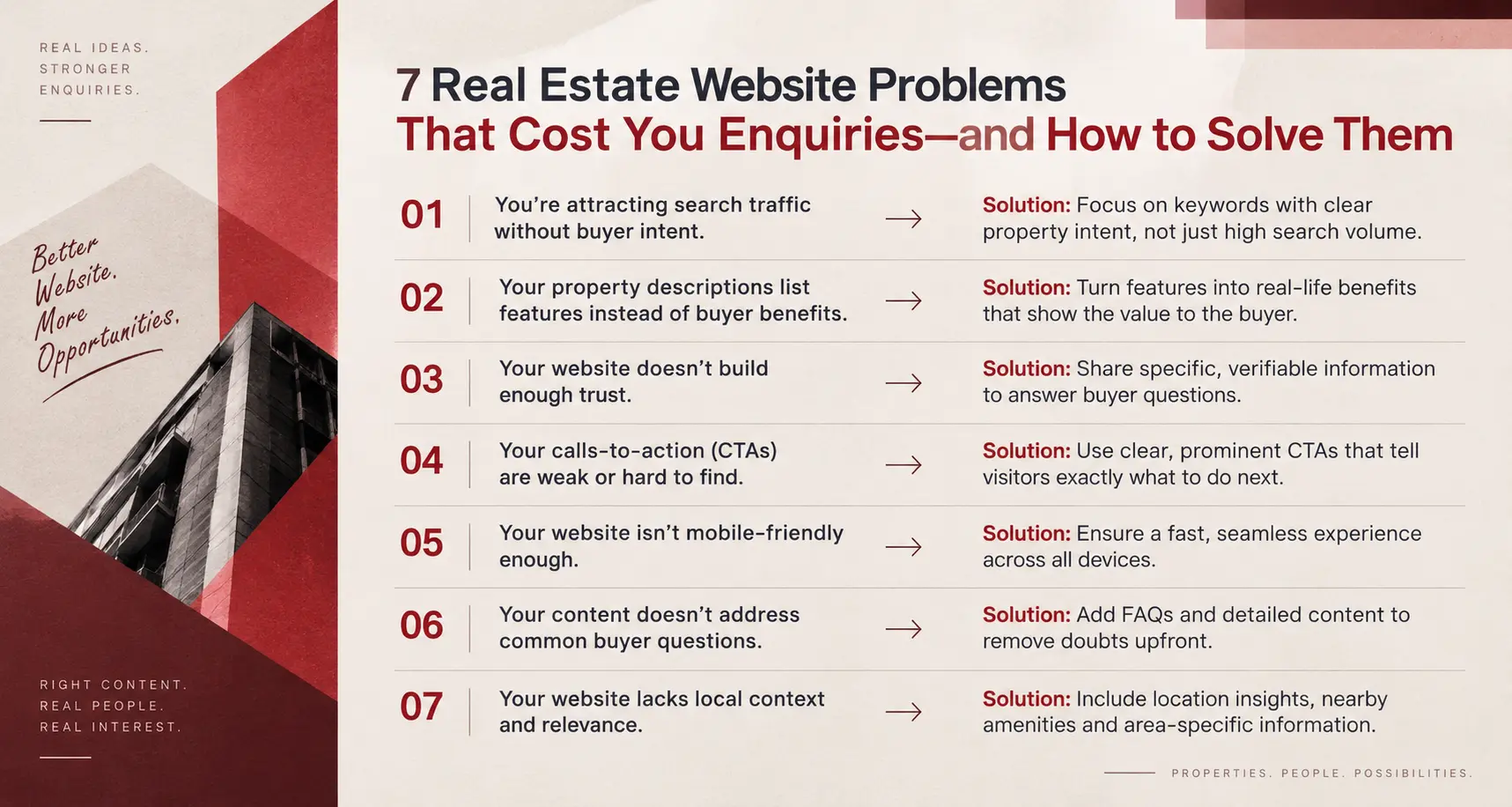
4. Your Real Estate Content Writer Isn’t Writing for a Specific Buyer
The problem
A single generic message reaching out to new buyers, as well as investors, families, luxury buyers, NRIs and commercial property investors is a bad idea. This is because the generic approach may not resonate strongly with any specific group of buyers.
The solution
Create a campaign centered on a particular persona and their motivations.
They might be interested in features like affordability, financing, safety, and living in the neighborhood for a first-time home buyer. An investor might be more interested in the demand for rentals, development, and location and resale opportunities.
These differences should be reflected in your content.
For Example
A page targeting families could be about school proximity, layout, safety, recreation and daily facilities.
On the other hand, a guide for investors might mention the level of rent demand, connectivity, any plans for new infrastructure, and factors that impact the long-term value of properties.
With this approach, your content will sound more relevant than random.
5. Your Local SEO Content is Too Generic
The problem
Location pages tend to use terms like “well-connected area,” “prime location,” and “rapidly developing neighborhood. These are just a few examples of the type of descriptions that may be useful for dozens of places.
The solution
Turn your local information into something that someone interested in moving or investing in your community will find useful.
Using the resources provided, make detailed neighborhood guides on:
– Connectivity
– Schools, colleges and education infrastructure
– Hospitals
– Shopping and entertainment
– Public transportation
– Employment hubs
– Lifestyle considerations
– Property types
– Typical buyer profiles
– Unique opportunities and constraints in the community.
For Example
Don’t simply say, “Powai is well connected.” Put in the effort to explain its relationship to key employment hubs, transport options, social amenities and residential property types.
Next, link the guide to related pages on the website. This sets a natural journey from “Is this a good location?” to “What properties are there available here?” to “How can I enquire?”
6. Optimizing for ChatGPT and Answer Engines
The problem
Real estate SEO is no longer just about Google ranking and site traffic. Today, customers check Google, ask ChatGPT for suggestions, look at Reddit threads or watch YouTube videos. The interesting aspect? Well, they look at these channels before even visiting your website.
Even though you don’t get the click, your brand can make a difference in their decision.
The solution
Develop valuable, structured content that tackles the questions buyers are asking and that is accessible to AI answer engines. Target specific factual information instead of generic promotional information.
So, here the real estate content writer can develop comprehensive location guides, property comparisons, buyer questions and answers, neighborhood information and content addressing common buyer questions.
For Example
If there is an article name, ‘Why Invest in Mumbai Real Estate?’ you can make it more specific as ‘Is Borivali West a Good Place to Buy a 2 BHK in 2026?’. Here, you may cover connectivity, prices, job centers, schools, lifestyle facilities, buyer types, pros, and cons.
This provides real-world insights that can help build your brand’s visibility and authority in both traditional search and AI-powered discovery.
The aim is to make a step beyond ranking → click → enquiry, and influence buyers throughout their buying journey.
7. Your Content Does Not Answer Questions Buyers Ask BEFORE Enquiring
The problem
Due to the immense financial commitment, likely buyers make property purchase choices on the basis of multiple features. Hence, they may have questions about pricing, location, ownership, amenities, financing, connectivity, maintenance, construction, configuration and suitability.
If your website doesn’t answer these questions, they might go elsewhere to get answers.
The solution
Real estate content writers can convert problematic queries to helpful content.
Talk to your sales team and determine the common questions that prospects come across repeatedly. Then use the answers to add to property pages, FAQs, guides and blogs.
Make sure to answer the following questions from prospective clients.
Example
If they routinely ask if a project has a children’s play area, don’t just say that it does. Develop content on the family-friendly features, nearby schools, local convenience and relevant property configurations.
This will lead to dual benefits-
– Without speaking to sales, likely buyers will get important information.
– They will come to know that your business understands their concerns.
How a Real Estate Content Writer Can Help Boost Property Enquiries
A real estate content writer can be beneficial for SEO. They can help connect the content with the buyer queries and motivations.
Rather than writing articles randomly, the author can create content on various aspects of the property buying process.
For Example
- Initial research– ‘Best Residential Areas for Families in [City]’.
- Location Evaluation– Connectivity, amenities and property options.
- Property Assessment– How to Determine Whether to Choose 2 BHK Vs 3 BHK Apartments In [Location]?
- Decision Stage– ‘What to Check before booking an apartment in [Location]?’
Every content asset can flow into other relevant pages on the website and the proper CTA.
A real estate content writer may even enhance real estate descriptions, create local SEO pages, respond to purchaser concerns, revitalize stale website copy, and create content that can be optimized for natural search and lead generation.
What Elements Should High Converting Real Estate Website Have?
Strong real estate website meant for conversions allows visitors to answer three main questions:
1. Is this relevant to me?
The content should clearly mention the buyer’s preferred location, property requirements, budget, lifestyle or investments.
2. Can I trust this?
Detailed property information, helpful neighborhood information and believable claims minimize uncertainty. Less of vague information and more concrete information helps.
3. What should I do next?
Each significant page needs to have a sound progression to the next step based on the visitor’s intent.
So, your content strategy should go beyond blogs for your site. It should be more comprehensive. Consider property pages, location guides and buyer resources. Even comparison articles, FAQs, case studies and market insights would matter.
Why Hire Textuar as Your Real Estate Content Writer?
Selecting a real estate content writer goes beyond just picking someone to attractively describe properties. You must have content that is understanding of how potential buyers research online before making the decision.
Textuar can help create content designed around these requirements. Our team can provide various types of content, including SEO-related website content, real estate property descriptions, blog posts, location-driven content, and other assets that support real estate marketing.
The emphasis needs to be placed on generating content that is relevant to visitors, expresses a clear value of the property, addresses any questions from a buyer, and draws prospects to a suitable next step.
In the case of real estate businesses, this implies that content may be more than just an SEO traffic generator. It can be an integral part of the search from property discovery to enquiry process.
Conclusion: Leads Made Easy with a Real Estate Content Writer
Low enquiries on a real estate website don’t indicate a traffic issue. The problem might lie with the content; it could be attracting the wrong visitors, failing to provide any benefit to the home buyer, contain no information to build trust, cater to anyone and not a specific buyer, or make it difficult for the next step to take place.
The solution is to create genuinely helpful content that centers on buyer intent and property relevance, local context, trust and conversion.
Contact Textuar to get webpage content that serves a distinct function and accelerates your prospects along the decision-making process. Our GEO-optimized content will help your brand be present where your target customers are, thus boosting conversion potential.
FAQs
Why my real estate website gets traffic but no enquiries?
You could be attracting the wrong type of visitors to your site, dominating generic property-related copy, lacking trust signals or not having effective calls to action. By optimizing search intent targeting and optimizing for conversion, you can improve your ability to convert relevant traffic into inquiries.
How can a real estate content writer get more property leads?
By writing property content for buyers, a real estate content writer can generate content that answers prospects’ questions and subtly pushes them to consider properties and enquiries. A real estate content writer can produce content for buyers that reply to prospects’ inquiries and subtly encourage prospects to consider the properties and take necessary next action.
What type of content works for real estate clients?
Property descriptions, location guides, buyer guides, comparison content are great options. A real estate content writer can also help with project pages, market insights, FAQs and case studies to entice buyers throughout the property journey. The best real estate content aligns the topic with the search intent.