📌 TL;DR Summary:
AI is changing travel planning by helping travelers research destinations, compare options and build personalized itineraries. Instead of moving between dozens of websites, travelers can now ask detailed questions and refine their plans conversationally. This means that travel companies must use a travel content writer so that their content is valuable to search engines and to AI-driven discovery tools like ChatGPT, Claude and AI Overviews.
Planning a holiday used to mean opening multiple tabs for destinations, hotels, attractions, maps, reviews, weather and transport.
AI is compressing much of that research into a conversation.
A traveller can now ask, “Where should I go in Europe in October for good weather, fewer crowds and a moderate budget?” Seconds later, the same traveller can request a five-day itinerary, vegetarian restaurants, family-friendly hotels and alternative activities for rainy days.
This shift is relevant enormously for travel brands. A travel content writer is no longer writing only for someone browsing Google results. Content may also influence the information AI platforms use to help travelers shortlist destinations, experiences and businesses.
How Are Travelers Using AI to Plan Trips?
From choosing where to go, to selecting activities, accommodation, restaurants and transport, travelers are using AI at every stage of the planning journey.
Booking.com‘s 2025 global AI research found that 67% of surveyed travelers had already used AI during some part of a trip. Among planning use cases, destination research, cultural activities and restaurant recommendations were particularly common. (Booking.com)
This creates a very different planning journey.
Previously, someone might search:
“Best places to visit in Thailand.”
Now, they can ask:
“Which places in Thailand are best for a couple who likes beaches and local food but wants to avoid crowded nightlife areas?”
AI allows travelers to add context that a conventional keyword often cannot capture.
1. AI Makes Destination Discovery More Personal
Traditional destination content often assumes that everyone visiting the same place wants roughly the same experience.
AI challenges that approach.
Travelers can specify—
- budget
- age group
- interests
- trip duration
- preferred weather
- dietary requirements
- accessibility needs
- desired pace
- travel style
The result is more personalized discovery.
For tour operators, this means generic destination pages such as “10 Things to Do in Dubai” may not be enough. Content writing for travel agency websites needs to cover different traveler intentions.
For example, one destination could support content around family travel, luxury breaks, solo itineraries, weekend trips, food experiences and off-season travel.
The more useful context a travel brand publishes, the more opportunities it creates to appear during different stages of trip research.
2. Travelers Can Build Itineraries in Minutes
One of AI’s clearest advantages is itinerary building.
A traveller can provide the destination, dates, interests and budget and ask for a day-by-day plan.
They can then refine it—
“Make day three less hectic.”
“Add activities for children.”
“Replace the expensive restaurant.”
“Which attractions are close enough to visit together?”
This does not necessarily make travel websites less relevant.
This shift alters the requirements that travelers have for these websites.
A tour operator should provide detailed destination information that helps people evaluate whether an AI-generated itinerary is actually practical.
Good tourism content writers can support these efforts with articles covering neighborhoods, realistic travel times, attraction combinations, opening considerations, seasonal conditions and locally relevant experiences.
AI can build an itinerary quickly. Reliable travel content helps travelers decide whether that itinerary makes sense.
3. AI Is Changing How Travelers Compare Options
Travel planning involves countless comparisons.
Should someone choose Bali or Phuket? A hotel or villa? A guided tour or self-drive itinerary? Five days or seven?
AI makes these comparisons conversational.
Travelers don’t need to do the research themselves on every option, but can get AI to compare them by specific priorities.
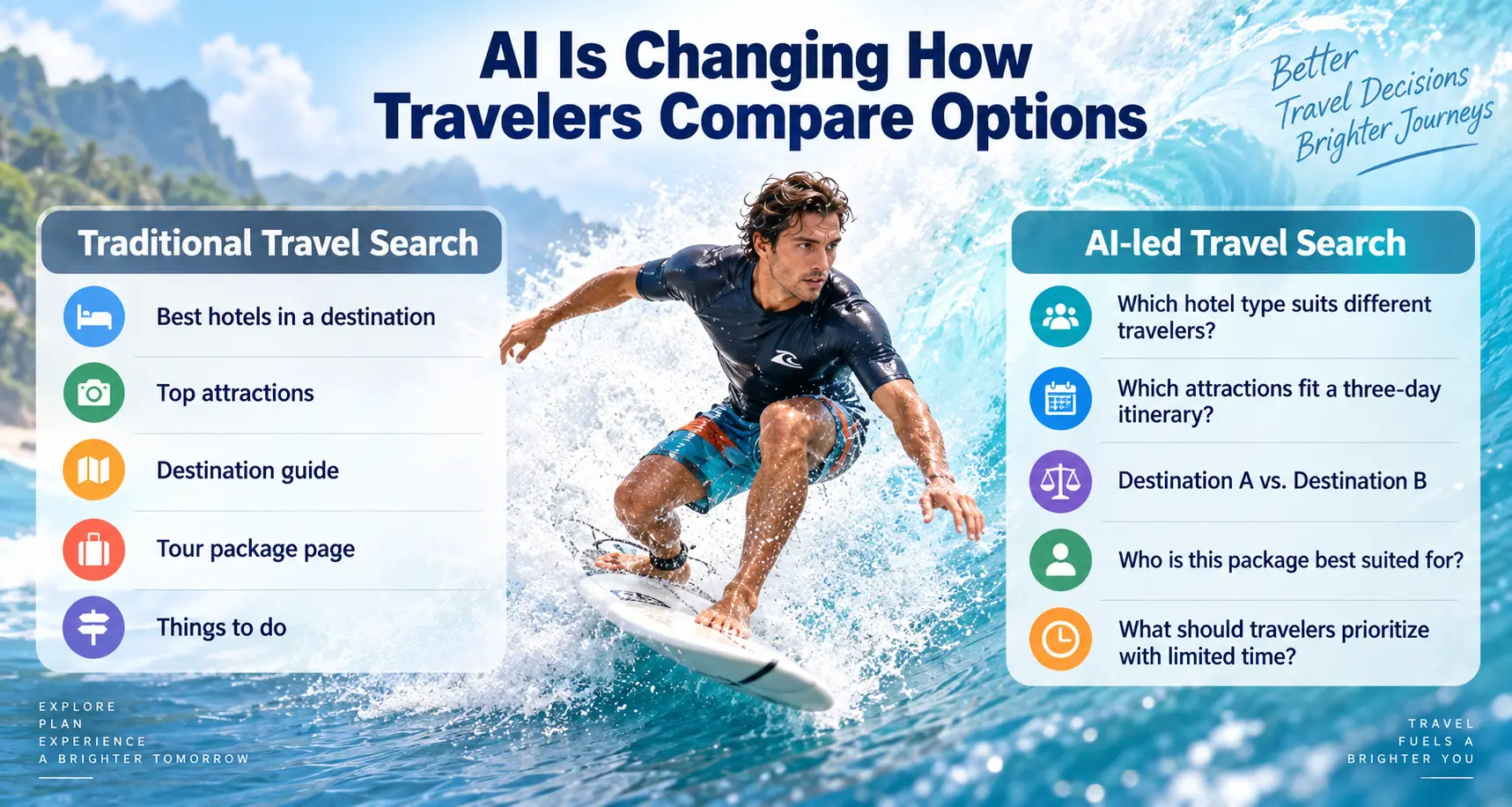
Travel brands should respond by creating genuinely comparative content.
Traditional travel content
AI-era travel content
Best hotels in a destination
Which hotel type suits different travelers?
Top attractions
Which attractions fit a three-day itinerary?
Destination guide
Destination A vs. Destination B
Tour package page
Who is this package best suited for?
Things to do
What should travelers prioritize with limited time?
This is where a skilled travel content writer can add value beyond simply describing beautiful destinations.
The content should help someone make a decision.

4. Travelers Are Using AI for Local Recommendations
AI is also becoming useful once travelers move beyond flights and hotels.
Booking.com‘s global research found that travelers use AI to discover cultural experiences and restaurants, while in-trip uses include activity suggestions, translation and navigating unfamiliar transport systems.
This creates an opportunity for travel companies with strong local knowledge.
A generic AI response may suggest famous attractions. A well-informed local operator can provide the details that make a trip memorable—
- quieter visiting times
- local food worth trying
- neighborhood experiences
- practical transport advice
- seasonal events
- lesser-known attractions
- cultural etiquette
This kind of information differentiates expert travel content from a generic destination summary.
5. AI Makes Budget Planning Easier
Travelers can now ask AI to build trips around financial limits.
For example—
“I have £1,500 for six days in Italy. How should I divide my budget between accommodation, food, transport and attractions?”
AI can help structure the decision, but prices and availability can change quickly.
Travel businesses therefore have an advantage when they publish current information about package inclusions, seasonal pricing considerations, optional extras, transport or likely additional expenses.
A good rule for content writing for travel agency websites is simple—
Give AI the context, but humans should give travelers the current details they need to make the final decision.
Does AI Mean Travelers No Longer Need Travel Brands?
No. AI is becoming an important discovery and planning tool, but travelers still value trusted travel businesses when making bookings and managing real-world trips.
Expedia Group’s 2026 research across the US, UK and India found that 68% of travelers preferred booking with a trusted travel brand rather than through AI platforms. That distinction matters.
AI can suggest.
But travel businesses still provide crucial elements such as verified availability and bookings.
- verified availability
- bookings
- customer service
- local coordination
- accountability
- specialist advice
- assistance when plans change
For marketers, the challenge is therefore not to compete against AI. It is to make their travel brand useful within an AI-assisted customer journey.
What Should Travel Companies Change About Their Content?
Travel brands should move beyond publishing only broad destination articles. Their content strategy should increasingly answer specific traveler questions.
For example—
Instead of “Guide to Switzerland,” consider
- Switzerland for first-time visitors
- Switzerland in seven days
- Best Swiss towns for families
- Switzerland by train vs. rental car
- What does a week in Switzerland cost?
- Best months to visit Switzerland for fewer crowds
These articles provide the specificity that modern search behavior demands.
Experienced tourism content writers can also structure information with concise answers, descriptive headings, comparison tables, FAQs and practical recommendations.
These formats work well for human readers while making important information easier for search and AI systems to interpret.
The Human Element Still Matters
AI can process an enormous amount of travel information, but travel remains emotional.
For example, people do not choose Santorini solely because an algorithm lists its attractions.
They imagine the sunset, the narrow streets, the food, the view from their hotel and how the experience might feel.
That means travel content still needs storytelling. The strongest approach combines the efficiency of AI-friendly information with distinctly human qualities such as experience, local insight, emotion, cultural context and imagination.
A travel content writer should therefore do more than provide travelers facts. Good content helps them picture the trip while giving them enough practical information to plan it confidently.
Conclusion
AI is making travel planning faster, more conversational and increasingly personalized. For travel businesses, the trend does not reduce the importance of content. It raises the standard.
Effective content writing for travel agency websites now needs to answer detailed questions, support comparisons, provide reliable local information and inspire action. Textuar’s tours and travel content writing agency excels in this aspect. We combine useful information with authentic expertise and storytelling. As a result, your travel brand will be better positioned to remain visible as travelers move between AI tools, search engines and trusted booking brands.
FAQs
How is AI content used in travel planning?
AI helps travelers research destinations, create itineraries, compare options, and find places to stay and things to do. Artificial intelligence can also help plan budgets, find restaurants and answer practical questions. Travelers can also refine recommendations according to their interests, budget, dates and preferred travel style.
Will AI replace travel agents and tour operators?
AI isn’t going to wipe out trusted travel businesses. It can lend weightage to research and recommendations while tour companies and travel companies offer bookings and verified information. AI also helps in areas like customer support, local expertise, coordination and assistance when travel plans change.
Why are expert travel content writers needed?
Tours and travel content writers turn destination knowledge into useful, engaging content. This helps with search visibility and traveler decisions. They can combine SEO, AI-friendly answer formats, practical information, brand voice and storytelling. This is done in ways that generic destination descriptions often cannot match.