
📌 TL;DR:
When you hire SaaS content writer, you can check for their research skills, technical accuracy, audience understanding, and feature-to-benefit writing, and not just grammar. With 61% of B2B buyers researching on their own. In such a case, quality SaaS content can help pull the customer closer to your brand. Test SaaS content writing agencies through paid trial assignments before committing long term.
Most SaaS content reads like it was written by someone who never opened the product.
Polished? Yes.
Useful? ……Barely……
Here’s the uncomfortable truth: 61% of B2B buyers now complete their research without ever talking to sales (Gartner, 2024).
That means your content is doing the selling before your team even gets a call.
Hiring the right SaaS content writer is not just about finding someone with good grammar. You need someone who can learn your product, understand your buyers and write with both accuracy and purpose. This will help your content rank not only on Google, but also on ChatGPT, Claude and Gemini.
What Should You Look for Before You Hire SaaS Content Writer?
Strong writing samples are a starting point, not a conclusion. The more important questions are about process. How does the writer learn a new product? How do they verify technical claims? Also ask how do they decide what a specific reader actually needs to know.
As mentioned earlier, buyers prefer a buying experience with no sales involvement. This clearly shows how much work content has to do on its own. A writer who cannot engage deeply with your product will produce content that sounds fine but converts poorly.
Look for research discipline, technical awareness, and an understanding of how buyers evaluate software. The points below outline what this looks like in practice.
Quick Summary – What to Look for Before You Hire SaaS Content Writer?
| Evaluation Criteria | What to Look For | How to Assess the Writer |
| 1. Product Research Skills | Ability to understand software features, workflows, integrations and limitations. | Ask how they use product demos, documentation and expert interviews before writing. |
| 2. Technical Accuracy | Strong grasp of technical concepts and ability to explain them without factual errors. | Review technical writing samples and ask how they verify product claims. |
| 3. Target Audience Understanding | Knowledge of buyer personas, pain points, purchasing concerns and decision-making stages. | Ask them to explain how they would write differently for a CTO and a business manager. |
| 4. Feature-to-Benefit Writing | Ability to connect software capabilities with meaningful customer outcomes. | Give them three product features and ask them to explain their benefits to a specific buyer. |
| 5. Competitor Analysis Skills | Ability to compare competing software products fairly using accurate information. | Review comparison articles for balanced evaluations, factual accuracy and relevant trade-offs. |
| 6. Writing Quality and Clarity | Clear explanations, logical structure, useful insights and appropriate technical depth. | Examine relevant SaaS writing samples and discuss the research behind them. |
1. Assess the Writer’s Product Research Process
Reading your website is not research. A writer who stops there will reproduce your existing messaging rather than contribute anything new.
Ask every candidate how they approach an unfamiliar product. The answer should go beyond a cursory review. Look for references to product documentation, demo walkthroughs, customer reviews and direct conversations with product managers or technical leads. A technical SaaS content writer who asks to speak with someone from your team before drafting is often a better sign than one who claims they can work solely from the brief.
Consider a brief exercise before you hire SaaS content writer. Give the candidate a short product description and ask them to list the questions they would need answered before starting an article. This reveals how they think. Do they ask about edge cases? Integrations? The type of customer who benefits most? These are the questions that lead to useful content.
A good B2B SaaS content writer distinguishes between confirmed information and assumption. This discipline keeps published content accurate and protects your credibility.
2. Check Technical Accuracy, Not Just Readability
Clear writing and accurate writing are not the same thing. A writer can produce very readable content that misrepresents how your software works.
Small errors matter. Confusing authentication with authorisation, or treating data backup and disaster recovery as interchangeable, can mislead the exact buyers you are trying to reach. These are not trivial mistakes in a B2B context.
Ask for a writing sample that covers a technical subject. Then ask the writer to explain what sources they used and how they checked the information. Assess whether they are able to retain critical distinctions while maintaining the accessibility of the explanation. A technical SaaS content writer ought to be apt at simplifying concepts and creating precise copies, if necessary. They should also be willing to flag gaps rather than invent answers.
This diligent writing matters even more for products in regulated or security-focused industries. Determine how the B2B SaaS content writer tends to verify claims about access control, encryption standards, data storage or compliance certification. These answers must come from authoritative documents or internal experts, and not general knowledge.
3. Test Their Understanding of Your Target Audience
The same product often serves very different buyers. A CTO evaluating your platform cares about architecture, scalability and security. A department manager using it daily cares about setup time, usability and whether it fits into existing workflows. Writing that works for one reader often fails to address the other. Check for this point before you hire SaaS content writer.
Ask the writer to describe your primary buyer in detail. Not just their job title, but their concerns, their constraints and the objections they bring into an evaluation. A strong candidate will think about what the reader already knows and where they are in the decision process.
This matters across content types too. An awareness article needs to explain the problem before it introduces any solution. A comparison guide needs to help readers evaluate options against their own needs. A good SaaS content writing company comprehends these differences and writes accordingly.
4. Evaluate How They Turn Features into Business Benefits
A feature tells you what the software does. A benefit tells you why that matters to the person using it. These are distinct concepts, and the gap between them is where a lot of SaaS content fails to deliver.
Here is a basic example. Saying a platform includes automated reporting describes a capability. Explaining that it removes manual data work and helps managers catch performance issues earlier connects that capability to something the buyer actually cares about. The second version is more useful. It is also harder to write, because it requires the writer to understand both the product and the reader.
Ask candidates to take three features from your product documentation and rewrite them for a specific buyer role. Look for explanations that are grounded in the product’s actual functionality that address a tangible outcome. Do not hire SaaS content writers who make unsupported claims or inflate what the feature delivers.
5. Review Competitor Comparisons for Fairness and Depth
Comparison content is harder to write than it looks. Summarising a list of features is straightforward. Understanding how two tools approach the same problem differently, and explaining that to a buyer weighing their options, requires substantive product knowledge.
When reviewing past comparison pieces, check for balance before you hire SaaS content writer. Does the writer present trade-offs honestly? Is the information produced current? Can they distinguish between confirmed facts and opinion?
An honest comparison acknowledges complexity. A self-hosted solution may give a business an added control over its infrastructure. Yet, it also demands more internal resources to manage. Buyers need that nuance. Writers who flatten these trade-offs into simple winner-takes-all conclusions are not serving your readers well.
6. Judge the Quality of Writing Samples
Select samples that are close to what you actually need, whether that is a product-focused blog, a technical explainer, a solution page or a comparison guide. Read each one from the perspective of a potential customer.
After reading, ask yourself whether you understand the product better. Does the writer handle unfamiliar terms clearly? Do they answer the questions a real buyer would bring? Is the structure logical, and are the claims supported?
Ask candidates to walk you through a sample during the interview. Find out what research they did, what sources they used, and how they verified the technical content. The answers reveal more than the article itself.
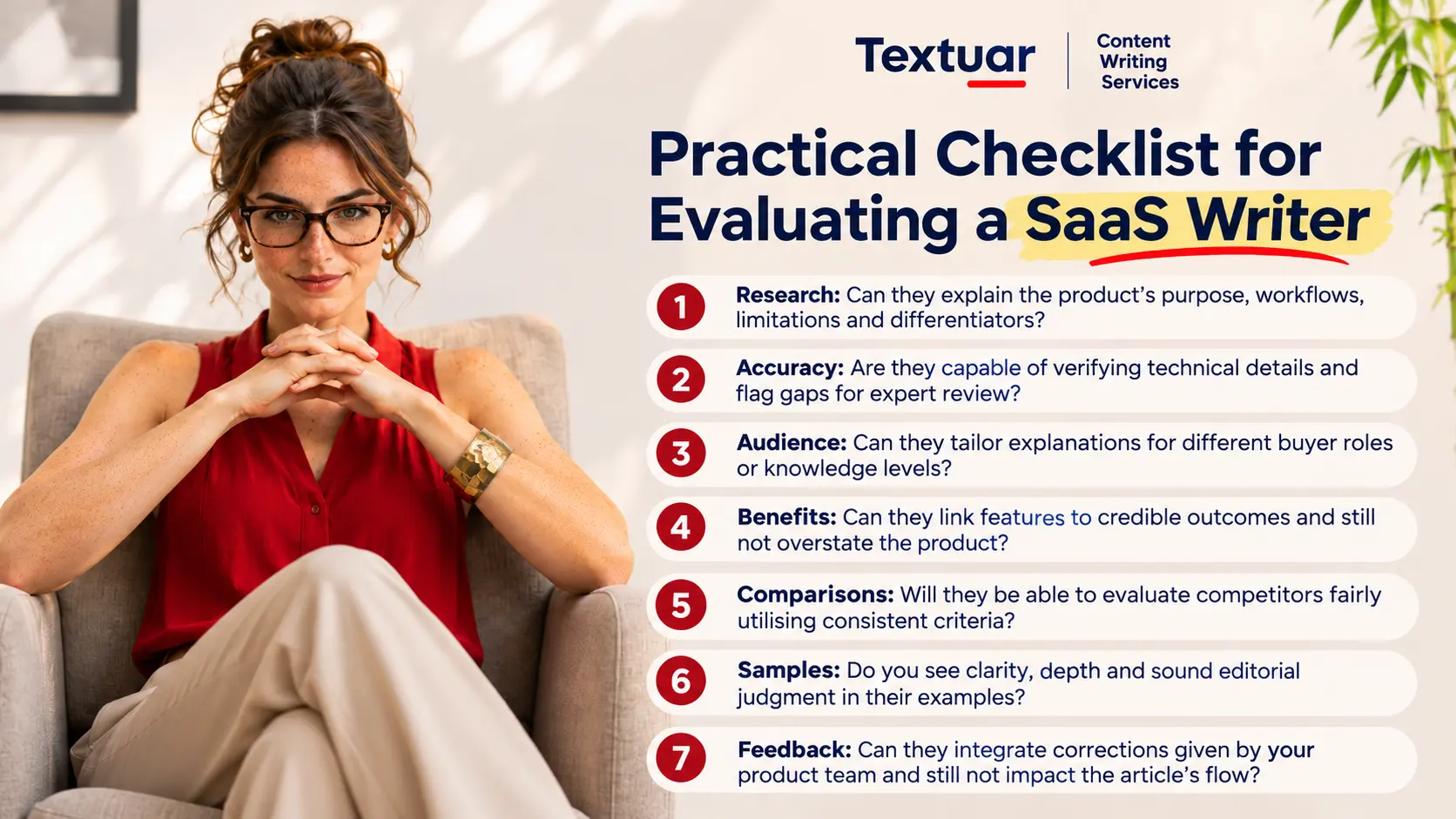
Practical Checklist for Evaluating a SaaS Writer
- Research: Can they explain the product’s purpose, workflows, limitations and differentiators?
- Accuracy: Are they capable of verifying technical details and flag gaps for expert review?
- Audience: Can they tailor explanations for different buyer roles or knowledge levels?
- Benefits: Can they link features to credible outcomes and still not overstate the product?
- Comparisons: Will they be able to evaluate competitors fairly utilising consistent criteria?
- Samples: Do you see clarity, depth and sound editorial judgment in their examples?
- Feedback: Can they integrate corrections given by your product team and still not impact the article’s flow?
Do a paid trial assignment before you commit to anything long-term. A trustworthy SaaS content writing company should explain its research and review process without hesitation. An expert like Textuar will provide case studies to showcase of its past SaaS content performance.
Ending Note
The right B2B SaaS content writer brings more than clean sentences. They bring the discipline to learn your product properly, the judgment to know what your buyers need to hear and the accuracy to say it without overpromising. Evaluate how they research, not just how they write. The writer who asks the right questions before drafting will produce content worth reading, and content that actually advances buyers through the decision process.
Contact Textuar to hire SaaS content writer and boost your lead generation capabilities.
FAQs
1. Before you hire SaaS content writer, how is he different from a general content writer?
A SaaS writer comprehends software workflows and technical terminology. Also, they know how your buyers evaluate products very well. Moreover, a skilled writer will produce accurate, relevant and useful content for your readers that sit at varying stages of decision-making.
2. Should a SaaS writer have a technical background?
Not really. However, check if they possess research skills. Also, they must willing consult your internal expert for specific details. Additionally, their ability to verify technical claims is an added plus point.
3. What should you get before you hire SaaS content writer?
When you hire hire SaaS content writer, the company should provide relevant samples, consistent editorial standards and experts excelling at clear research methods. Also, they have a process for correcting inaccuracies.
4. How can I test before I hire SaaS content writer?
You can assign the writer with a short, paid trial of a product brief. Then, cross-check this brief for research quality, technical accuracy and audience relevance. Lastly, check their receptiveness to feedback.
5. Are SaaS content writing services suitable for complex products?
Yes. Experienced writers adhere to documentation, demos, expert interviews as well as structured review process. With this, they often validate critical details prior to publication.