Last updated on July 16th, 2025
Ask any content writing company in India, and you will find a common denominator that dictates their operational success. This main factor is their ability to create valuable content.
Also, this type of content is the hardest to create.
First, let’s look at what is valuable content. Then, we unveil a checklist of best practices to create such content.
What is Valuable Content?
Any content that provides answers to the problems of the searchers will be considered as valuable content.
The reason behind it is simple. This type of content has the highest stickiness, generating amazing leads and enquiries for the business
Bloggers and article writers will seek to provide information that answers readers’ queries for which they landed on the blog in the first place. If you are able to resolve their problems – two things will happen
1 – They will be happy that they got the answers they are searching for, i.e. it will be engaging content
2 – They will start trusting your brand – a hallmark of successful conversions later on, i.e. it will be trustworthy content.
So experts in content writing services will look at creating valuable content that is both, engaging and trustworthy.
But how to do that?
Let’s take a look!
How to Create Valuable Content?
1 – Radiate authority through in-depth content writing
No, we aren’t saying that you should be preachy or gruff like your school principal. Instead, the content should give an idea to the readers that you are a leading authority in your field.
As article writers, you may not be a subject matter expert or SME in your client’s field. But your research process needs to be so deep that by the time you are finished with the articles, your readers should go, “Wow!“.
They should think, “Ok, this is a brand that knows what it does“.
With such a perception, they will be more prone to doing business with you.
How to show authority in valuable content?
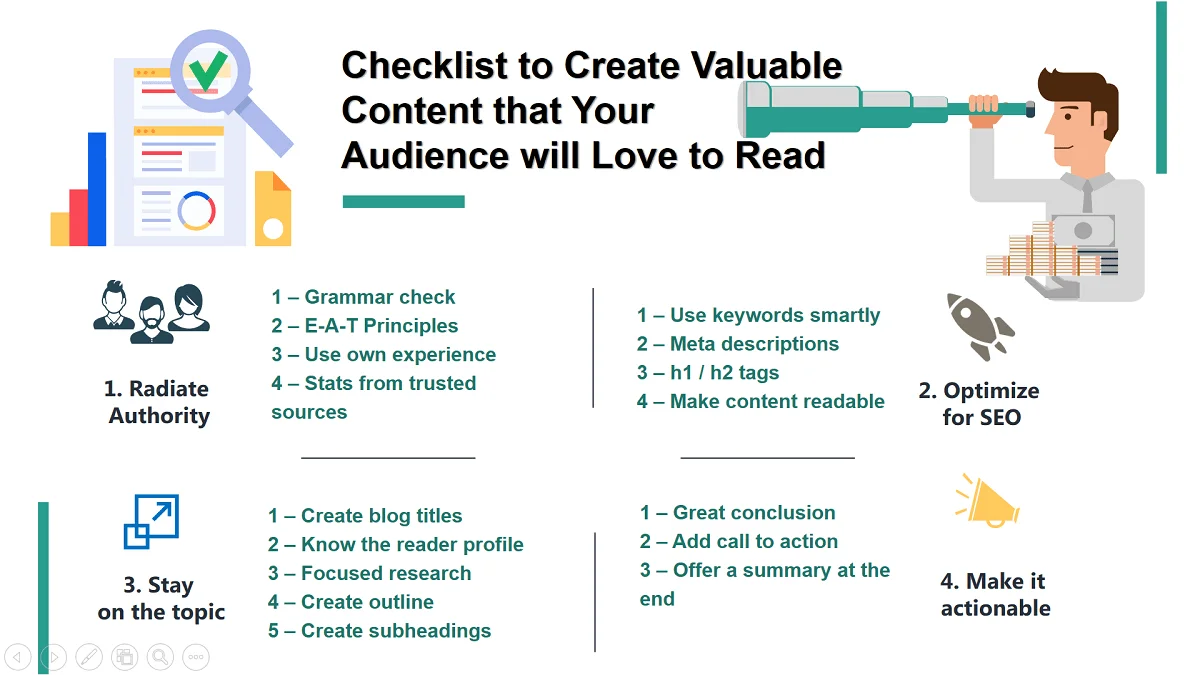
1 – Being strict with grammar issues and spelling checks
2 – Abide by Google’s E-A-T principles of quality content writing
3 – Use your own opinion and experience (no matter how shallow it is) to bring a degree of freshness to the content
4 – Add stats from verified sources like Wikipedia and NY Times
2 – Optimize valuable content for SEO
No matter how amazing your content is, what’s the point if readers aren’t able to find it.
So when they search for information on the search bar, make sure that your content pops up on the results page.
How to optimize content for SEO?
A few ways to make SEO-friendly content include:
1 – Weaving in the keywords organically so that your name pops up when searchers find businesses like yours.
2 – Writing SEO optimized meta description
3 – Use h1 for the heading of the blog or article
4 – Optimize for content readability by breaking into smaller, easily digestible chunks of text.

3 – Stay on the key theme of the blog topic
Experts in content writing services know that every single blog or article has a central idea or theme.
The entire narrative of the content is built upon this central theme.
But sticking to it is easier said than done!
It is easy to digress from the main theme when drafting the content. But as content writers, we need to be mindful of this problem.
Remember that readers are reading your blog to get answers to a particular problem. Make sure that you stick to providing helpful information to help solve the problem rather than branching out to other unrelated topics.
How to stick to the content’s central theme?
1 – Create blog titles and headlines for the blog. This title will reside prominently on your WORD file (like a mission statement) to remind you about what you are going to write about.
2 – Make sure that you know who you are writing for. You need to write for your client’s customers, and not for your client.
3 – Once you are clear about what you need to write on, commence research on this topic only. Don’t spread out to other related/unrelated topics, but maintain content focus.
4 – Based on your research, create an outline of what you need to write about. So you will craft an outline (like a table of content) that has the order of appearance of the blog narrative. You will get an idea about which points to cover and how much of each point to cover.
5 – At this stage of creating outline, create the subheadings to break the entire content into digestible chunks of text.
This is essential. Experts say that the maximum time readers will spend in a blog is 37 seconds. She will spend this time scanning the text. These subheadings in bold font will be the first text she will scan. Once she scans from top to down, she will then decide if reading the blog will be worth her time or not.
4 – Sign off on a positive note
The last few minutes sent by the reader dictates what she will really do after she reaches the end of the blog. Make sure that you open up avenues to keep the reader’s interest alive even at this stage.
How to give readers something to do after reading the blog?
1 – Write a good conclusion to round off the discussion and sum up the key takeaways
2 – Include a call to action to let the reader know what she needs to do next after reading the blog. Most probably, it will invite her to check out other related pages. Alternatively, it can help her find the ‘Contact us’ page to connect with your sales team and take the engagement ahead.
3 – Provide a summary of the discussion towards the end. This is especially useful if the content is long-form. It will help jog the reader’s memory about the key points to focus on.
Key Takeaways
There are nearly 2 billion web pages on the internet. You need to make sure that your blog catches the attention of your target audience. How will you do so?
Well, this post can help in catching readers’ attention. It will keep them hooked and let them gain trust in your brand.
To sum it up, you can do these things to create valuable content
1 – Radiate authority in content
2 – Optimize content for SEO
3 – Stick to a single central theme of the blog
4 – Conclude the content with takeaways for the reader
The outcome? You will successfully create valuable content that your audience will love to read and act upon.
Connect with Textuar for more such insights on writing high quality content for digital marketing