

Last updated on July 16th, 2025
In our school lives, we may have always related an anchor to something that keeps boats from floating away. They add weight and keep the boat steadfast. We see the same analogy applied to anchor text for SEO content writing.
Anchors in your content writing keeps readers from floating away. It keeps them hooked to the content.
Let us learn more about this important aspect of SEO content writing.
What is Anchor Text in SEO Content Writing?
If you have read content online, you must have seen some text that appears in underline. When you place your mouse pointer, the arrow on this label turns to a finger. This indicates a certain action upon clicking on such a label.
The action is that you are re-directed to another URL.
You might ask, “Which URL am I re-directed to.”
Well, it is the URL embedded via HTML behind the anchor text.
It looks something like this.
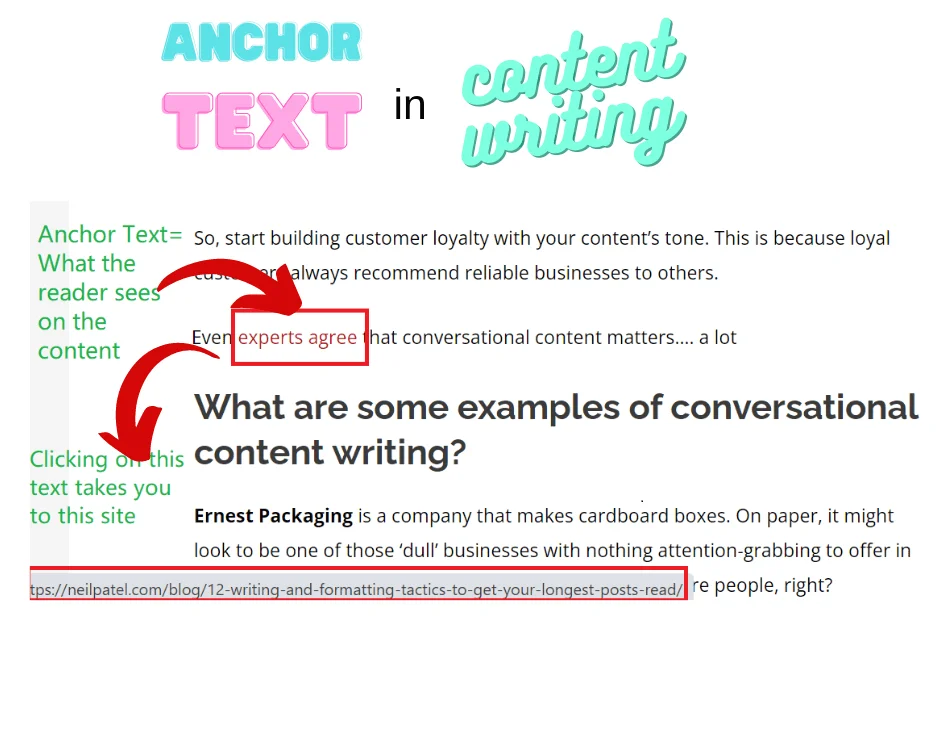
The URL embedded into the anchor text is known as the target link. The HTML code for the above looks something like this:
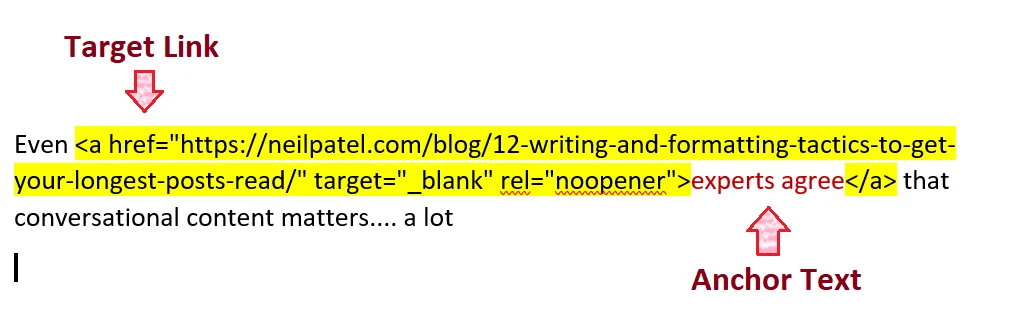
As an SEO content writer, you need to ensure that the anchor text is relevant to the content covered in the target link.
What is an Example of Good (and Bad) Anchor Text?
Here is an example of good and bad anchor text.
Example of Good Anchor Link
Anchor Text = Readability in blog
Target link = https://textuar.com/blog/how-to-use-readability-in-blog-writing-to-boost-seo-ranking/
(when readers see the text “Readability in blog”, they will expect something in the same domain. And the target link will fulfil this expectation)
Example of Bad Anchor Link
Anchor Text = Conversational AI
Target link = https://textuar.com/blog/tips-for-conversational-content-writing/
(when readers sees the text “Conversational AI”, they will expect something in same domain – Artificial Intelligence. But the target link will not fulfil this expectation, as they point to a content writing blog)
What are the Types of Anchor Text?
Anchor texts come in different varieties, as given
- Branded – The anchor text is the company name.
E.g. “According to Textuar, readability is vital for content quality.”
- Exact Match – the text is the exact match keyword
E.g. Buy running shoes
- Partial Match – text is a partial match for a keyword
E.g. Buy white running shoes in New York (targeting “buy running shoes”)”
- Naked URLs – has actual HTML URL
E.g. textuar.com
- Generic – random words that don’t offer any context
E.g. “click here,” “this blog,” or “read more.”
Why is Anchor Text Important in SEO Content Writing?
Smart SEO content writers use anchor text to improve the relevance of the blog or page. When Google bots crawl your site, it focuses on the anchor text.
With meaningful anchor text added at the right place, your content impresses Google.
Such content is likely to rank well on key characteristics like authority and relevancy.
How Does Google Determine Relevance from Anchor Text?
Links are the key indicators that Google bots use to determine high-quality content writing. Since anchor text is a form of a link, it does the same job as links. It helps Google to find out about the three key traits of quality content:
1 – Relevance
Google sees that the correctly placed anchor link is highly relevant to the content of the target link. This helps the bot to figure out that the content must be valuable.
2 – Internal linking
With a few internal links, Google knows that the same site has valuable information on other pages related to the same topic. This improves the quality of the page, which has internal linking.
3 – Page experience
If the target link doesn’t match with the anchor text, then it might lead to a frustrated reading experience. This results in a poor page experience and may lead to a drop in rankings.
So to paraphrase the importance of anchor text –
If the target link content is not relevant to the topic being discussed, you may lose visitors as they will be frustrated with the poor experience provided by anchor links

How to Optimize Anchor Text in SEO Content Writing?
1 – Make them clearly visible
Some websites offer anchor text to be in underlined. This makes it clear to the readers that the text has a URL to click on.
Make sure that when the readers come to the target page, the context remains the same instead of providing a poor experience.
2 – Must be woven naturally into the content
The anchor text should appear organically into the narrative of the content. This way, you preserve the natural flow of SEO content writing.
Some writers may stuff keywords in an attempt to optimize the anchor text. But this is a strict no-no. Such low quality hyperlinks may lead Google to penalize your rankings.
3 – Pay attention to surrounding text of SEO content writing
The surrounding text around anchor text should be in a natural human language. When the writer optimizes content as per this factor, she ensures that readers can read the content in a natural way without having a jerky and stuffed effect.
4 – Use different types of anchor texts
Your SEO content writing needs to have variety in usage of anchor texts. As per SEMRush, the ideal distribution of anchor text in should be somewhere in this range
- Named or brand anchor text will be around 30% to 40%
- Partial match anchor text will be around 30% to 40%
- Other types ( naked, exact match, generic) will be around 20% to 30%
5 – They need to be relevant to the topic of discussion
Let’s see this with an example:
“You can use a professional real estate content writer like Textuar. It will do a stellar job of creating magic with words.“
The anchor text is the one marked in red “Real estate content writer” . Now when the reader clicks on this, she need to see a page that is relevant to this term. The target URL is “https://textuar.com/real-estate-content-writing”, which opens to Real estate content writing services. So Google sees that it scores high on the relevancy factor.
To conclude
Anchor text is a good way to optimize your SEO content . It helps let Google know that your page and links in it are relevant. It shows that the context is present and have the depth that the reader expects.
Knowing about the different ways to optimize anchor text will ensure that you have a well-rounded SEO strategy.