What Digital Marketing and SEO Companies Need to Know About the GST Update

GST Update-2019

The 32nd meeting of GST council headed by Finance minister Arun Jaitley came up with a series of measures aimed at MSMEs. With the fairly exciting phase the digital marketing industry is going through, this relaxation of norms will aim to help many entrepreneurs in content marketing and SEO.

Who does it impact?

It is interesting to note that 45% of the digital marketing companies have less than 10 employees, while 33% have less than 30 people. For these 78% of the companies, their turnover is bound be less than Rs. 40 lakhs (give or take a few outliers)

The 10th Jan 2019 GST updates will surely affect these almost 4/5th of the industry including our content writing agency.
GST Update-2019

A look at the GST updates for digital marketing companies

Interested to see what these updates are that will impact the entire domain digital marketing in India? Then let’s read on and find out:

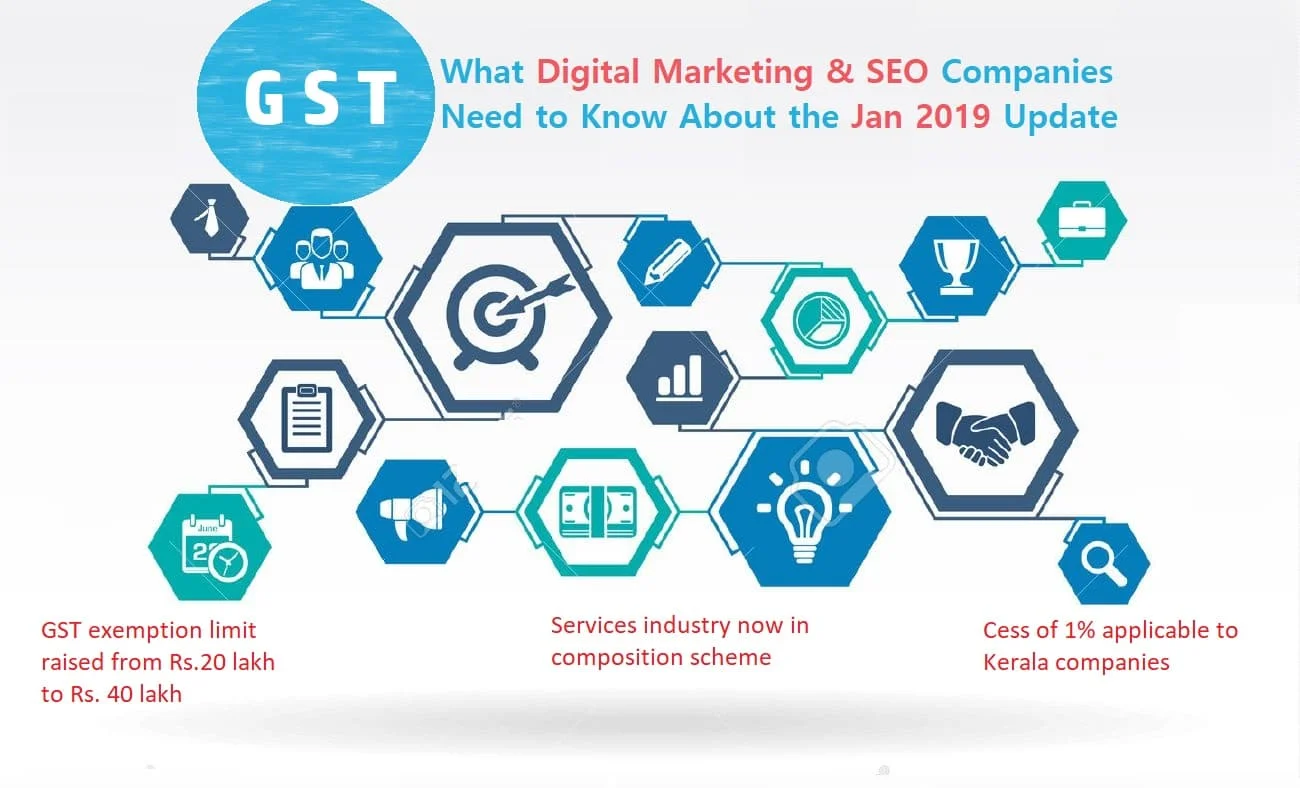
1 – GST exemption limit raised

Earlier – up to Rs. 20 lakhs annual turnover

Now – up to Rs. 40 lakhs annual turnover

Many digital marketing companies earning a turnover between Rs. 21 lakhs to Rs. 40 lakhs rued the burden of GST compliance and subsequent CA fees hike. The new announcement is expected to spread cheer to these companies as it raised the exemption threshold to Rs. 40 lakhs.

States can decide either of the two slabs – exemption of Rs. 20 lakhs or of Rs. 40 lakhs. In Maharashtra and Karnataka (two hubs of digital marketing) the Rs. 40 lakh exemption will apply in all probability.

GST-Update-Jan 2019 for digital marketing companies

2 – Services industry in composition scheme

Earlier – Services sector not in composition scheme

Now – Services sector and mixed supply (booth goods and services) are now in composition scheme

Service suppliers like online marketing agencies in India or content writers can avail of composition scheme at a flat rate of 6% (3% for cGST and 3% for sGST) in case they have an annual turnover of less than Rs. 50 lakhs in the past year. This low-compliance scheme is bound to bring joy to many SEO content writing companies with advantages like

1 – File returns just once a year

2 – Pay at a flat rate

It is important to note that the digital marketing companies cannot claim input tax credit if they opt for composition scheme. Hence they will have to pay the tax from their own pocket.

For content marketing companies and other businesses, they would need to register by filling up the GST CMP-01 form. They need to be on the lookout for filings under GSTR-4.

3 – Cess of 1% applicable to Kerala companies

Earlier – No Cess

Now – 1% cess for two years

Digital marketing companies and other businesses in Kerala will have to bear 1% cess for two years to aid the rebuilding effort after the devastating rain and floods that ravaged the state in August 2018.

To sign off

The Times of India reports that these updates will have an annual revenue impact of Rs. 3000 crore. It is important to note that these updates will come into effect from 1st April 2019. So, plan your tax year ahead smartly and save big bucks on your financial compliance related costs for your digital marketing company.


Share This Post

Recent Posts

AI SEO

How to Use Generative Engine Optimization to Boost AI Search Visibility

To win in AI search visibility, you must implement Generative Engine Optimization. This means moving beyond keywords and directly answer specific queries and earning third-party citations. This blog covers-
• Why Your Brand Is Invisible to AI Search (Even If Google Loves You) – We cover the issue as a visibility gap, not an SEO gap.
• How AI Search Actually Decides What to Surface – We look at the core ranking signals (content relevance, authority, structure, freshness, brand reputation)
• The 5 Mistakes That Are Killing Your AI Visibility – We check common failure points that can be eliminated with generative engine optimization
• How to Audit Your Brand for AI Search Readiness – Here, we explore a practical, step-by-step self-audit framework.
• A Phased Plan to Rebuild Your AI Search Visibility – You also see a solid action roadmap for generative engine optimization from scratch.
• How to Track Whether It’s Working
• Why Textuar is Ideal for Your Generative Engine Optimization Content Needs

SaaS SEO CTR Optimization
SEO

How Textuar Increased CTR and Organic Trial Signups for a SaaS Business?

This case study explains how SaaS SEO CTR optimization helped a mid-stage productivity software company convert visibility into real trial signups. The client was generating impressions on Google but wasn’t receiving clicks or conversions. Textuar reworked titles, metadata, content depth, structured data, technical performance, and intent alignment to match how SaaS buyers compare and evaluate tools.

In 90 days, the company achieved a 200% CTR uplift, jumped 18 SERP positions, captured rich-results, and improved demo and free trial signups. The study highlights why impressions alone don’t matter in SaaS; CTR, buyer intent, and demand framing determine actual conversions.

SEO for attorneys
SEO

SEO for Attorneys: How Law Firms Can Rank Higher, Attract Better Leads, and Stay Visible in AI Search

SEO for attorneys is the process of optimizing a law firm’s website, content, and local presence so potential clients can find, trust, and contact the firm through search engines and AI-powered platforms. It focuses on ranking for high-intent legal searches, appearing in local results, and being cited in answer engines like Google AI Overviews and ChatGPT.

Law firms that rank well focus on high-value legal keywords, strong on-page optimization, and local SEO that captures nearby, ready-to-hire clients. Modern legal SEO also requires optimizing content for AI Overviews and answer engines like ChatGPT through clear structure, FAQs, and credibility signals.
When done right, SEO delivers long-term, high-quality leads that outperform short-term ads and keep your firm discoverable as search continues to evolve.

blogging for startups
Blog Writing

How to do Blogging for Startups in 2026 (+2 Checklists)

Blogging for startups is a powerful growth engine in 2026. See why this is the case. Also check out-

–Key reasons startups should invest in blogging early
–Best-performing blog formats for startups, with real examples
–Step-by-step guidance on how to start a startup blog in 2026
–A practical checklist to launch and scale blogging consistently
–KPIs to measure blogging success beyond just traffic
–How Textuar helps startups turn blogging into a measurable lead engine

Related Posts