Google keeps updating its search algorithms to ensure that the search results are relevant to user queries.
As a part of refining this objective further, they came up with Google E-A-T guidelines in late 2018. Ever since then, SEO webmasters and content writing companies have been looking to align content as per these guidelines.
But what exactly is Google E-A-T and how to refine content to meet its norms?
Let’s have a look.
The Basics of Google E-A-T
E-A-T stands for the triple pillars enshrined by Google to ensure that the results meet the search intent of the user. The three pillars are
- Expertise
- Authoritative
- Trustworthy
These 3 pillars are a part of a crucial Google document – “Google Search Quality Evaluator Guidelines”. It was released way back in 2015 and sought to provide a way to differentiate a good quality website from others.
Naturally, Google’s aim would be to present only the high quality website on search results and give them a ranking boost. And sites that display expertise, are authoritative, and are trustworthy will be classified as good quality sites.
How SEO webmasters & content writers took a cue for Google E-A-T?
The document was intended for internal use but gave a glimpse to content developers and SEO experts on what parameters could lead a website to be classified as a good quality website. Knowing this will help them get a much higher chance of being ranked better than their competing brands. No wonder that SEO leaders like Moz have covered these guidelines and their impact extensively.
Now this guideline kept evolving since its rollout in 2015. As a result, by June 2018, it came up with another big news.
The basement team inside Google will look not only at the site’s E-A-T but also at the content writing team’s E-A-T adherence. This brought about a significant change in how content writing companies drafted and delivered content on their own site or on the client site.
What are the three pillars of Google E-A-T?
Looking at the critical impact of E-A-T on content creation, let’s delve deeper now. Let’s examine these 3 pillars one by one.
1 – Pillar#1 – Expertise
Expertise denotes any company or individual that is perceived as knowledgeable and skillful in their chosen line of business. But just ‘knowledge’ will not shoot up your ranking. You also need to know how to craft content that depicts your expertise in your domain. Plus, it also needs to engage readers and convince them to buy from you rather than your competitors.
1a. How to create ‘expert’ content?
Here are a few handy tips for driving this objective within the site’s content:
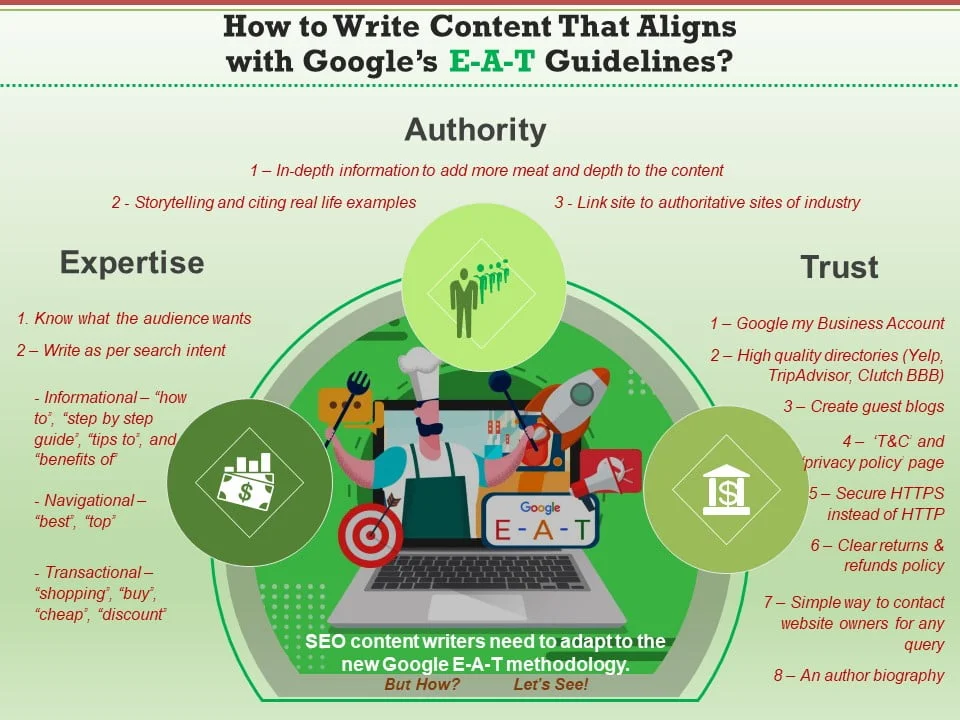
1 – Know what the audience wants
You need to create content that readers love to read. So use keywords that appear as search terms typed by your target audience.
2 – Search intent
There are three search queries – informational (searchers look for specific information), navigational (searchers go through many pages), and transactional (buy or signup). So high quality content writing will contain certain types of words in content and titles to fit into one of these categories:
- Informational – “how to”, “step by step guide”, “tips to”, and “benefits of”
- Navigational – “best”, “top”
- Transactional – “shopping”, “buy”, “cheap”, “discount”
‘Expert’ content is something that does two key things:
1 – it answers the searcher’s query
2 – it also anticipates the next set of queries, and answers that too.
For example – a blog on ‘tips to cultivate medical marijuana’ has this point “the seeds need the right pH level in soil for proper growth”. This is the first part of the two key things.
The next part would be to show the actual level of pH needed. So the point will elaborate saying that “weed plants take up nutrients only when the pH level of the soil is between 6 and 7”.
Imagine if you are a cultivator. While the first part will answer your query, you will still need further clarification. You will need to go to other sites by Googling ‘What is the ideal pH level of soil for cannabis growing’.
But if the same site provided this answer too, then the reader won’t have to go through many sites. He will get all answers on one site itself. This will elevate the expertise of the site in the reader’s eyes.
With these tips, you will create expert content that your target audience would love to read.
Now, we move to the next pillar – authoritative content
2 – Pillar#2 – Authoritative
There is a difference between authority and expertise
Expertise = when you say you are the expert
Authority = when others say you are the expert
So when other influencers or industry authorities start citing you as a source of credible information, then you go beyond expertise. You become an authority.
2a. How to create ‘authoritative’ content?
The best way for others to show trust in your brand is to link your brand in their content assets. So, when you create your content, make sure to write like an authority.
One pro tip – I write picturing myself like a 55-year old with all the ‘gyaan’ of the world to share with someone. This way I write with authority with a genuine intention to help others. It is this type of content that tends to have these factors:
1 – in-depth – it has in-depth information that will help readers so much that they don’t need to visit any other site to resolve their specific query
2 – storytelling – citing real life examples and company/individual names substantiates every point
3 – link – I link my site to authorities in SEO and digital marketing like Neil Patel, Ryan Deiss, and Brian Dean
3 – Pillar#3 – Trustworthy
Today, the reader has many options to consume content from. She will naturally gravitate towards content from a company that has proven itself to be trustworthy. This is the third pillar of the E-A-T methodology that Google focuses on to deliver site rankings.
It involves keeping a stellar reputation online. If there are any negative brand mentions, then you should jump in to redress the problem, before it harms brand reputation further.
3a. How to build the ‘trust’ factor?
1 – Create a Google my Business Account and ensure the presence of accurate details
2 – Register on high quality directories like Yelp, Foursquare, TripAdvisor, Clutch, and Better Business Bureau (BBB)
Search Engine Journal has a nice roundup of the high value listings where you need to link to. Of course, you need to remember that the site you link to is relevant to your industry. For example, TripAdvisor is majorly preferred by any company in travel, tourism, and hospitality industry.
3 – Create guest blogs for sites that are relevant to your industry.
4 – Have a ‘terms and conditions’ page and ‘privacy policy’ page on the site
5 – Go for HTTPS instead of HTTP
6 – In case you accept financial transactions on the site, then you need to have a clear returns/refunds policy
7 – Show a clear and simple way to contact website owners in case of any queries.
8 – An author bio is a good way to build trust especially when you are sharing knowledge through in-depth blogs. A LinkedIn bio of the author will help build further credibility.
To sign off
This post shows how difficult is to create compelling content that ranks well on Google search results page (SERPs). Of course you can try and understand how EAT impacts your industry and what angle or narrative you need to come up with to score well on these norms.
A better alternative would be to get in touch with a content writing expert like Textuar. Our writers can help come up with catchy and intriguing SEO optimized content and helps your brand win big business online.