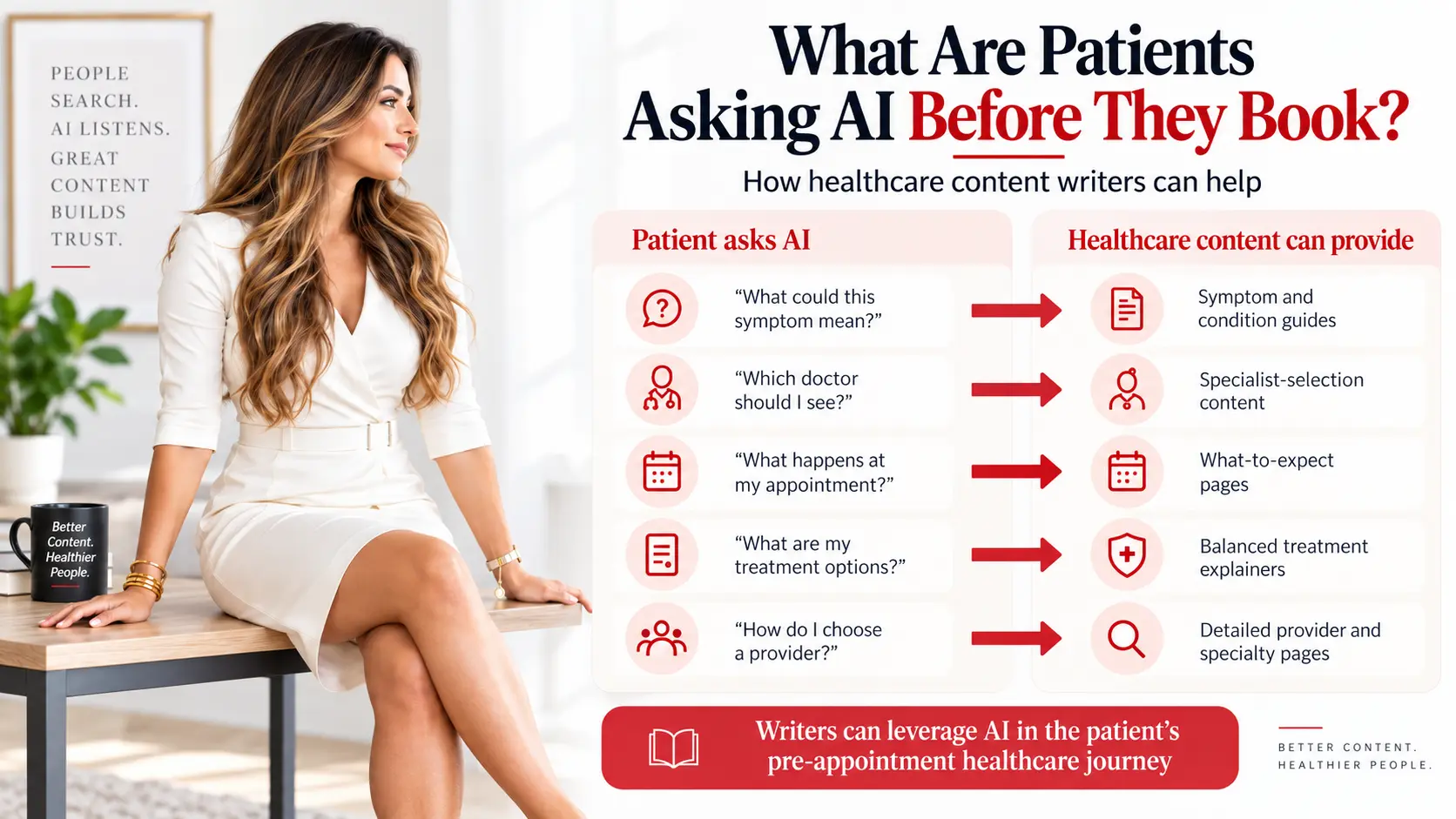
📌 TL;DR Summary:
SEO alone cannot make Healthcare content trustworthy. To rank and command reader trust in AI searches, healthcare content must be accurate and have well sourced information. It should demonstrate medical review and provide clear answers. Also, it should include E-E-A-T elements like readability and credibility. These elements in healthcare content writing services uplift trust with patients as they find the information to be accurate and useful.
A healthcare page can rank well and still fail to engage the reader.
It may contain the right keyword, optimized headings, internal links, and a strong meta description. But when someone is researching symptoms, treatment options, or whether to consult a specialist, ranking is only the beginning. The reader also needs reasons to trust the information.
AI-driven search like ChatGPT and AI Overviews raises that standard further. Users increasingly expect direct, useful answers rather than a list of pages to interpret themselves.
That means effective healthcare content writing services must do two things well:
- Help the content to get discovered on AI answer engines, and
- Make the content credible enough to deserve ChatGPT attention.
Why Is SEO Alone Not Enough for Healthcare Content?
SEO improves discoverability. But it cannot establish medical credibility on its own. Healthcare readers also need-
-accurate information,
-reliable sources,
-appropriate expertise,
-transparency and regulatory adherence, and
-realistic claims
With these aspects, readers can confidently rely on what they read.
Traditional SEO still matters. Pages need keywords, clear headings, readable structure, internal links and content that matches search intent.
Two articles can target the same keyword and offer very different levels of value.
- One may explain the subject carefully cite sources acknowledge limitations and undergo medical review where appropriate.
- Another may simply repeat information found across competing websites.
From an SEO perspective, both may look optimized.
But, from a trust perspective, they are very different.
Why Does Trust Matter More in Healthcare?
Healthcare information can influence decisions involving symptoms, diagnosis, medication, treatment, and when someone seeks professional care.
That makes accuracy especially important.
Google classifies health-related topics under Your Money or Your Life (YMYL) because poor-quality information can significantly affect a person’s well-being. Its guidance also places strong emphasis on E-E-A-T signals for these sensitive subjects.
E-E-A-T refers to:
– Experience
– Expertise
– Authoritativeness
– Trustworthiness
For healthcare organizations, this changes the content question.
Instead of asking only:
“How do we rank for this keyword?”
ask:
“What would make a patient comfortable relying on this information?”
That is where an experienced healthcare content writer can add real value.
What Makes Healthcare Content Trustworthy?
Trust is rarely created by one element. Several signals need to work together.
1. Accurate medical information
Well-established information and claims that need qualification should be clearly separated in healthcare content.
Statements pertaining to symptoms, treatment results, diagnostic accuracy, medications, or recovery times may require reliable medical sources.
Writers should avoid absolute phrases such as-
– “This treatment will cure…”
– “This symptom definitely means…”
– “This procedure is completely risk-free.”
A better approach is to explain what is generally known, where circumstances may vary and when professional evaluation may be appropriate.
Trust often comes from explaining uncertainty correctly rather than hiding it.
2. Reliable Sources
Statistics and medical claims should not be added to make an article seem more trustworthy. The source must be both credible and directly connected to the topic being discussed.
Depending on the subject good references can include:
– Government health agencies
– Recognized medical organizations
– Professional associations
– Peer-reviewed studies
– Academic institutions
A professional healthcare content writing company must treat fact checking as a vital part of the writing process. It should not be seen as something to do at the end just to check a box. Fact checking should be strictly built into every stage of content creation.
This helps ensure accuracy and protects the credibility of the information being shared.
3. Visible Expertise and Review
Readers should know who created or reviewed the information.
Details can include-
– Author(s)- Medical Content Group
– Reviewed by- [Specialty] Dr. [Name]
– Last reviewed- [Date]
Not all pages need to have the same review process. A general wellness article may need less oversight than a page discussing surgery or complex treatment.
The expertise level should correspond to the complexity and potential impact of the topic.
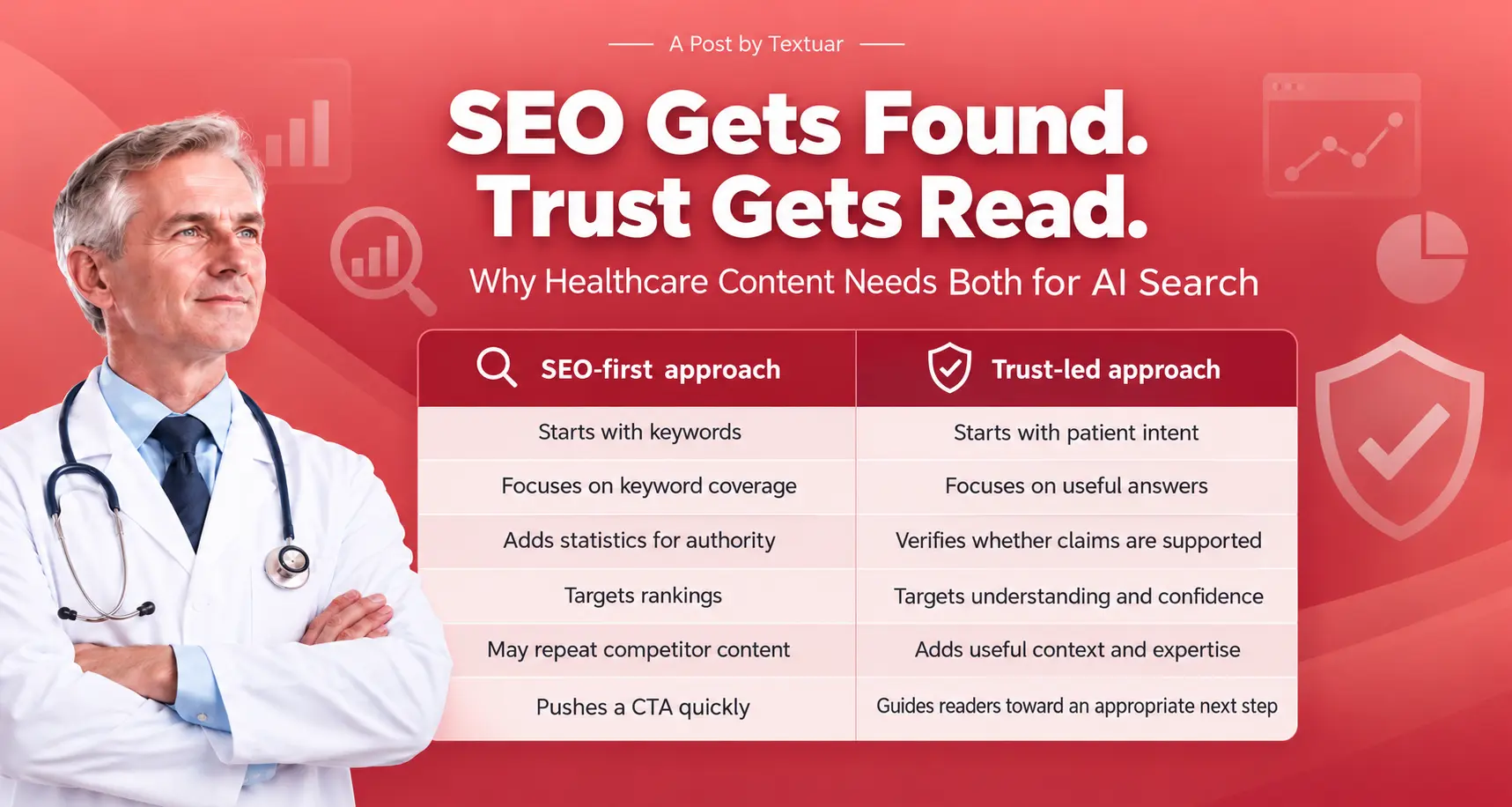
SEO-First vs Trust-Led Healthcare Content
The difference becomes clearer when comparing both approaches.
| SEO-first approach | Trust-led approach |
| Starts with keywords | Starts with patient intent |
| Focuses on keyword coverage | Focuses on useful answers |
| Adds statistics for authority | Verifies whether claims are supported |
| Targets rankings | Targets understanding and confidence |
| May repeat competitor content | Adds useful context and expertise |
| Pushes a CTA quickly | Guides readers toward an appropriate next step |
The strongest healthcare content combines both approaches.
SEO helps patients find the page. Trust gives them a reason to stay and rely on it.
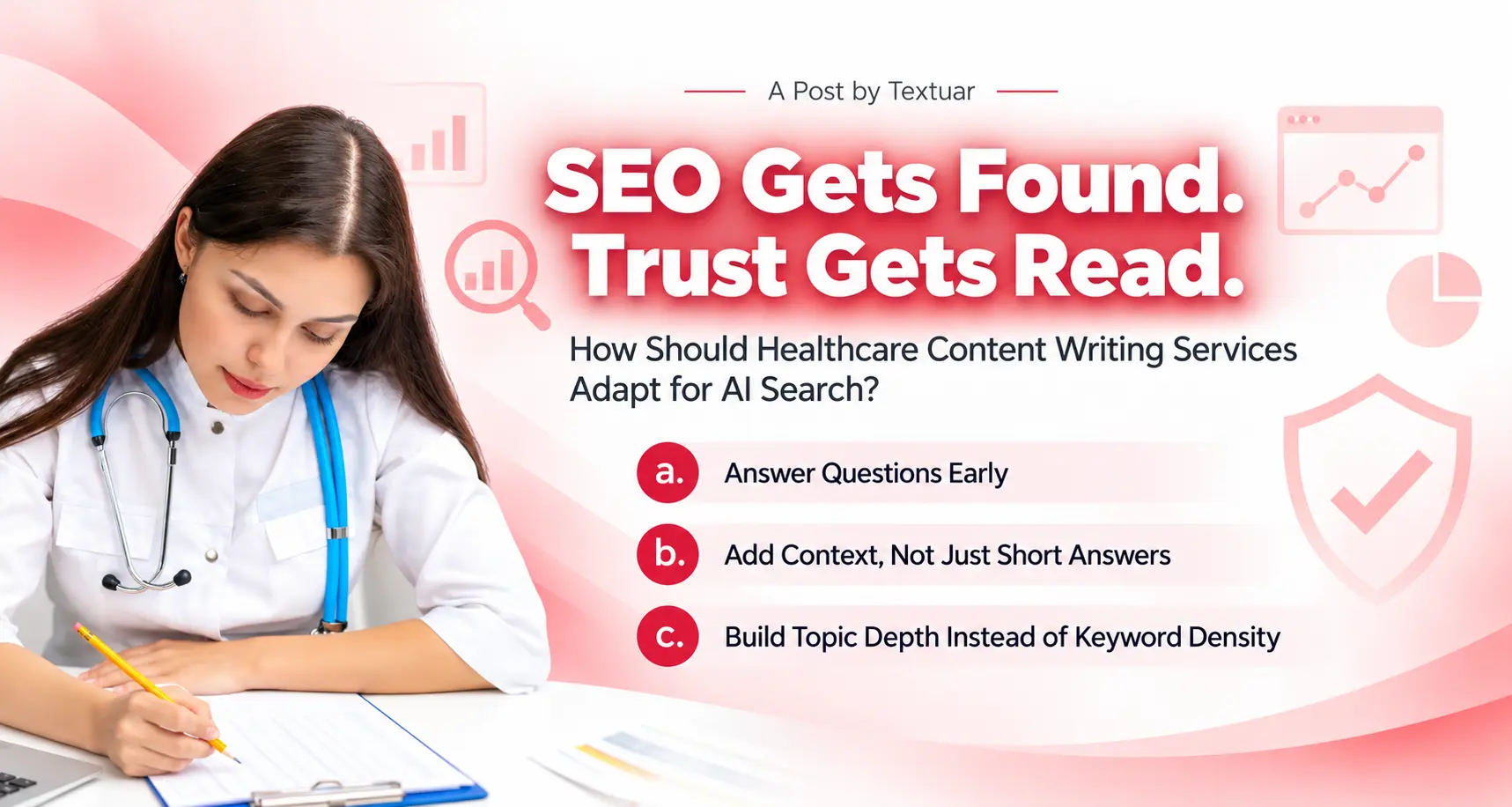
How Should Healthcare Content Writing Services Adapt for AI Search?
It is clear that healthcare content writing companies cannot simply do in 2026 what they used to do in 2016. They now know that AI search encourages users to ask complete questions rather than rely only on short keywords.
Healthcare content therefore needs to answer the wider conversation around a topic with strong QC mechanism. Here are some changes needed in healthcare content writing.
1. Answer Questions Early
If a heading asks, “When should someone see a doctor for persistent headaches?”, do not spend several paragraphs discussing headaches before answering. Give the direct answer first. Then explain context, warning signs and limitations.
This helps readers reach useful information quickly. It also creates clearer passages for AI powered search systems to interpret.
2. Add Context, Not Just Short Answers
Healthcare information often requires nuance.
A useful answer may include-
- the general guidance
- factors that could change it
- warning signs
- when professional evaluation may be needed
This keeps the content concise without oversimplifying it.
3. Build Topic Depth Instead of Keyword Density
A page about knee replacement should not repeat the phrase “knee replacement surgery” unnecessarily.
A medical writer provide in-depth information by answering questions such as:
- When is knee replacement considered?
- Who may be a suitable candidate?
- What happens before surgery?
- What risks may be involved?
- How long can recovery take?
- What alternatives may be discussed?
This builds topical depth while answering the questions patients are likely to have.
What Role Does a Healthcare Content Agency Play?
A capable healthcare content agency does more than produce articles from a keyword spreadsheet. It helps healthcare organizations turn specialist knowledge into information patients can understand.
That often requires collaboration.
The writer contributes research, structure, SEO, readability and audience understanding. Doctors or qualified reviewers provide clinical expertise where needed. Marketing teams ensure the content supports business goals without overstating medical claims.
For hospitals and multispecialty healthcare organizations, this approach also helps create consistent standards across large volumes of content.
Professional healthcare content writing services can help standardize-
– sourcing
– medical review
– tone and readability
– author attribution
– article structure
– content updates
– internal linking
– SEO and AI-search optimization
The goal is not simply to publish more. It is to create a more dependable information library.
Common Mistakes That Weaken Healthcare Content Trust
Even technically optimized content can lose credibility quickly with these issues.
1. Writing Beyond the Evidence
Avoid absolute medical claims when individual circumstances or available evidence do not support them.
2. Using Statistics Without Clear Sources
Readers should be able to identify where important figures and claims came from.
3. Publishing Generic AI Summaries
Repeating information gives users little reason to value your particular page. Content should add clearer explanations, expert input, useful examples or actionable next steps.
- Allowing Information to Become Outdated
Healthcare information can change. Treatment options, clinician details, technology, services and recommendations may all require periodic review.
A visible update or medical review date can help demonstrate that the information is maintained.
A Simple Trust Checklist for Healthcare Content
Before publishing an important healthcare page, use this checklist to strengthen content-
| Trust Checklist for Healthcare Content |
| Is authorship clear? |
| Does the topic need medical review? |
| Are important claims properly sourced? |
| Does the content answer the patient’s actual question? |
| Is it separating general information from medical advice? |
| Does the content explain limitations properly? |
| Is the information current? |
| Does it add value beyond competitor pages? |
| Can a non-medical reader understand it easily? |
One final question is especially useful:
Would you feel comfortable sharing this article with a patient?
If the answer is no, the content probably needs more work.
Conclusion
Effective healthcare content writing services now need to go beyond keywords and rankings. Healthcare organizations need content supported by credible sources, appropriate expertise, transparency, and clear explanations. SEO can earn visibility, but trust determines the value of that visibility. At Textuar, we recommend the strongest: optimize for discovery, but write for people who need reliable information.
Connect with Textuar to know more about our competencies in healthcare content writing services.
FAQs
Does E-E-A-T directly improve healthcare SEO rankings?
E-E-A-T is not a single Google ranking factor. It reflects qualities such as experience, expertise, authoritativeness and trust. These are especially important for sensitive healthcare and other YMYL topics.
Should every healthcare article be medically reviewed?
Not every healthcare page requires the same level of review. The need depends on the topic, complexity, claims and potential consequences of inaccurate information. High stakes clinical content generally requires stronger expert oversight.
What should a healthcare content writing company provide beyond SEO?
A healthcare content writing company should combine research, readability, credible sourcing, patient intent, careful medical claims, structured answers and SEO. It should also support expert review and updates where the subject requires them.