

Last updated on July 16th, 2025
Website content writing operates on a singular rule.
It aims to let the reader take action that results in a gain for your business.
It won’t be wrong to say that your web content is a salesperson for your website. Well-written content engages the readers. It provides the necessary information to them. It evokes an emotion within them. As a result, catchy content drives successful conversion from a reader to a customer.
But such challenging KRA means that such content is extremely hard to create.
At Textuar, we have helped many clients put up compelling web content. They use this content to speak to readers. Our web content writers apply a few rules to create well-articulated web content.
Let’s see what these rules are.
What is website content writing?
It is the content present on a page of your website. It tells people about your products and services. Such content also shows why you should choose this particular brand over their competitors. Some of the pages include
a. Home Page
b. About Us
c. Services / Products
d. Blogs
e. Contact Us
So what makes a good website content?
It is something that combines the two winning formulae –
a. It is helpful enough to solve the site visitor’s search intent
b. It is persuasive enough to let them open up their wallets to you.
What Rules Will Amplify the Impact of Your Website Content Writing?
1 – Ditch the English Grammar in Favour of Colloquialism
We all know the importance of checking each and every piece of content through Grammarly. But we bet you that the tool will show a poor grammar score for website content.
Take the example of captions of famous brands
- Apple – Think Different
- Nike – Just Do It
- Adidas – Impossible is Nothing
All three (or at least two) captions will throw a typo alert on Grammarly. But yet they are insanely popular the world over.
So chuck out what your English teacher taught you. With website content creation, you can add colloquial terms (or rather pepper it).
Remember that readers don’t read Internet content like a book. So stop writing a copy as if you are writing a book.
2 – Know the Reader of the Web Content
The three main stages of a buyer journey are:
1 – Awareness – Introduce brand through better visibility
2 – Consideration – Provide helpful information during customer research phase
3 – Purchase – Convince interested user to be a customer
Your website content writing will touch upon all three stages. But it will majorly focus on stage 2 (consideration).
So try to think what questions will the user have at this crucial juncture:
1 – after she is made aware of your brand.
2 – before she makes her mind to purchase from your site.
At this stage, they are looking for reassurance.
Even experts agree that this is vital for writing high-quality website content.
So your content should show why they should go ahead with your product or service. This can be done in a few ways
- Adding data to reassure readers that their decision is corroborated by many others
- Give a hint of the rates or pricing plans to compare
- Showcase your industry authority. You can do so by telling why you are preferred over your competitors
- Last, and most important – show them “what’s in it for them?”
3 – Answer “What’s in it for Me?” for the Reader
Many web content pages keep on rambling about how their product has a truckload of features. But what’s the point if they don’t show how it benefits readers?
Make the content relatable to the readers. Show them the benefits they can get when they go for your products and services.
Let’s take this example:
“We have a team of website content writers. They have 11 years of experience in this domain. They have written for different industries.”
All three sentences have the company in focus.
Rather you should take a backseat in the narrative. The website content writing should focus more on the reader.
So we can re-write this sentence as:
“Get high quality content with our website content writers. You can rely on our expertise to generate new leads and make content your revenue enabler. Now get content that aligns to your industry and target customers.”
In a nutshell – Don’t make a monologue. Create a two-way conversation. Involve the readers at a deeper level.
4 – Show a Human Touch
Consider these two sentences:
– “High performance, device agnostic, vendor neutral mobility application solutions”
– “Mobile apps that work everywhere!”
When readers read the first sentence, they will scratch their heads thinking of one damning question.
“What the heck are you trying to say?”
Many marketers think that by using convoluted wordings, they can impress readers. However, it is sadly the opposite that actually happens. Readers tend to walk away from such statements that they cannot understand.
So do a favour on your content goals. Stop writing difficult, jargon-heavy words.
To cut the long story short – don’t show off your expertise. Rather, say words that your reader can understand. So, make sure that the level of technicality/jargons should not insult the reader’s sensibilities.
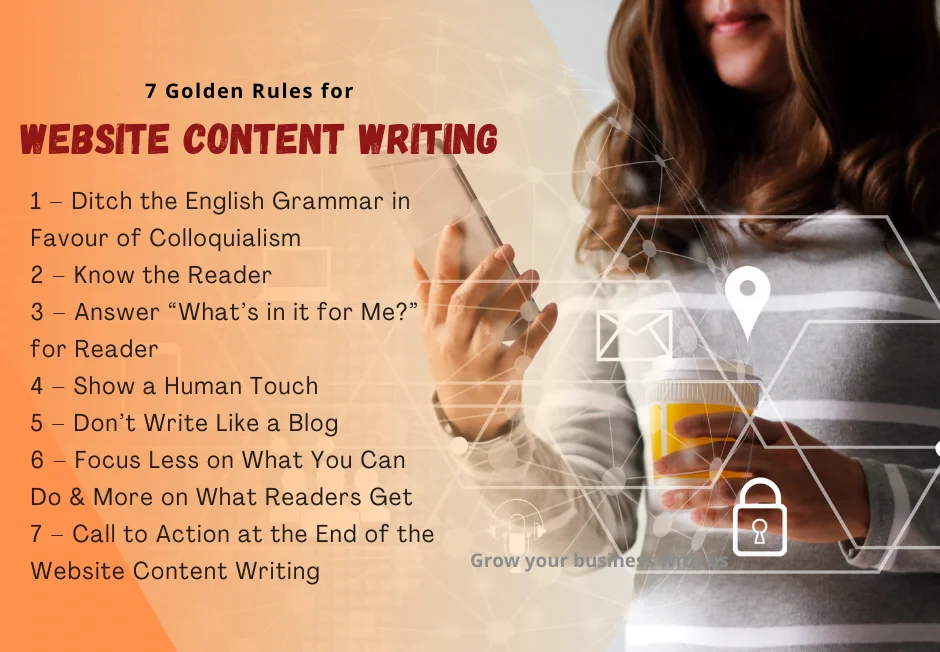
5 – Don’t Write Like a Blog
A blog’s purpose is to educate and inform.
A website copy’s intent is to subtly prod towards a sale.
For website content writing, you need to be clear that every sentence or line works towards eliciting a sale.
You need to smartly lead the reader towards a sale. You can do this with short sentences and concise words. A few other tips are as below:
- Don’t write paragraphs after paragraphs separated by subheadings as you do for a blog
- Play around with one-line paragraphs. Then you can follow this line by a section of 2-3 lines.
- Blogs tend to be more than 1200w or more. But website copy will be substantially less (around 300 words)
6 – Focus Less on What You Can Do & More on What Readers Get
No one. Really no one cares about what you can do with your expertise.
So what do readers look for?
It’s simple!
They look for “What you can do for them?”
So, stop talking about yourself and instead do these:
- Use more of ‘you’ and ‘your’ instead of ‘we’ and ‘our’
- Simplify and align the words to readers’ level of comfort rather than your level of expertise
- Clearly outline the benefits they will get on using your product or service
7 – Call to Action at the End of the Website Content Writing
Make sure to let the readers clearly know what they need to do after reading the website content. You can do one of the below:
- Invite them to check other pages
- Send them to an ‘Enquire now’ or ‘Contact us’ page, or
- Solicit subscriptions
As such, your CTA can be any example out of the below:
- “Subscribe to our channel now.” (popular with YouTube views)
- “Call us today.”
- “Learn more about our services.”
Experts say that CTA also helps with SEO optimization.
To sign off
Remember that the ultimate aim of any website content writing copy is either of the three –
- to increase leads,
- boost sales, or
- win new customers.
All elements of your copy need to work toward a singular goal.
With these tips, you will be able to create a killer website copy that will do its intended job.
Discover how it is done for your specific company. Contact our team at Textuar for a polished website content copy that is simply awesome