
Did You Know About the 7-Step Professional Content Writing Process?

professional content writing process

Any work can be accomplished through a variety of methods.  However, doing anything with the right methodology is the key to success.  Similarly, in content writing, with a large number of professional content writers, the methods also vastly vary. So having the right approach to the process will be the key to success.

You may come across many write-ups when you browse the web, but the one with a clear flow of thought will always stand out. This is because the content writing is done according to a few successful guidelines of content writing.  One successful method that many professional content writers approach is the 7-step content writing process.

Interested to know what these steps are for professional copywriting? Then read on and find out?

7-Step Content Writing Process 

1.Idea

First and foremost, we have to insight into what we want to achieve.  The thought is a prerequisite for action to follow.  It may be your own or one for which you are employed to write about by an organization.  An idea in content writing is the focus around which the whole write-up will revolve.

Tip – Build a central theme around a content piece and don’t digress from it.

2. Appropriate/catchy heading

An idea should now be narrowed to phrase or sentence that will make the aim for writing clear.  It has to be concise yet able to explain the general idea that it intends to display.  The heading should be attractive as it is the first thing a reader will glance through, and the viewer should be led into reading further.

Tip – Use tools provided by experts like Moz and Hubspot to improve its magnetic potential

3.Layout

Professional content writers suggest that it’s a good practice to prepare an outline for our idea to give more relevance and flow to the process.  This will include how we want to structure the thought.  We should always proceed from a general notion to being specific.  We should note every thought related to the idea that crosses our mind in whichever order they come for us to later arrange it orderly so that we are able to express our topic in a meaningful manner.

Tip – Once you have prepared the outline check if it all ties up nicely without an abrupt or jarring section that breaks the train of thought in the content

4.Research

We have to look up other similar works to get more ideas related to what we are writing.  This will help us improve upon what we have intended to write.  Also, we have to verify facts and be sure that what we have written is accurate with any falsity.

Tip – It is important to cite sources if we are referring to a statistic or a figure. This will add more credibility (and hence, weightage) to our content

5.Evaluation

Once we have pretty much got everything on paper, we have to re-visit it again to make sure we have jotted every detail we had outlined.  This step is important because it will minimize any errors that can be corrected without proofing it thoroughly.

6.Proofing

This is a very important step in the content writing process.  In this step, we have to go through the document for it correctness with respect to grammar, word usage, spellings, etc.  Any error in these aspects will put the reader off and discourage him from reading through the work entirely.

Tip – At Textuar, we encourage a two-step proofing technique – once we do a manual proofing. Then, another copyeditor does a tool-based proofing with tools like Grammarly.

7.Final Product

Having gone through the above steps, we finally come to the end result, a well thought, well executed piece of content writing.  Out heading and the content should be in tune to each other.  If so, we are now ready with our work.

Content writing, if done keeping in mind the above steps, will ensure our efficacy as new age professional content writers. It will also enhance the value of the written content.  It will be doing justice to the organization we cater to.

Which of these steps was missing from your content writing process? Do write to us and let us know your thoughts.


Share This Post

Recent Posts

b2b content marketing trends 2026
Content Marketing

B2B Content Marketing Trends to Follow in 2026

B2B content marketing trends in 2026 signal a major shift from volume-driven publishing to authority-driven ecosystems. Brands must use AI as an assistant, not a replacement, while prioritizing interactive and product-led experiences. Verifiable expertise and human-first media build stronger trust in an AI-saturated market. Distribution now matters as much as production, requiring strategic amplification across channels. Generative Engine Optimization ensures visibility inside AI tools like ChatGPT and AI Overviews. Winning teams combine structured systems, expert insight, and intelligent distribution. These B2B content marketing trends redefine how brands attract, educate, and convert modern decision-makers.

AI SEO

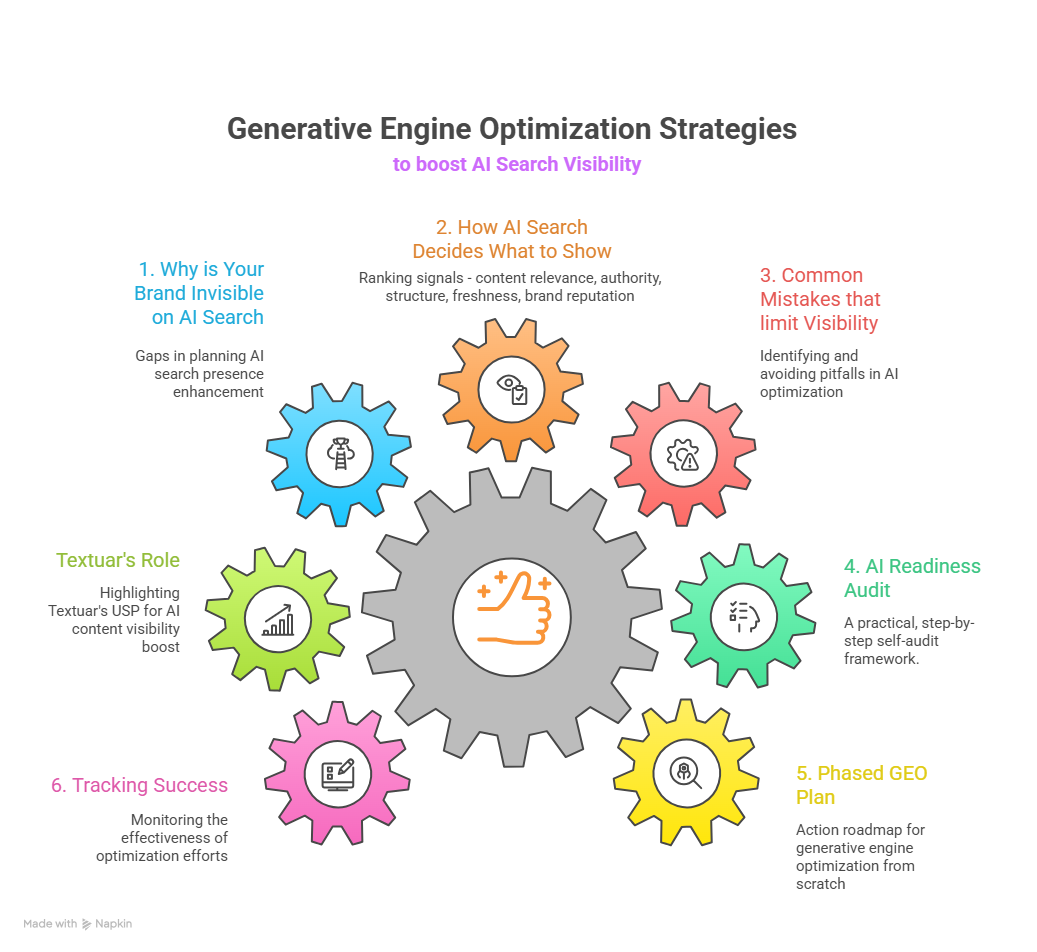
How to Use Generative Engine Optimization to Boost AI Search Visibility

To win in AI search visibility, you must implement Generative Engine Optimization. This means moving beyond keywords and directly answer specific queries and earning third-party citations. This blog covers-
• Why Your Brand Is Invisible to AI Search (Even If Google Loves You) – We cover the issue as a visibility gap, not an SEO gap.
• How AI Search Actually Decides What to Surface – We look at the core ranking signals (content relevance, authority, structure, freshness, brand reputation)
• The 5 Mistakes That Are Killing Your AI Visibility – We check common failure points that can be eliminated with generative engine optimization
• How to Audit Your Brand for AI Search Readiness – Here, we explore a practical, step-by-step self-audit framework.
• A Phased Plan to Rebuild Your AI Search Visibility – You also see a solid action roadmap for generative engine optimization from scratch.
• How to Track Whether It’s Working
• Why Textuar is Ideal for Your Generative Engine Optimization Content Needs

SaaS SEO CTR Optimization
SEO

How Textuar Increased CTR and Organic Trial Signups for a SaaS Business?

This case study explains how SaaS SEO CTR optimization helped a mid-stage productivity software company convert visibility into real trial signups. The client was generating impressions on Google but wasn’t receiving clicks or conversions. Textuar reworked titles, metadata, content depth, structured data, technical performance, and intent alignment to match how SaaS buyers compare and evaluate tools.

In 90 days, the company achieved a 200% CTR uplift, jumped 18 SERP positions, captured rich-results, and improved demo and free trial signups. The study highlights why impressions alone don’t matter in SaaS; CTR, buyer intent, and demand framing determine actual conversions.

SEO for attorneys
SEO

SEO for Attorneys: How Law Firms Can Rank Higher, Attract Better Leads, and Stay Visible in AI Search

SEO for attorneys is the process of optimizing a law firm’s website, content, and local presence so potential clients can find, trust, and contact the firm through search engines and AI-powered platforms. It focuses on ranking for high-intent legal searches, appearing in local results, and being cited in answer engines like Google AI Overviews and ChatGPT.

Law firms that rank well focus on high-value legal keywords, strong on-page optimization, and local SEO that captures nearby, ready-to-hire clients. Modern legal SEO also requires optimizing content for AI Overviews and answer engines like ChatGPT through clear structure, FAQs, and credibility signals.
When done right, SEO delivers long-term, high-quality leads that outperform short-term ads and keep your firm discoverable as search continues to evolve.

blogging for startups
Blog Writing

How to do Blogging for Startups in 2026 (+2 Checklists)

Blogging for startups is a powerful growth engine in 2026. See why this is the case. Also check out-

–Key reasons startups should invest in blogging early
–Best-performing blog formats for startups, with real examples
–Step-by-step guidance on how to start a startup blog in 2026
–A practical checklist to launch and scale blogging consistently
–KPIs to measure blogging success beyond just traffic
–How Textuar helps startups turn blogging into a measurable lead engine

Related Posts

AI SEO

How to Use Generative Engine Optimization to Boost AI Search Visibility

To win in AI search visibility, you must implement Generative Engine Optimization. This means moving beyond keywords and directly answer specific queries and earning third-party citations. This blog covers-
• Why Your Brand Is Invisible to AI Search (Even If Google Loves You) – We cover the issue as a visibility gap, not an SEO gap.
• How AI Search Actually Decides What to Surface – We look at the core ranking signals (content relevance, authority, structure, freshness, brand reputation)
• The 5 Mistakes That Are Killing Your AI Visibility – We check common failure points that can be eliminated with generative engine optimization
• How to Audit Your Brand for AI Search Readiness – Here, we explore a practical, step-by-step self-audit framework.
• A Phased Plan to Rebuild Your AI Search Visibility – You also see a solid action roadmap for generative engine optimization from scratch.
• How to Track Whether It’s Working
• Why Textuar is Ideal for Your Generative Engine Optimization Content Needs

SaaS SEO CTR Optimization
SEO

How Textuar Increased CTR and Organic Trial Signups for a SaaS Business?

This case study explains how SaaS SEO CTR optimization helped a mid-stage productivity software company convert visibility into real trial signups. The client was generating impressions on Google but wasn’t receiving clicks or conversions. Textuar reworked titles, metadata, content depth, structured data, technical performance, and intent alignment to match how SaaS buyers compare and evaluate tools.

In 90 days, the company achieved a 200% CTR uplift, jumped 18 SERP positions, captured rich-results, and improved demo and free trial signups. The study highlights why impressions alone don’t matter in SaaS; CTR, buyer intent, and demand framing determine actual conversions.

AI content

AI vs Human Content – How to Use Both in 2026 (+Choosing the Right Approach)

The AI vs. human content debate is missing the point. In 2026, the winning strategy is a hybrid approach, not choosing one over the other. Use AI for speed, scale, and data-driven tasks like research and drafting. Rely on human writers for emotional connection, creativity, fact-checking, and nuanced storytelling. This blend ensures content is both efficient and deeply engaging, ranking well on search engines while building audience trust. The key is leveraging each for their strengths, not choosing one exclusively. Contact Textuar for content writing services.