Last updated on July 1st, 2025
Your search rankings aspiration gets a new avenue in the form of SearchGPT. You would sit up and take notice when we say that your competitors have already started to dominate SearchGPT’s results. As a content writing agency that has helped clients bolster their visibility, we know the SearchGPT landscape inside out.
In this post, we’ll unravel SearchGPT’s algorithm and show you the techniques for ranking.
What is SearchGPT?
It is an AI-powered search engine that is fast changing how we discover information online. It blends traditional search capabilities with advanced AI understanding. Conventional search engines only match keywords. However, SearchGPT comprehends context and intent. As a result, you feel like you are asking a knowledgeable friend than querying a database.
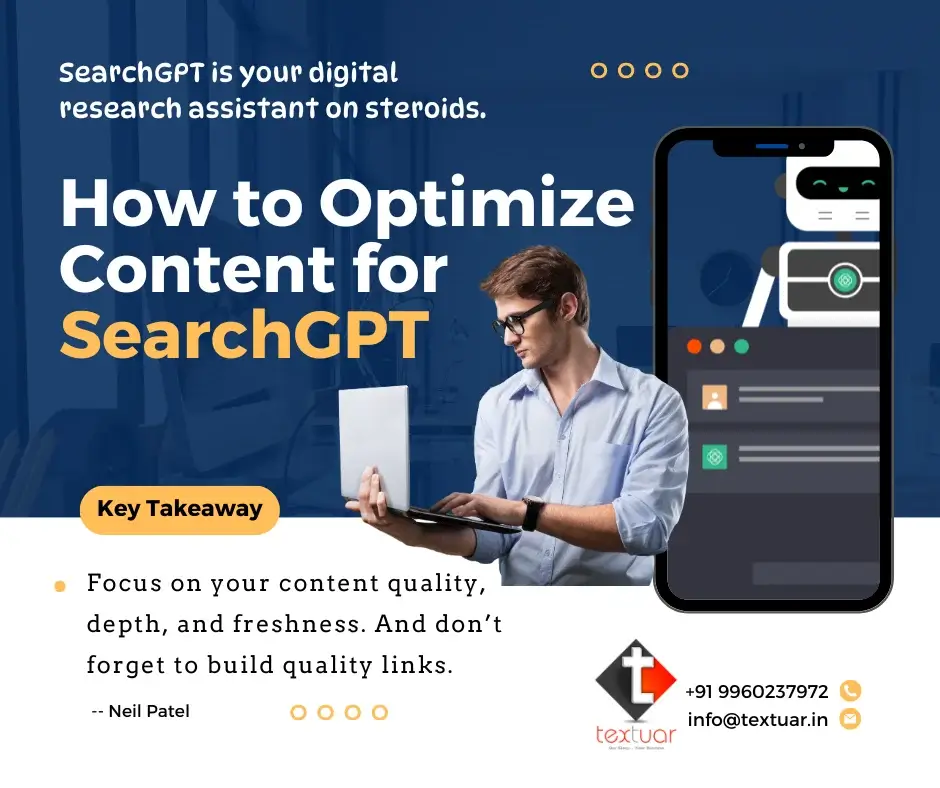
You can think of it as your digital research assistant on steroids.
When you search ‘best coffee shops for remote work,’ it doesn’t just list places with WiFi. It understands you need a quiet atmosphere and reliable internet. Others may look for comfortable seating and good coffee. It will assess content through an AI lens. Hence, it focuses on authentic, detailed information over pages stuffed with keywords.
For businesses and content creators, this means one thing- the old SEO playbook needs a complete rewrite.
How are results for SearchGPT different from Google SERPs?
Google presents a list of blue links and snippets in response to your search terms. SearchGPT delivers a more conversational and curated experience. You can understand this difference with an example. You may search for ‘how to make sourdough bread.’ Google might show you 10 different recipes with varying approaches.
But SearchGPT works a bit differently. It takes information from multiple sources. This way, it presents an elaborate guide that mixes the most reliable methods and expert tips for making sourdough bread.
SearchGPT also excels at understanding context chains. If you follow up your bread query with “what can go wrong?” it remembers your previous search. This way, it provides relevant troubleshooting advice. You need not fire up new searches or specify ‘sourdough bread problems.’
In my experience, the results are also more dynamic. They adapt to your follow-up questions and provide real-time clarifications. As a result, the experience feels less like searching and more like consulting an expert.
How to optimize content for SearchGPT?
There are a lot of interesting experiments happening in this nascent space. I was particularly intrigued by Neil Patel’s analysis of how to optimize content for SearchGPT.
A key reason for this fascination was that it gave a lot of coverage to high-quality content – an offering of Textuar, our content company.
His analysis of this search engine threw up some captivating insights.
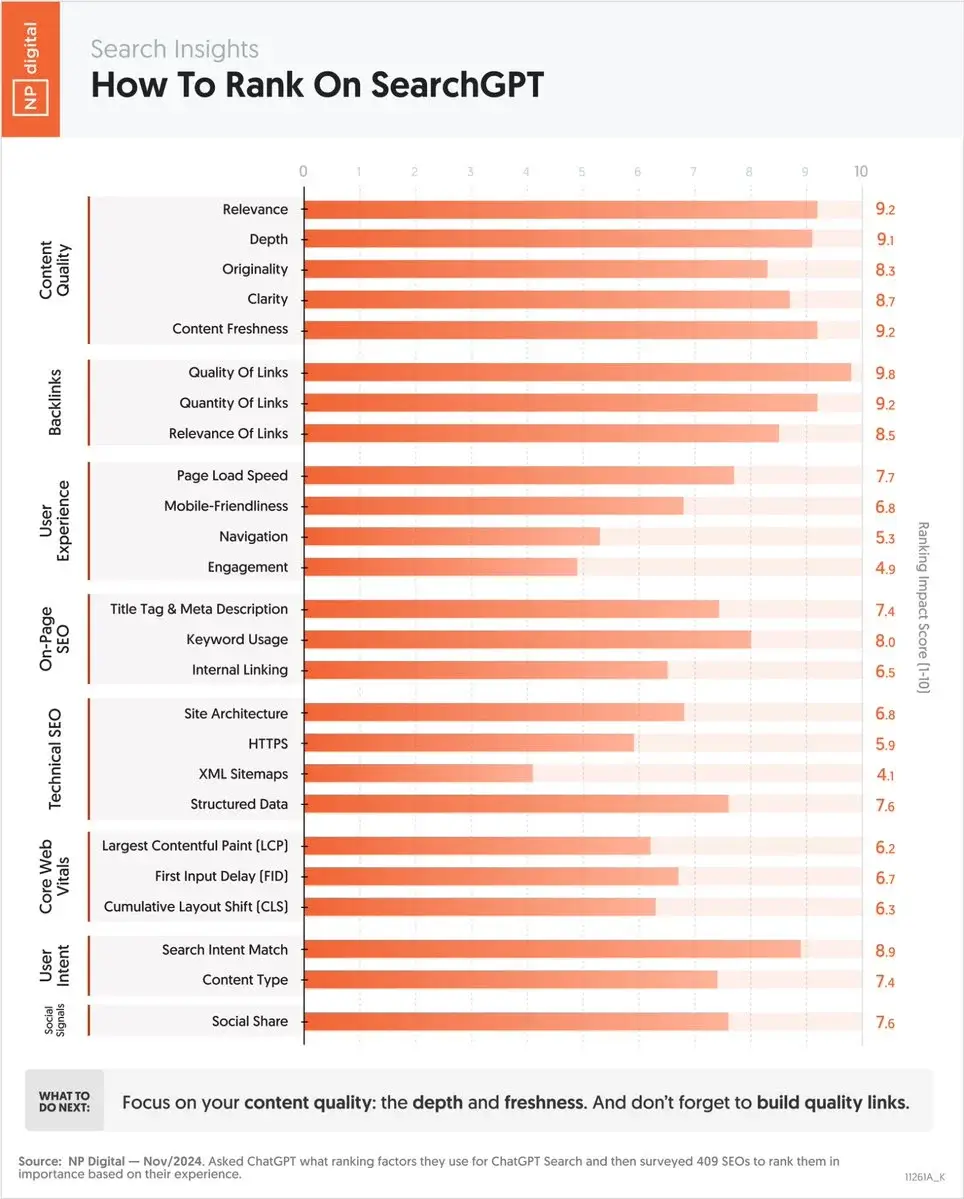
So, I have tried to break down the points within this chart and add my two cents to it.
1 – Content quality
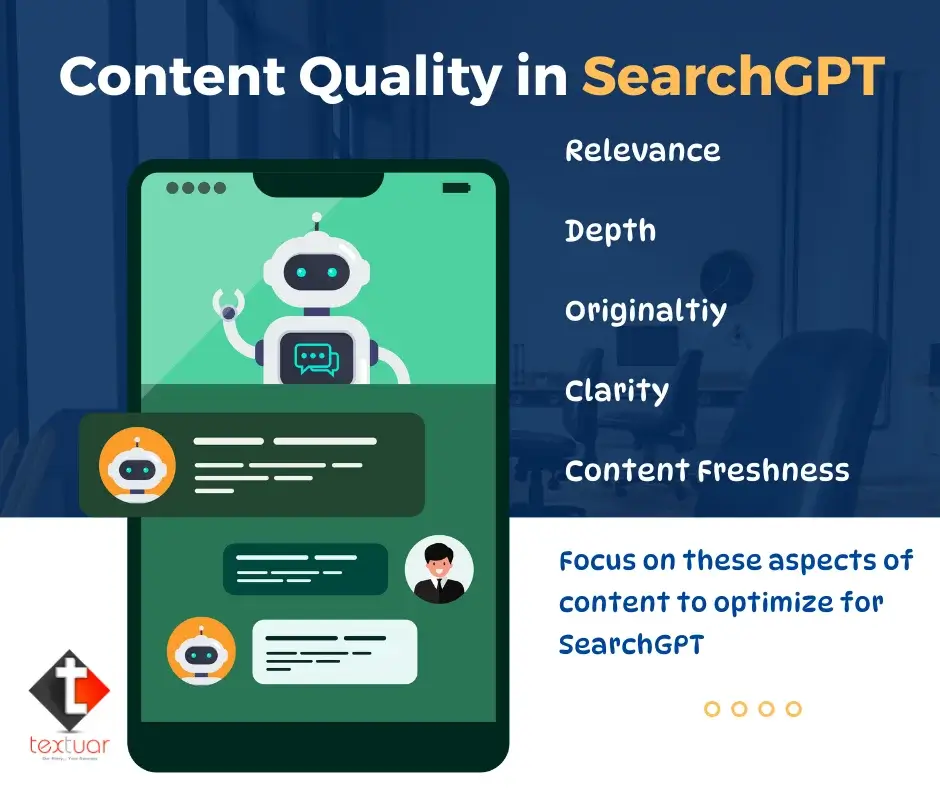
1. Relevance
Your content writer should not merely make content. Rather, they should focus on providing answers that actually matter. Imagine running a fitness equipment store. If someone searches for “best treadmill for small apartments,” don’t push the whole treadmill catalogue. Focus on solving a specific problem: compact dimensions, noise levels, or foldability.
SearchGPT rewards content that solves a specific user problem in and of itself.
So, instead of “Our XZ100 Treadmill is the best,” explain why: “The XZ100’s 45-inch folded height fits under most beds, making it perfect for studio apartments.”
2. Depth
Surface-level content won’t cut it anymore. If you’re writing about “sustainable packaging solutions,” don’t just list alternatives – dive deep. Explain how switching from plastic to mushroom packaging saved your client 30% in shipping costs while reducing carbon footprint by 70%.
You can also include real implementation challenges and cost comparisons. Even industry trends and supplier insights will add a lot of depth to an otherwise bland piece of content. SearchGPT gives priority to content that goes all the way – the good, the bad, and practical workarounds.
In my experience, you should definitely think of each blog as a mini-consultation rather than a brochure. This will lead to higher success rates if you want to optimize content for SearchGPT.
3. Originality
We are in an era of content that is increasingly being AI-generating, and authentic experiences come alive. Let us consider an instance here. Don’t copy all that everybody else writes on “digital marketing trends”-tell the story about something new from your agency. So, you can say, “We flipped our client’s Instagram strategy from curated posts to behind-the-scenes reels; engagement shot up by 300%.”
SearchGPT will reward you for bringing something fresh, some new insights, some angle. Failures will also teach interested readers. This, again, will turn into valuable original content.
4. Clarity
‘Clear’ beats ‘clever’ every time. For instance, I recently wrote a blog on “invoice automation software.” We avoided using the parade of jargon when crafting the draft.
For example, we didn’t say, “Our solution leverages AI-driven OCR technology.” Instead, we said, “Our software reads invoices like a human but 10 times faster.”
It is wise to use concrete examples: “Restaurant owner Sarah reduced billing errors by 95 percent and saved 15 hours weekly.” SearchGPT loves content that breaks down a complex topic into easily digestible chunks.
In my experience as a content writing agency owner, I feel that you need to give prominence to structure, too. So don’t shy away from using headers, bullet points, and short paragraphs.
5. Content Freshness
Yesterday’s news doesn’t rank tomorrow. If you’re talking about ‘social media marketing,’ be sure to cover the latest platform updates and the most recent trends.
You can bring in the time context to the narrative. For example, ‘Although Instagram 2024 algorithm change puts a focus on video content, our analytics reveal photo carousels remain the leading driver of conversions by 2x for B2B clients.’ SearchGPT prefers current information presented in updated content.
No wonder that this point makes it to Neil Patel’s list of techniques to optimize content for SearchGPT.
Tip: Refresh your high-performing content with new statistics, examples, and insights rather than trying to develop completely new posts. Think evolution, not revolution.
2 – On-site SEO

Here, we will cover some points that relate to fine-tuning your website for SearchGPT.
1. Title Tags
You should alter your title tags from bland labels into powerful first impressions. The generic tag will look something like, ‘Digital Marketing Services – Company Name.’ Instead, you may try ‘Data-Driven Digital Marketing That Doubled Client ROI in 90 Days.’
SearchGPT understands user intent. Hence you should try to make your titles match it. For service pages, highlight outcomes- ‘Remote Team Building Workshops- 97% Employee Engagement Rate.’
For blogs, you can spark curiosity with the headline. An example would be ‘Why Your AI Marketing Strategy Is Failing (And How Top Brands Fixed It).’ Remember this if you want to optimize content for SearchGPT- your title tag is your elevator pitch.
2. Meta Descriptions
Think of meta descriptions as your elevator pitch’s wingman. While Google truncates at 155-160 characters, SearchGPT analyzes the full description for context and relevance. Make every word count.
Let us consider an example to explain this point better. “Discover how our AI-powered content strategy helped 50+ SaaS startups increase organic traffic by 200%. Download our proven framework, complete with real A/B test results and implementation guides.”
Notice how this meta description combines specific results, clear value proposition, and a compelling call-to-action? That’s what SearchGPT rewards.
3. Keyword Usage
As a content writer, you should never focus on keyword stuffing. It is wise to remember that SearchGPT craves context. Instead of repeating “best accounting software” fifteen times, you can build a semantic universe around your topic. Include related terms like “financial automation,” “bookkeeping efficiency,” and “expense tracking.”
Share real scenarios- “How a retail chain automated 90% of their monthly reconciliation using cloud accounting tools.” SearchGPT understands variations and intent. Hence, you need to focus on covering topics comprehensively rather than hitting specific keyword densities.
4. Internal Linking
Think of internal links as your website’s neural network. Don’t just link – connect ideas meaningfully. If your page about “email marketing automation” mentions A/B testing, link to your detailed guide on “How we increased email open rates by 150% through systematic testing.”
SearchGPT values contextual relationships. At the end of the day, each link should feel like a natural next step in the reader’s journey.
How to hire a content writer to optimize for SearchGPT?
At this stage, you may wonder how to let your brand stand out in the SearchGPT with well-articulated content. You would be making a smart move by delegating this time-intensive task to a specialist content writing agency like Textuar. For this, you can focus on these aspects in your chosen vendor-
1. Focus on Subject Matter Experts
You should recruit writers who know your business inside out. Unlike standard SEO, SearchGPT looks for expert and original content with fresh insights. For e.g., a writer in healthcare tech should have a deep knowledge of terms, compliance regulations, and industry trends.
If a writer doesn’t have in-depth knowledge of your industry, then it is best to move on to other options.
2. Search for AI-Awareness
It is better to source writers who know how AI language models work. They should know how to structure content that is both AI-friendly and human-engaging. Your ideal writer can explain complex topics in simple terms while maintaining technical accuracy. They should depict skills in creating content that answers follow-up questions before they’re asked.
Plus, they should be aware of the chat-like conversational aspect of the interface of GPT tools. They differ vastly from the static results of traditional search engines.
3. Check their Research Skills
You would extract more value if you pick writers who excel at research. They would be aware how to cross-reference information from various sources. SearchGPT prefers content that combines established facts with fresh perspectives. In interviews, you can ask vendors how they cross-reference studies and keep up with industry updates. Strong research skills help create content with the human touch.
4. Test for Strategic Thinking
You can evaluate the candidates by giving them a test piece to write on. Good SearchGPT writers are aware of information hierarchy. With this, they will know how to create logically flowing content. They should explain why they chose certain examples and the structure of headings. You will also understand their approach to internal linking and how they adapt to SearchGPT results.
5. Assess Adaptability
Seek writers who will evolve with AI technology. The ideal candidates are inquisitive about AI-related development and able to tweak their writing styles based on performance metrics. They must be at ease examining metrics and fine-tuning their approach in accordance with what works best for SearchGPT rankings.
If your chosen writer ticks all these boxes, then you are likely to make a good choice in selecting writing experts who will help you optimize for SearchGPT.
To sum it up
SearchGPT is giving some serious competition to conventional search engines like Google. They won’t like it, but as SEOs, we truly love that the status quo is being challenged (finally). The next step for us would be to align our content strategy with this new AI search engine.
Before parting, I would like to re-emphasize Neil Patel’s tiny byline at the bottom of the image –
“Focus on your content quality, depth, and freshness. And don’t forget to build quality links.”
You may want to apply this playbook to your company. A good starting point, in this case, would be to engage an experienced content writing company like Textuar. We have the tools and resources that help us deliver exemplary results in optimizing for SearchGPT.