The overcrowded Internet means that there are all sorts of people browsing online.
As a company you need to create content that resonates with your target buyer and engages with them.
This type of content writing for buyer persona has a better chance of conversion than plain vanilla content meant for a universal audience.
What is a buyer persona in content writing?
A buyer persona is the profile of the ideal customer for a brand’s customer. Every type of persona will think, act, and behave in a certain manner.
For example, a CEO will have the perception of a busy person who needs direct, ‘to the point’ content for reading. A teenager will appreciate the use of witty content with humour added in.
You see where this is going?
When we read something we are familiar with, we agree to it and act upon it.
Imagine if a teenager sees boring whitepapers with huge paragraphs of text. She will find it boring and move to competitor content asset. Since the content writing wasn’t fine-tuned to the buyer persona, it is an opportunity lost forever probably.
Conversely if the same reader came across lesser text, a ‘how to’ video, and plenty of engrossing images, the chances of engagement rise up dramatically.
This is why content writers need to know the buyer persona. This will help them frame the appropriate content.
Let’s look at some examples
1 – For Nike sneakers, the ideal customer is a teenager who is studying in college.
2 – For a mobile app development company the ideal customer is a business owners, CEO, or decision maker.
Tips for content writing for buyer persona
Let us now take the discussion ahead. These are a few writing tips that will help you come up with good quality content and target a buyer persona.
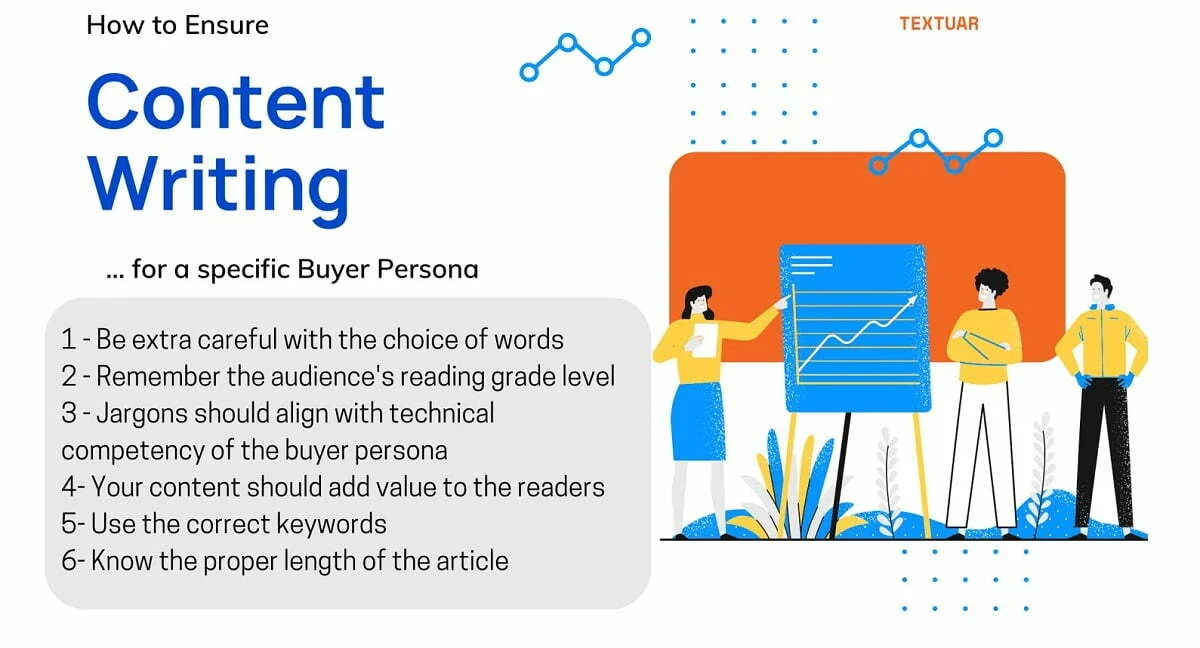
1- Be extra careful with the choice of words
There are many pieces of content available on the internet for any given topic. Most of the articles though delve superficially into the topic. As a result, they do not help you get enough information for addressing a specific problem. This will ruin the client’s experience, especially in B2B content.
For example, when you’re looking at a car, all you’re seeing is the outside of a car. But when a mechanic, an engineer or a car fanatic looks at the car, they see things differently. This is applicable, even though all are looking at the same car.
Therefore, you should know how your clients think, talk, imagine, etc. This will help you come up with good content creation ideas.
2- Remember the audience’s reading grade level
When writing for a target audience, you must remember the grade level understanding the audience might have. There is no use in writing big blogs with complex words for a blog read by a high school student.
As per experts in digital marketing, Flesch Reading Ease score determines readability. Content checks on this parameter comes with a score of 0 to 100. A score of 60 is considered good by SEO content writers
Choose your words carefully. Content writing for buyer persona involves conversational content. It keeps the readers engaged in the article. When you get an idea about the reading grade of your target audience, it becomes very easy to frame sentences. It also helps you convey your message properly in fewer words.
Learn More – Why is Readability Important in SEO Content Writing?
3- Jargons should align with technical competency of the buyer persona
Some content writers shy away from using the common slang, jargon and acronyms used by the target audience. But if you know that your target audience is more comfortable in such slang, then using them won’t hurt at all. By researching on your buyer persona, you can determine how many technical words to use.
For example, if you’re writing for software designed to help construction contractors easily manage their projects. Then you can use terms such as organize RFIs, change orders and closeout documents.
But if you deal in mobile app for general customers, then it makes sense to write content that will appeal to the universal audience. Such content will be free of slang and business words
4- Your content should add value to the readers
Many writers state the obvious and beat around the bush. Do not be one of them. Whatever you write, even if it is a small blog, it should be valuable. It should add value to readers and help them learn a thing or two from your blog.
Content writing for buyer persona should have a compelling introduction to the topic.
In addition to the above, add some statistics and figures and explain how the said topic has helped make a difference in the world.
In the blog conclusion, you can explain how the topic can help the readers. When you increase the curiosity in the reader, she will be happy to act on the call to action.
5- Use the correct keywords
One main thing that you should always remember is that you should be aware of the keywords the clients are searching for. These keywords are the search queries your target audience will type on Google search bar. The search results will help her discover brands like yours. In turn, your company gets quality site traffic.
Therefore, you should research and find out the keywords mainly used by the audience. You can use these keywords in your content writing.
Smart content writing agencies will use keywords to weave it organically into the content. In addition they will use semantically correct alternatives and long tail keywords.
6- Know the proper length of the article
Knowing your target audience will help you understand how long your article should be. You do not want your article size to be too small or too large. If the article length is too small, the reader will have more questions than answers by the end of the article.
If the article is too long, the reader might get confused about a simple topic or leave it in the middle. You can do some research on your competitor’s website and use several online tools and get an idea about the article’s length.
Learn more – 6 Tips for Writing Long Form Content That Engages
Final thoughts
Mastering the buyer persona writing is not an easy process, but with practice and proper reading, you can master it and help add value to the readers.
Get on-board a capable content writing professional like Textuar. We can help you with content that aligns with the buyer persona. This way you can extract more ROI from every dollar invested into your content marketing campaigns.